Temazcal Ceremony: What Happens and Where to Do One in Mexico
A temazcal ceremony is a guided session in a small, dark, low-roofed steam chamber, and it is shorter than most listings imply: about an hour from welcome to farewell, with roughly half of that spent inside. The session is run in four stages called “doors,” and at each door the chamber is opened to bring in more hot stones, which is also your chance to look at daylight and breathe cooler air.
The version sold to visitors (four doors, drumming, songs, a conch blown to the four directions) is a modern ceremonial format, not the household steam bath that Mesoamerican families used for childbirth and colds. Researchers who have studied its spread describe it as a blend of Mexican and North American ceremony. If you want the background first, here’s what a temazcal is and where it comes from.
What happens, door by door
You meet the group outside the chamber, where the guide explains the format and purifies participants with incense smoke. This part is short: Xcaret, which publishes its timings, allots 5 minutes to the welcome and 10 minutes to the opening ceremony before anyone goes in.
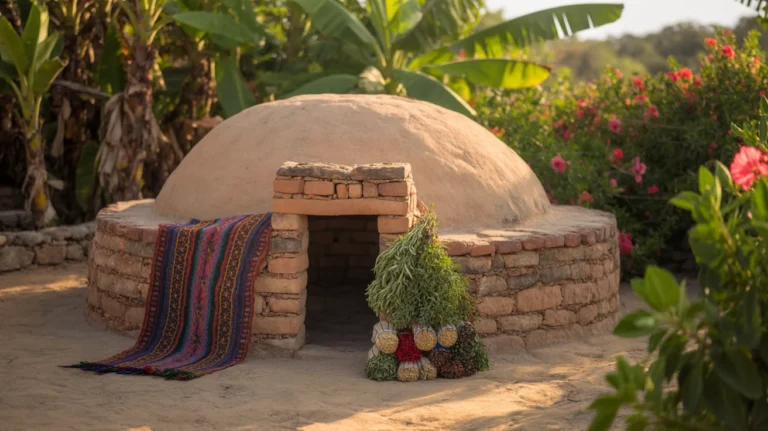
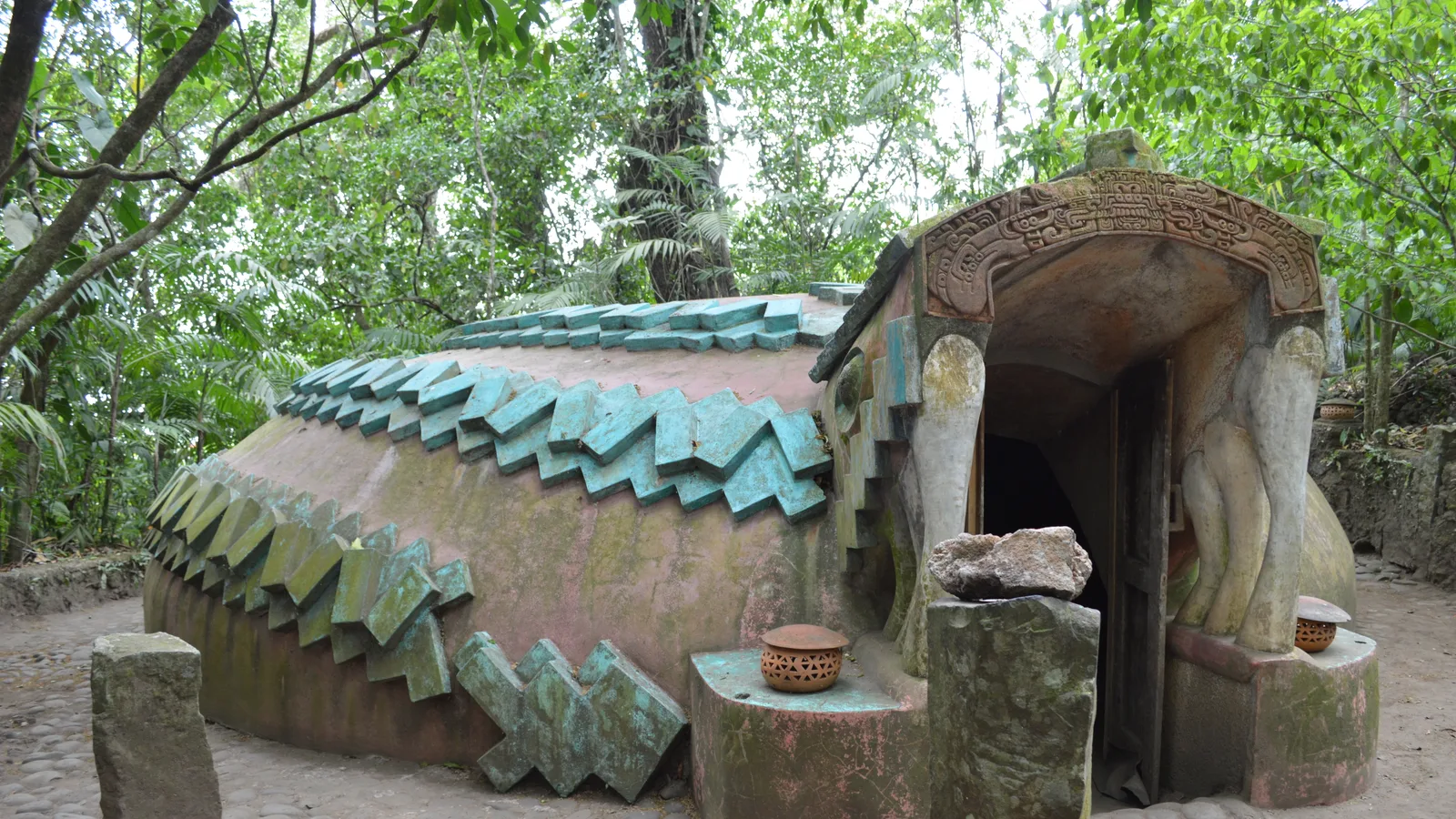
Then you crawl. Entrances are deliberately low, a design feature that goes back to the archaeology: low ceilings concentrate heat and moisture, and bathers traditionally sit or lie low rather than perching on high benches. Inside it is dark, humid, and closer than you expect.
Each door follows the same shape. Hot volcanic stones are carried in, the doorway is closed, and the guide pours herbal water over the stones to raise steam, the same physics as löyly, the burst of steam a Finnish sauna throws off its stones, but in a chamber built to hold the humidity in. There may be drumming, singing, a conch blown to the four directions, and leafy branches waved to push the steam around. Between doors the chamber opens again and another batch of stones goes in, so each round is hotter than the last.
The person running all of this is the temazcalero or temazcalera, the guide. How much ceremony you get depends entirely on who that is: the songs used in many contemporary sessions come from Lakota sweat lodge practice, brought into Mexico through spiritual networks in recent decades. Sessions end with a cool-down: a bucket of cold water, a shower, or in Xcaret’s case 15 minutes in a river pool before the farewell.
Xcaret’s inside time is 25 to 30 minutes. Other operators vary, and a few run substantially longer ceremonial formats, so ask for the actual schedule rather than the total advertised duration.
Who should skip it
The Secretaría de Salud del Estado de Puebla advises against entering if you are pregnant, under 6 years old, under the influence of alcohol, or living with uncontrolled blood pressure or diabetes, claustrophobia, frequent migraines, or a heart or respiratory condition. It also recommends resting 15 to 30 minutes before you go in, allowing 40 minutes to 2 hours of recovery afterward, drinking non-cold fluids, and having continuous supervision throughout.
There is a real tension worth knowing about. Traditional practice put women into the steam bath soon after giving birth, attended by a midwife; the same health ministry advises waiting 40 days after a vaginal delivery and 80 to 90 days after a caesarean. If you’re recently postpartum, that gap between tradition and public health guidance is your doctor’s question, not a tour operator’s.
Xcaret states its ceremony is not recommended for children, pregnant women, or people with claustrophobia, hypertension, diabetes, heart problems, asthma, or low blood pressure. That’s one park’s policy. Plenty of smaller operators publish nothing at all.
How to choose an operator: three questions
Where is the fire? Historically both designs existed: some temazcales had the hearth inside the chamber, others were heated by an external furnace and a shared wall. For a ceremony you’re paying to sit through, an external firebox with stones carried in is the safer arrangement. The recurring hazard in Mexican temazcal fatalities has not been heat alone but carbon monoxide from combustion in a closed, poorly ventilated chamber, a gas that is colorless, odorless and flagged by Puebla’s health authorities alongside heat cramps, heat exhaustion, and heat stroke.
Do they screen participants? The guidance from Mexican health authorities is to check vital signs and ask about conditions and medications before anyone enters. An operator who takes your money and waves you toward the door has skipped the one step that makes the exclusion list useful.
How long is a round, and how long is the total inside? Twenty minutes is the ceiling Puebla’s health ministry gives. If the answer is vague, or “as long as the group wants,” that’s information.
Affiliation is a fourth, softer signal. Oaxaca’s state health services ran a first gathering of 60 traditional doctors on temazcal knowledge in 2018, covering uses, contraindications, and safety measures, and the state’s council of Indigenous traditional doctors is made up of 20 certified organizations. In Oaxaca in particular, asking whether a practitioner is connected to a recognized traditional-medicine group is a fair and answerable question.
Where to book, and what it costs
Prices below were checked on operator pages in September 2026.
| Operator | Where | Format | Price |
|---|---|---|---|
| Nômade Tulum | Tulum | Group ceremony, 4 doors, 6 slots, book 24 h ahead | $40 per person |
| Yäan Healing Sanctuary | Tulum | New- and full-moon group ceremony, 6 pm; 48 h notice | 1,500 MXN ($86) per person (665 MXN ($38) local rate); private 10,500 MXN ($600) for up to 5, plus 1,200 MXN ($68) per extra person |
| Temazcal Oaxaca | ~30 min drive from Oaxaca city | Private session, about 1 hour, up to 10 people, transport included | 800 MXN ($46) pp (2 people), 700 MXN ($40) (3), 650 MXN ($37) (4+); with massage, 2 hours, 1,200 to 1,500 MXN ($68–86) pp |
| Xcaret | Riviera Maya | 60 minutes, add-on to a same-day park ticket, age 12+ | No price published |
Two caveats on that table. Xcaret sells the ceremony only as an add-on to park admission and doesn’t post a figure, so budget for the ticket plus an unknown. And the Temazcal Oaxaca booking page listed the facility as temporarily closed with a tentative reopening date when it was checked, so confirm directly before you plan a day around it.
Tulum, Oaxaca, and the parks
Tulum is where the temazcal has been most thoroughly absorbed into the beach-wellness economy: hotel-attached sanctuaries, ceremonies scheduled by moon phase, dollar pricing, group sessions you book like a yoga class. It’s polished and easy to arrange, and it is the format furthest from a village steam bath.
Oaxaca works differently. Sessions tend to be private rather than drop-in, they’re often outside the city with transport folded into the price, and the state has a documented living tradition and a certification structure behind it. Tulum’s version comes with a moon calendar; Oaxaca’s comes with a van.
The Riviera Maya parks and resort spas are the most packaged option. Xcaret runs a fixed 60-minute ceremony with published timings and a published contraindication list, which is more transparency than most independent operators offer. Resort spas sell it the same way: the academic study that traced the ceremony’s spread documented one running at the spa of a five-star hotel in Nuevo Vallarta as an example of the ritual sold as a wellness product. If that framing bothers you, the smaller operators in Oaxaca are the other end of the same spectrum. If it doesn’t, the parks are the lowest-friction way to try one, and a reasonable stop on a wider tour of sauna destinations.
Common questions
What happens in a temazcal ceremony?
A guide welcomes the group outside the chamber and purifies participants with incense smoke, then you crawl through a low door into a dark, humid steam chamber. The session runs in four stages called doors; at each one the chamber is opened, more hot stones are brought in, and herbal water is poured over them to raise steam, often with drumming and singing. It ends with a cool-down: cold water, a shower, or a pool.
How long is a temazcal ceremony?
About an hour in total, and less than half of that inside. Xcaret’s published breakdown is 5 minutes of welcome, 10 minutes of opening ceremony, 25 to 30 minutes in the chamber, and 15 minutes of pool and farewell. Other operators vary, and some run longer ceremonial formats, so ask for the schedule rather than the advertised total.
How much is a temazcal in Tulum?
Nômade Tulum lists a group ceremony at $40 per person with six slots and 24 hours’ notice. Yäan Healing Sanctuary charges 1,500 MXN ($86) per person for its new- and full-moon ceremonies, with a local rate of 665 MXN ($38), and 10,500 MXN ($600) for a private session of up to five people plus 1,200 MXN ($68) per additional person. Prices checked September 2026.
Is a temazcal ceremony safe?
It carries real risk, and the risk is not only heat. Mexican health authorities flag heat cramps, heat exhaustion, and heat stroke, plus carbon monoxide poisoning where combustion happens in a closed or poorly ventilated chamber. Puebla’s health ministry caps time inside at 20 minutes and advises continuous supervision; ask whether the fire is outside the chamber and whether the operator screens participants before you book.
Who should not do a temazcal?
Puebla’s state health ministry advises against it for pregnant women, children under 6, anyone who has been drinking, and people with uncontrolled blood pressure or diabetes, claustrophobia, frequent migraines, or heart or respiratory conditions. Xcaret sets a minimum age of 12 and adds asthma and low blood pressure to its own list. If you have a condition on any of these lists, ask your doctor rather than the operator.
Hero photo: AlejandroLinaresGarcia, CC BY-SA 3.0, via Wikimedia Commons