Wood-Burning Sauna Stoves: Which One Fits Your Sauna
Some links on this page are affiliate links. If you buy through them, I earn a small commission at no extra cost to you. As an Amazon Associate I earn from qualifying purchases.
Match the stove to the room first. Every maker rates its stoves in cubic feet of hot-room volume, and that number decides more than brand does. Then choose whether you load wood from inside the hot room or through the wall, and in the US, check the safety listing with your building department before you order.
At a glance
- Size first: measure the hot room in cubic feet and buy a stove whose rated range covers it; 212 to 459 cu ft (6 to 13 m³) fits most home and cabin rooms.
- Only Kuuma has a US listing: the Classic and External Feed are listed to UL 1482, while Harvia, Narvi and Kastor wood stoves carry CE marking only.
- Stove-only budget: $969 for a Harvia M3 up to $4,495 for the largest Kuuma, before chimney, stones, shields and a water tank.
Our picks
- Typical home or cabin room: Harvia M3
- Loading from outside the hot room: Harvia M3 SL
- Bigger rooms: Harvia Pro 20
- Large stone load in a small room: HUUM Hive Wood 13
Start with the room, not the stove
Measure the inside of the hot room in feet, length by width by height, and multiply. That cubic-foot figure is what maker ratings refer to, and those ratings assume an insulated room. Choosing between fuels is a separate decision, covered in how to choose a sauna heater.
| Stove | Rated room volume | Stone load | US price |
|---|---|---|---|
| Harvia M3 | 212 to 459 cu ft (6 to 13 m³) | 66 lb (30 kg) | $969 |
| Harvia M3 SL (through-wall) | 212 to 459 cu ft (6 to 13 m³) | 66 lb (30 kg) | $1,416 |
| HUUM Hive Wood 13 | 212 to 459 cu ft (6 to 13 m³) | 198 lb (90 kg), included | see Amazon |
| Harvia Pro 20 | 283 to 706 cu ft (8 to 20 m³) | 88 lb (40 kg) | $1,559 |
| Harvia Legend 240 | 353 to 848 cu ft (10 to 24 m³) | 440 lb (200 kg) | $1,765 |
| Narvi NC 24 | 353 to 847 cu ft (10 to 24 m³) | 180 lb (80 kg) | $1,795 to $2,295 (NC range, US dealer) |
| Kuuma Classic (Small, Medium, Large) | 336 to 1,000 cu ft (9.5 to 28 m³) | 80 to 140 lb (36 to 64 kg) | $2,395 to $2,795 |
US retail prices as of October 2026, stove only. All of these take rounded stones of 4 to 6 in (10 to 15 cm); the sauna stones you load decide how the room holds steam, and they are usually sold separately.
The stoves worth shortlisting
Harvia M3: the compact entry point for a small room
Harvia rates the M3 at 16.5 kW for rooms of 212 to 459 cu ft (6 to 13 m³), with 66 lb (30 kg) of stones, a glass door and a 4.5 in (115 mm) flue connection from the back or top. It weighs 99 lb (45 kg) empty, and wood goes in from inside the hot room. Full specs are on Harvia’s US site.
Harvia Pro 20: a step up in room size
The Pro 20 is 24.1 kW for 283 to 706 cu ft (8 to 20 m³), holding 88 lb (40 kg) of stones. It needs a ceiling of at least 82 in (2,090 mm) and takes logs up to 15 in (380 mm). A chimney-model water tank is available separately.
Harvia Legend 240: a lot of stone
The Legend 240 is 21 kW for 353 to 848 cu ft (10 to 24 m³), with a steel frame carrying 440 lb (200 kg) of stones. Harvia’s point is heat storage: the stone mass keeps the room usable even when the fire dies down between loads.
Kuuma: made in Minnesota, and listed
Kuuma stoves come from Lamppa Manufacturing in Tower, Minnesota, sold factory-direct in three lines: the Classic, the shorter Low Profile and the BluFlame, which Kuuma describes as a gasification design that burns the wood gases a second time. Prices run $2,395 to $4,495 for the stove alone.
Every Kuuma has a 6 in (150 mm) flue collar, so it fits US chimney parts without an adapter. Kuuma says a well-insulated room reaches temperature in 45 to 60 minutes with the Classic. Details are on the Kuuma stove pages.
Narvi NC 24: the biggest of the NC family
Finnish maker Narvi builds the NC in three sizes; the NC 24 covers 353 to 847 cu ft (10 to 24 m³) with 180 lb (80 kg) of stones and a 4.7 in (119 mm) flue, loaded from inside the room. Narvi’s listed North American dealer sells the NC range for $1,795 to $2,295 depending on size; other dealers ask more, so get a quote that includes freight. Specs and the manual are on the Narvi NC page.
HUUM Hive Wood 13: stone mass in a small footprint
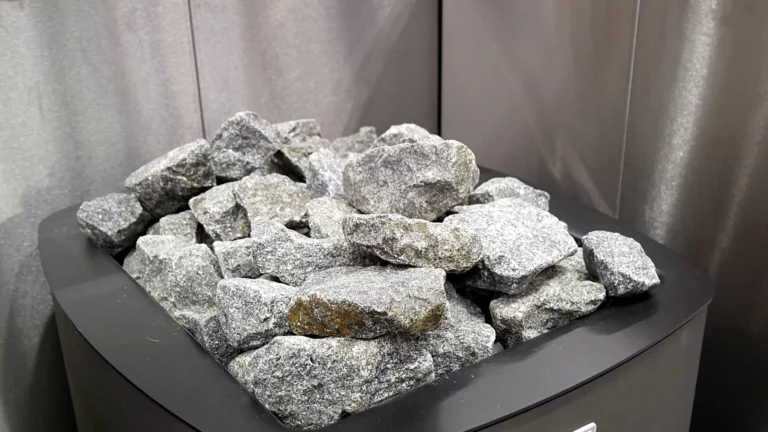
The Estonian-made Hive Wood 13 from HUUM is an open stone-cage stove rated for the same 212 to 459 cu ft (6 to 13 m³) as the M3, but it ships with 198 lb (90 kg) of rounded olivine stones. That is the reason to pick it: a big exposed stone surface in a stove sized for an ordinary room.
Loading from inside or through the wall
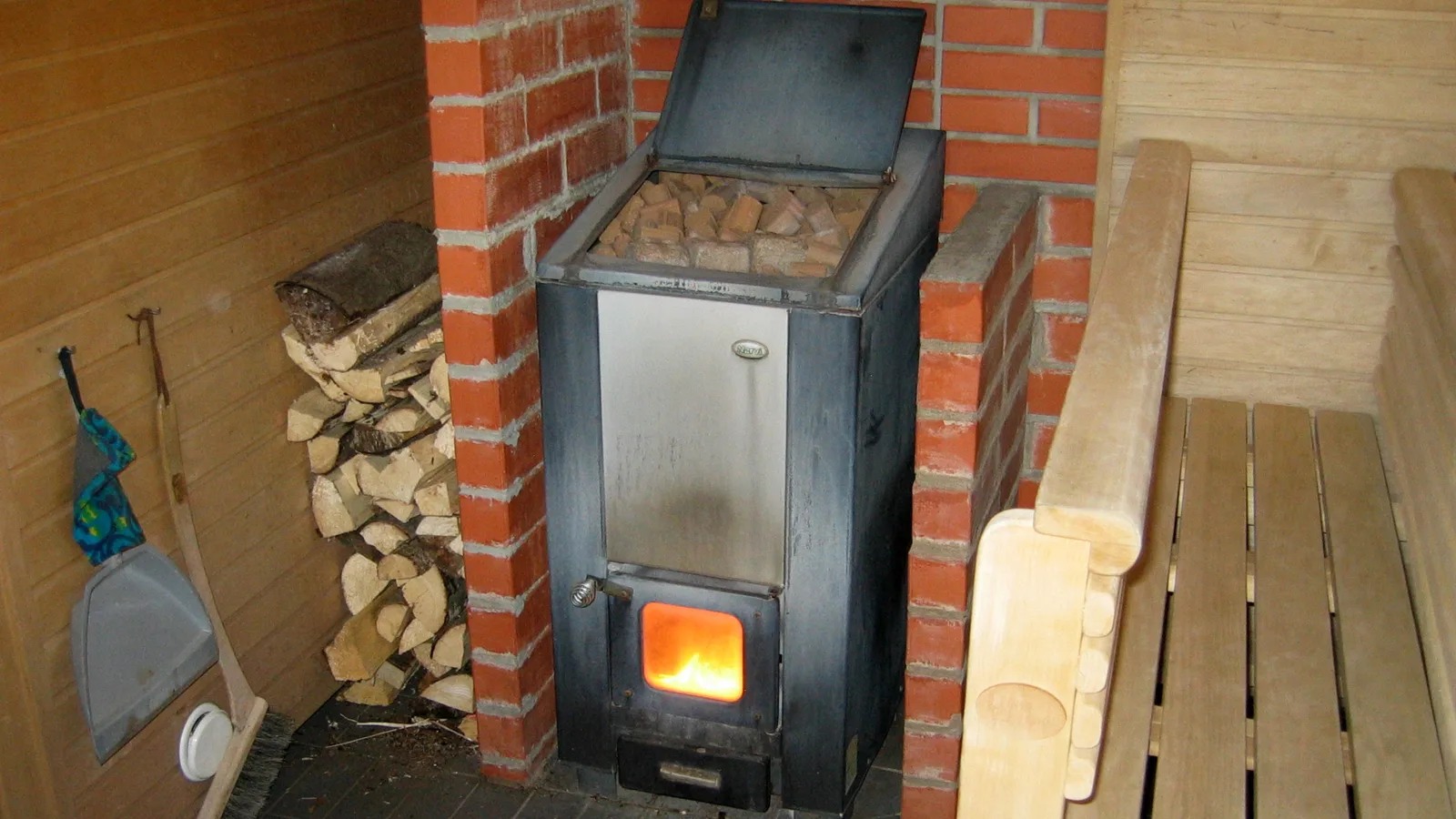
An inside-feed stove opens into the hot room, so you load wood and watch the fire from the bench. A through-wall stove has an extended firebox that passes through the wall, so you feed it from the changing room, another room or outdoors. The Harvia M3 SL is the small-room version; Kuuma’s External Feed is the Classic with an 8 in or 12 in (200 or 300 mm) throat extension.
Kuuma is blunt about the trade-off. Loading from outside keeps bark, ash and firewood mess out of the hot room, but Kuuma says roughly 25% of the usable heat then ends up outside the sauna room and the arrangement adds about $1,000 to building costs. The draft control also ends up outside the hot room.
The listing question your inspector will ask
In the US, this decides more purchases than heat quality does. Only the Classic Kuuma and the Kuuma External Feed are listed to UL 1482, the standard for solid-fuel room heaters, with a serialized label on each stove. Kuuma’s Low Profile and BluFlame are not listed. Harvia, Narvi and Kastor wood stoves carry CE marking (the M3 is tested to EN 15821, the European sauna-stove standard), which is a real certification but not a US one.
That matters because the US model codes require solid-fuel room heaters to be listed, labeled and installed per their listing, while the codes’ sauna-heater section points to UL 875, a standard for electric sauna heaters. Wood sauna stoves fall into that gap, and your local building official decides how to handle it.
Clearances, floor protection and chimney
Clearances vary far more between brands than the stoves do, because they come from different test standards. Harvia’s M3 needs 47 in (1,200 mm) to a combustible ceiling, 10 in (250 mm) at the sides and 12 in (300 mm) at the back and front. Narvi’s NC asks 20 in (500 mm) in front and 6 in (150 mm) at the sides and back.
Kuuma’s listed Classic needs 48 in (1,220 mm) clear in front of the loading door and 38 in (965 mm) at the sides unshielded, dropping to 7 to 8 in (180 to 200 mm) with stove shields and a wall shield on a 1 in (25 mm) air gap. Heat shields cut side and rear distances on all of these stoves. Use the manual for the exact stove you buy, not a number from a comparison table.
Floors need the same care. Harvia accepts a concrete slab of at least 2.4 in (60 mm) with no pipes or wires beneath; tiled and wood floors need a non-combustible base, because tile adhesive and waterproofing are not heat-resistant. Narvi asks for sheet metal reaching 4 in (100 mm) past each side of the door and 16 in (400 mm) in front. Kuuma wants a non-combustible surface 8 in (200 mm) past the back and sides and 18 in (460 mm) in front.
For the flue, the US standard is a 6 in (150 mm) insulated Class A chimney listed to UL 103 HT, following the 3-2-10 rule: at least 3 ft (0.9 m) above the roof and 2 ft (0.6 m) above anything within 10 ft (3 m).
Kuuma recommends 12 to 16 ft (3.7 to 4.9 m) of total chimney height for good draft and an open-style cap rather than mesh; check your local spark-arrestor rules before following that part. More in the sauna chimney requirements guide.
Hot water from the stove
Three layouts exist. A side tank bolts to the stove body: Narvi’s NC 20 VS carries 6 gal (23 l), and Kuuma offers a stainless side tank of 12 gal (45 l) on the Small and Medium Classic or 16 gal (61 l) on the Large. A front tank sits at the loading face, as on Harvia’s 20 ES Pro and Kastor’s ES versions. A pipe or chimney tank wraps the flue: the M3 takes a pipe-model heater and the Pro 20 a separate chimney-model tank.
Fill the tank before you light the fire and drain it before freezing weather. Kuuma adds that its tank should stay at least half full while the stove burns.
Running it safely
- Burn dry, natural firewood only. Narvi wants moisture below 20%; Kuuma says season it at least a year.
- Never use gasoline, kerosene or lighter fluid, and never burn painted or treated wood, chipboard, plastic, pellets, coal or garbage.
- Keep the firebox door closed while the fire burns.
- Do not overfire: the stove and pipe must never glow red. Harvia warns that several full loads in a row risk fire; Narvi says do not heat continuously for more than three hours.
- Run the first burn outdoors to cure the paint, before the stove goes into the room.
- Empty ashes into a lidded metal container on a non-combustible surface.
- The stove needs combustion air, so never install one in an air-tight room. Vent placement is covered in the sauna ventilation guide.
- In a chimney fire, close the firebox door and the air control and call the fire department. Have a sweep check the stove and flue before you use it again.
FAQ
What size wood-burning sauna stove do I need?
Multiply the hot room’s interior length, width and height in feet and match that figure to the maker’s rated range. A 6 by 7 ft room with a 7 ft ceiling is 294 cu ft (8.3 m³), inside the Harvia M3’s 212 to 459 cu ft band. The ranges assume an insulated room; uninsulated or glass-heavy rooms need more stove than the rating suggests.
Do wood sauna stoves need to be UL listed?
Your local building official decides. The model codes require listed solid-fuel heaters, and among the stoves here only the Kuuma Classic and External Feed carry a UL 1482 listing; that serialized label is what an inspector looks for. Ask about the specific model before buying, not after.
Can I load a sauna stove from outside the sauna?
Yes, with a through-wall model such as the Harvia M3 SL or the Kuuma External Feed. Kuuma requires the extension to be surrounded by at least 16 in (400 mm) of brick or other non-combustible material, with cement-board protection on the wall above. Narvi adds one operating rule for stoves fired from another room: put all the wood on the grate, never in the front section or the extension.
Hero photo: Riisipuuro, CC BY-SA 3.0, via Wikimedia Commons