Sauna Heater Sizing: How to Calculate the Right kW
Some links on this page are affiliate links. If you buy through them, I earn a small commission at no extra cost to you. As an Amazon Associate I earn from qualifying purchases.
Measure the room in cubic feet, add a little for any glass or tile, then pick the heater whose rated range puts your room near the middle. The table below matches common room sizes to heater sizes.
At a glance
- Rule of thumb: about 1 kW for every 35 cu ft of room (Harvia’s rule, converted from 1 kW per cubic meter).
- Glass counts extra: each square foot of glass or tile adds about 4 cu ft to the room you size for.
- Aim for the middle: every heater has a minimum room size as well as a maximum, so bigger is not safer.
Quick answer: room size to heater size
| Room volume | Example room (7 ft ceiling) | Heater size |
|---|---|---|
| 84 to 130 cu ft | 4 x 4 ft (112 cu ft) | 3 kW |
| 100 to 210 cu ft | 4 x 6 ft (168 cu ft) | 4.5 kW, such as the Harvia KIP 4.5 kW |
| 170 to 300 cu ft | 6 x 6 ft (252 cu ft) | 6 kW, such as the Harvia KIP 6 kW |
| 250 to 425 cu ft | 6 x 8 ft (336 cu ft) | 8 kW, such as the Harvia KIP 8 kW |
The ranges are Harvia’s rated room volumes for its KIP heaters, from the KIP installation manual. Other brands publish their own ranges, so check the one for the heater you buy. Where two sizes overlap, the sections below settle it.
Step 1: measure the room
Length times width times ceiling height, measured inside the finished wood. A 6 by 7 ft room with a 7 ft ceiling is 294 cu ft. Measure the room, not the floor plan: a high ceiling adds volume you have to heat.
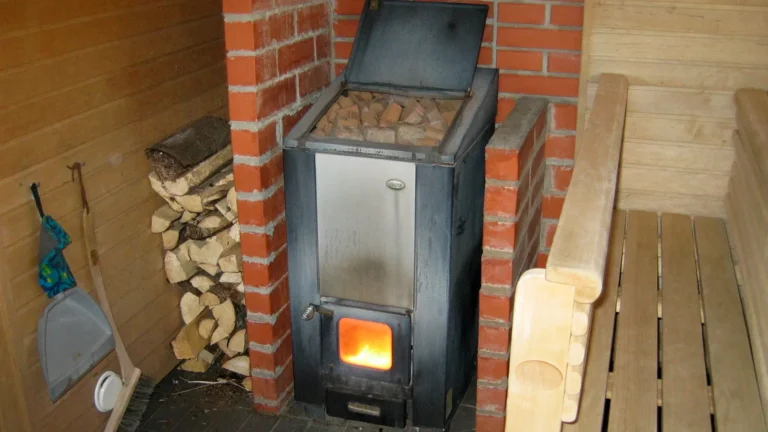
The ranges assume an insulated room with a vapor barrier behind the paneling. If the sauna insulation is missing, or the room is a basement corner with bare concrete, no heater size fixes it. This page covers electric heaters; wood-burning stoves are sized on their own ranges.
Step 2: add for glass and tile
Glass, tile, brick and bare stone soak up heat, so heater makers have you size for a bigger room than you have. Harvia adds about 4 cu ft for every square foot of glass or stone, and about 5 cu ft per square foot of bare log wall. HUUM adds 3.3 cu ft per square foot of brick, tile or glass, and Tylö about 4 to 7 for plastered walls. Use the rule of the brand you are buying, not an average.
Worked example: one glass door, one size up
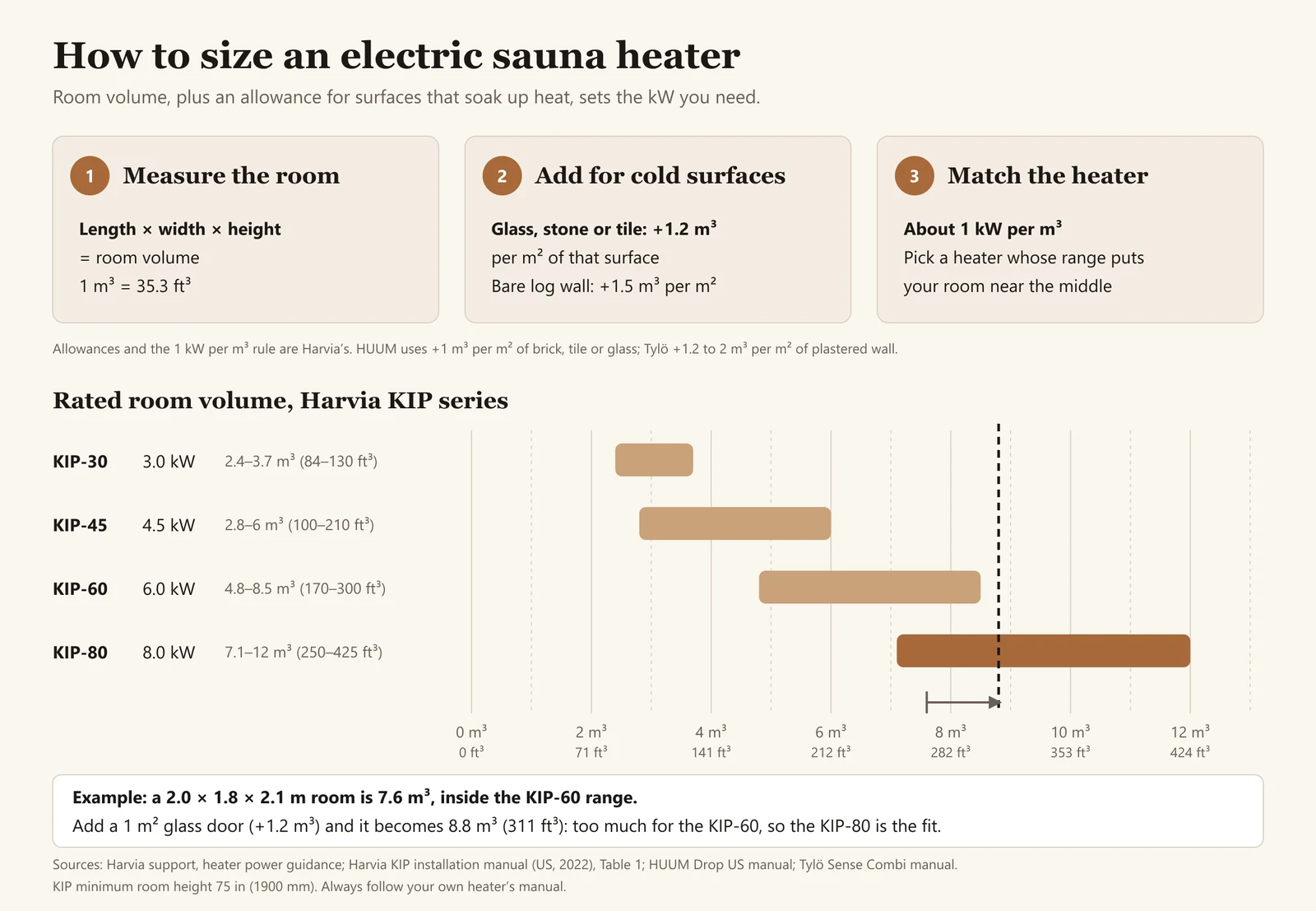
Take the room in the diagram: about 6.6 by 5.9 ft with a 6.9 ft ceiling, roughly 267 cu ft. That sits inside the 6 kW range, so an all-wood version of this room takes a 6 kW heater.
Now give it a glass door of about 11 sq ft. Under Harvia’s rule the door adds about 42 cu ft, taking the room to about 310 cu ft. That is past the 6 kW maximum of 300, so the fit becomes the 8 kW heater, where 310 sits comfortably inside the 250 to 425 range.
Why bigger is not safer
Harvia’s advice is to pick the heater whose range puts your room near the middle, not at either end.
An undersized heater warms the room slowly, sags when someone opens the door, and gives thin löyly (the burst of steam when water hits the stones), because the water cools the stones faster than the heater can recover.
Oversize it and the heater heats the air before the benches, walls and stones have warmed, so the thermostat switches off early. The air feels hot, the benches stay cool, and the steam fades fast. A heater also needs its full load of sauna stones to work as rated.
Outdoor saunas in a cold climate need more power than the same room indoors, but no maker publishes a figure to add. Pick a heater that puts your room in the upper half of its range, and ask the seller for the brand’s outdoor advice.
Ceiling height
Harvia’s KIP heaters need a room at least 75 in tall in the US and no taller than 7 ft. HUUM recommends 79 to 91 in. A tall ceiling stores the heat above your head and leaves the bench cooler than the thermometer says, and where that heat goes also depends on sauna ventilation.
The electrical side
Heater size sets the circuit, so settle the size before anyone orders a breaker. A sauna heater is a large fixed electrical load: have a licensed electrician confirm the circuit for the exact model and your local code, and hand them the heater’s installation manual. Harvia’s KIP manual, for example, rules out a ground-fault (GFCI) breaker on the heater circuit and an electrical outlet inside the sauna.
FAQ
What size sauna heater for a 6×8 sauna?
With a 7 ft ceiling, a 6 by 8 ft room is 336 cu ft, right in the middle of the 8 kW range. A glass door still keeps it inside that range.
Can a sauna heater be too big?
Yes. Every heater has a minimum room size, and going below it gives hot air, cool benches and short-lived steam. HUUM also states that its warranty is void if the heater output does not match the room volume.
Do glass walls need a bigger heater?
Usually, yes. Harvia and HUUM both count glass as extra room volume, so one glass door can move a room into the next heater size, and a full glass wall adds far more.
Hero photo: W.carter, CC0, via Wikimedia Commons