Sauna Stones: Types, How to Stack, When to Replace
Some links on this page are affiliate links. If you buy through them, I earn a small commission at no extra cost to you. As an Amazon Associate I earn from qualifying purchases.
Sauna stones are not decoration and they are not interchangeable with rocks from your yard. Buy olivine diabase sold for heaters, stack them loosely by hand with the big ones low, and check them once a year. Old, tightly packed stones heat the room slower and force the element to run hotter than it should.
At a glance
- Tired, tightly packed stones cost you heat and push the heating element toward failure.
- Olivine diabase is the standard stone for every heater type; rounded olivine diabase gives softer steam, because the water runs down to the lower layers.
- Most electric heaters take 5 to 10 cm (2 to 4 in) stones, but the weight depends on the model: HUUM’s Core takes 40 kg (88 lb), the Drop about 55 kg (121 lb).
- Check the bed at least once a year. HUUM counts hours instead: a look at 100, a rearrange at 200, a full replacement at 400.
Our picks
- Refilling the heater: The Sauna Place olivine stones, 45 lb (you’ll need two or three boxes)
- Topping up after discarding cracked stones: the same olivine stones, 25 lb
Why the stones decide how your sauna performs
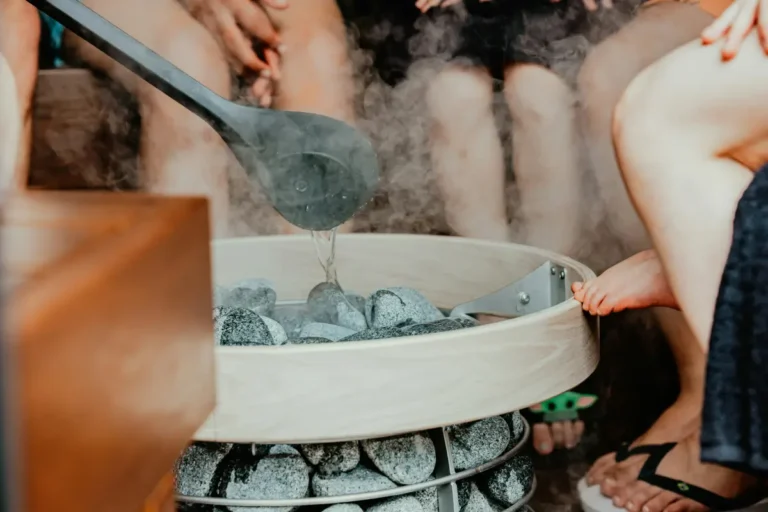
The stone bed is the thermal battery of the whole room. It stores the heat, releases it slowly, and turns a ladle of water into löyly (the burst of steam when water hits the stones).
Harvia heated the same 10 m³ sauna twice with a 7 kW heater. After one hour, new and loosely laid stones put the room at about 70°C (158°F); old, tightly packed stones managed about 60°C (140°F). In the second case the element peaked at 680°C (1,256°F) instead of 580°C (1,076°F), because air could not move through the bed and carry heat away.
That is the real cost of neglected stones: longer heat-up, more electricity for the same session, and an element cooking itself. Broken stones crumble into the gaps, pack the bed tighter still, and can end in heater failure or a fire. Stones are the cheapest part of the heater and the part that decides the rest of it.
The stone types worth buying
There are fewer real options than the shelf at a sauna retailer suggests. Four stone types cover almost everything.
| Stone | What it is | Best for |
|---|---|---|
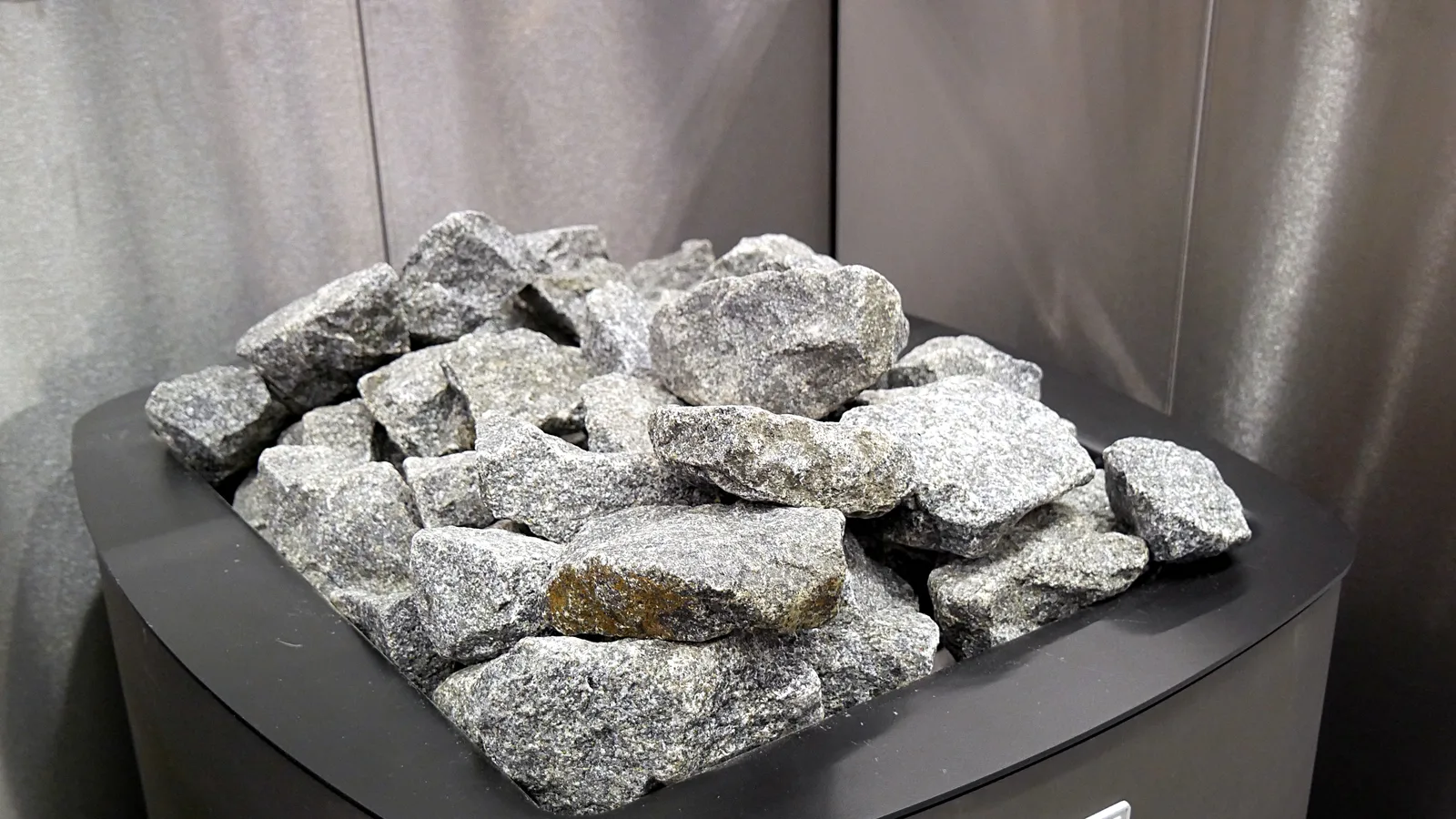
| Olivine diabase, split | Subvolcanic rock from Western Finland, angular pieces | The default choice for any electric or wood heater |
| Olivine diabase, rounded | The same rock, worn smooth like rapids stones | Softer steam, and HUUM’s recommendation for its own heaters |
| Black vulcanite | Small granular dark gray stone that shines black when wet | Durability, and a heater that looks good with the lights low |
| Heat-treated olivine diabase | Treated at about 1000°C | Intensive commercial use, public saunas |
White and red granite belong on top as a thin decorative layer, one box at most. They are a finish, not a foundation.
What not to put on your heater
Buy stones sold for sauna heaters, full stop. Untested rock has unknown thermal stability; Harvia has its own stones quality-checked with the Geological Survey of Finland.
HUUM names the other common mistake: decorative stones break easily. As a thin top layer that is survivable. Carrying the weight and the heat cycles of the whole bed, it is not. The free pile of rocks in the yard gets paid for in heating elements.
Size and how much you need
Most electric heaters take 5 to 10 cm (2 to 4 in) stones, sold in boxes of 15 to 20 kg (33 to 44 lb). Some models call for a coarser 10 to 15 cm grade.
The right amount depends on your heater model, for example about 40 to 55 kg for the HUUM heaters, so check its specs. If you are still choosing a unit, stone capacity is worth reading before you buy, and choosing a sauna heater is where that decision starts. Compare models in the roundup of electric heaters.
How to stack them
To stack them:
- Wash the stones under running water first to get the dust off.
- Lay them in one by one. Never pour or throw them in from the box.
- Put the larger stones at the bottom and around the sides, and use smaller ones to fill the gaps.
- Pack them tight enough to stay put, but leave room for air to move through.
- Cover the outer surfaces so the heating elements are not visible anywhere.
Work with the heater off and cold. The one-by-one rule sounds fussy, but it is how you control where the gaps go.
When to check and when to replace
| Harvia | HUUM | |
|---|---|---|
| Check | At least once a year, sooner if you find stone debris under the heater | Visual check after 100 hours of use, or at least once a year |
| Rearrange | Take all stones out, tap them together, discard any that crumble or have discolored, wash and dry the rest, restack loosely | After 200 hours: rearrange and replace cracked stones |
| Full replacement | When the stones no longer pass the tap test | After 400 hours: replace all stones |
Hours are more honest than years, because a heater used twice a week and one used twice a day are not on the same schedule. Three one-hour sessions a week is roughly 150 hours a year, so the 400-hour mark lands in the third year. Heat your sauna daily and you reach it inside a year and a half.
A rearrange usually leaves you a handful of stones short once the cracked ones go in the bin, which is what a small box like the same olivine stones in a 25 lb box is for.
Where to buy
Harvia and HUUM both sell stones matched to their own heaters, and US sauna specialists stock Finnish olivine diabase by the box. Hardware stores do not.
A Finnish-sourced box such as The Sauna Place olivine sauna stones, 45 lb holds about 20 kg (45 lb), so a heater that takes 40 to 55 kg needs two or three boxes. Check your heater’s stone weight, and let your manual decide the size grade.
Common questions
What kind of stones go in a sauna?
Olivine diabase, a subvolcanic rock from Western Finland, suits every heater type and is the usual answer. Black vulcanite is the other mainstream pick, chosen for durability. Either way, use stones sold for sauna heaters.
How do you stack sauna stones?
Rinse them, then set them in place one at a time: big ones low and along the sides, small ones plugging the gaps, elements hidden on every outer face. The bed should hold its shape and still let air slip through.
How often do you replace sauna stones?
Once a year, look them over and throw out anything that crumbles or has changed color. HUUM’s hour-based schedule is a check at 100, a rearrange at 200 and a clean sweep at 400, which is about year three for a twice-or-thrice-weekly sauna.
Can I use rocks from my garden or a river?
No. Rock nobody has tested may not survive repeated heating and dousing, and once it splits apart it chokes the airflow and can wreck an electric element.
Do bigger stones heat the sauna better?
Size follows the heater, not your taste. Most electric units want 5 to 10 cm (2 to 4 in) stones and a few take the 10 to 15 cm grade. A loose bed matters more than big pieces.
How much do sauna stones weigh for one heater?
It varies by model, from about 40 kg to 55 kg across HUUM’s range alone, so go by your heater’s stated figure and buy boxes to match.
Hero photo: Santeri Viinamäki, CC BY-SA 4.0, via Wikimedia Commons