Moroccan Hammam: How the Neighborhood Bath Works
Some links on this page are affiliate links. If you buy through them, I earn a small commission at no extra cost to you. As an Amazon Associate I earn from qualifying purchases.
A Moroccan hammam is a public steam bath, not a spa treatment. In the old cities it works more like a neighborhood utility: you pay around 10 to 20 dirhams (roughly $1 to $2 in 2020 to 2024 reporting), carry in your own soap and mitt, sweat through rooms of rising heat, fill plastic buckets from hot and cold taps, and scrub yourself until the dead skin comes off in grey ropes. Most Moroccans do this about once a week.
The part foreign visitors think of as the main event, an attendant kneading and scouring you on a marble slab, is optional here and costs extra. You can hire one. Plenty of people never do, and scrub their own backs or take turns with a friend instead. That single difference explains most of what separates this bath from the Istanbul version and from the rest of the world’s bathing cultures.
Where it sits in daily life
Smithsonian Magazine’s June 2026 piece on Marrakech bathhouse cooking quotes a flat description of the situation: there is no neighborhood in the medina without a hammam. They are built into the dense fabric of the old city alongside mosques, madrasas and souks, often close to a mosque so that ablutions are easy. Traditionally a quarter was described as having a mosque, a hammam, a communal bread oven, a fountain and a Qur’anic school, though that is a pattern rather than a rule.
From the street they are easy to miss. Entrances are discreet and facades usually windowless; the giveaway is on the roof, where a row of domes marks the rooms underneath. In Fes and Marrakech many of these baths still serve residents of the medina, and they matter most to people whose homes have no washing facilities.
Larger hammams have two sections or two buildings, one for men and one for women. Smaller ones run separate hours instead, commonly women during the day and men in the evening, but the schedule is set by each bath and you have to ask. The women’s side functions as a social space in its own right, where women from very different backgrounds, urban and rural, traditional and modern, use the same room. It is also part of wedding and birth customs: brides are scrubbed and hennaed before the wedding, and new mothers bring babies for a first bath.
The rooms, and how they differ from Turkey
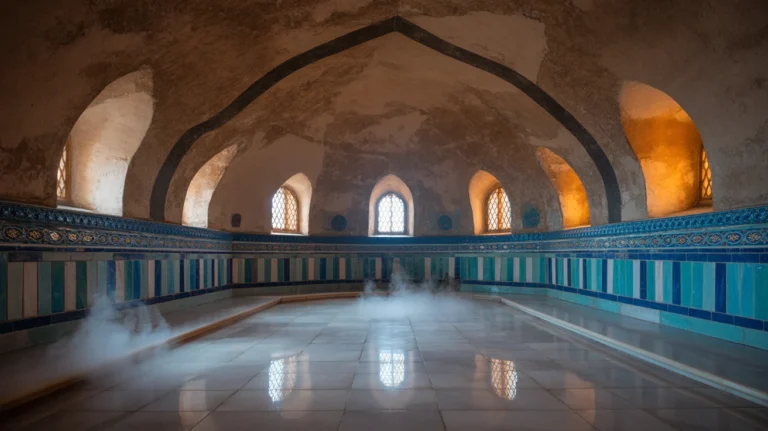
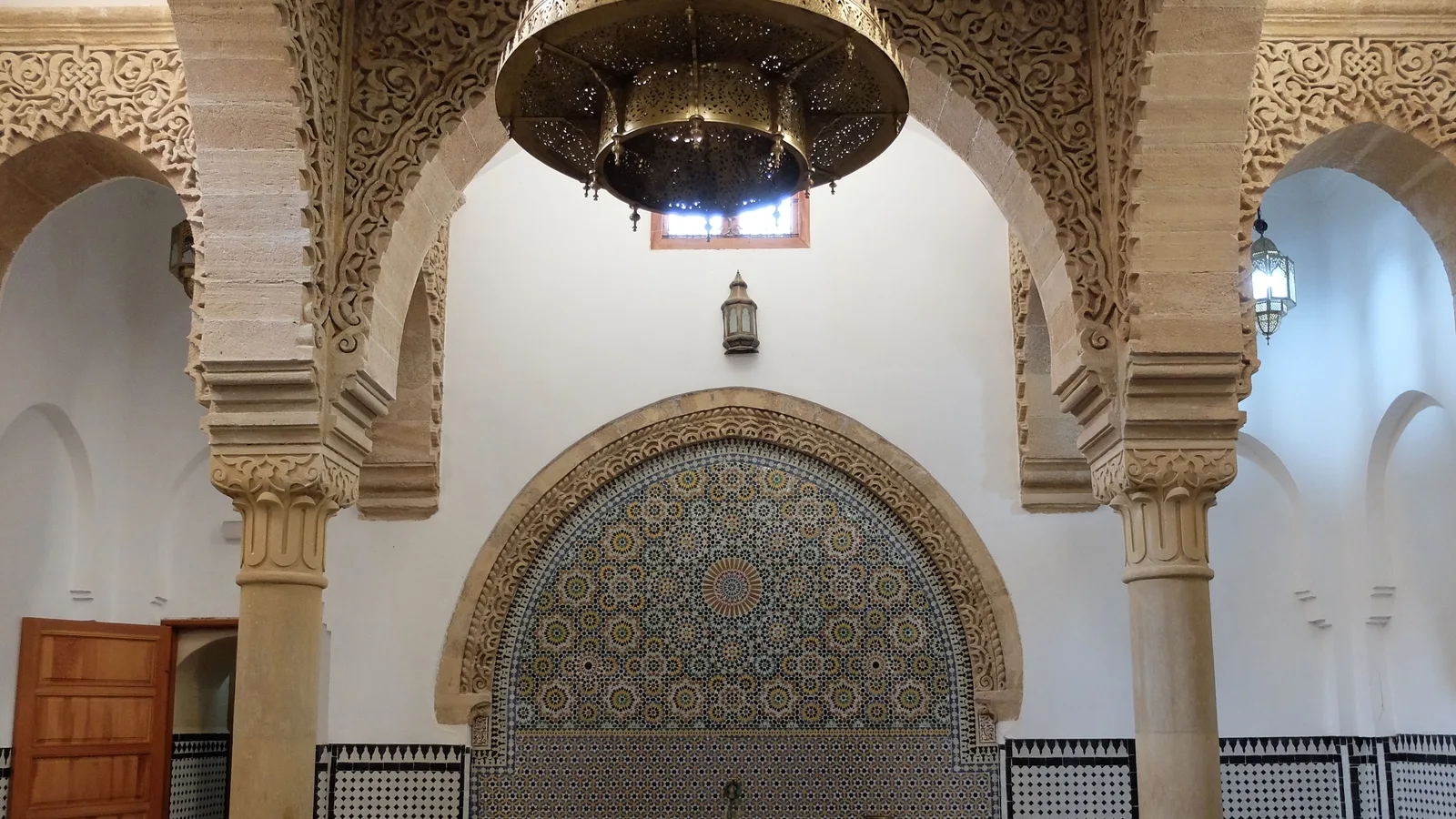
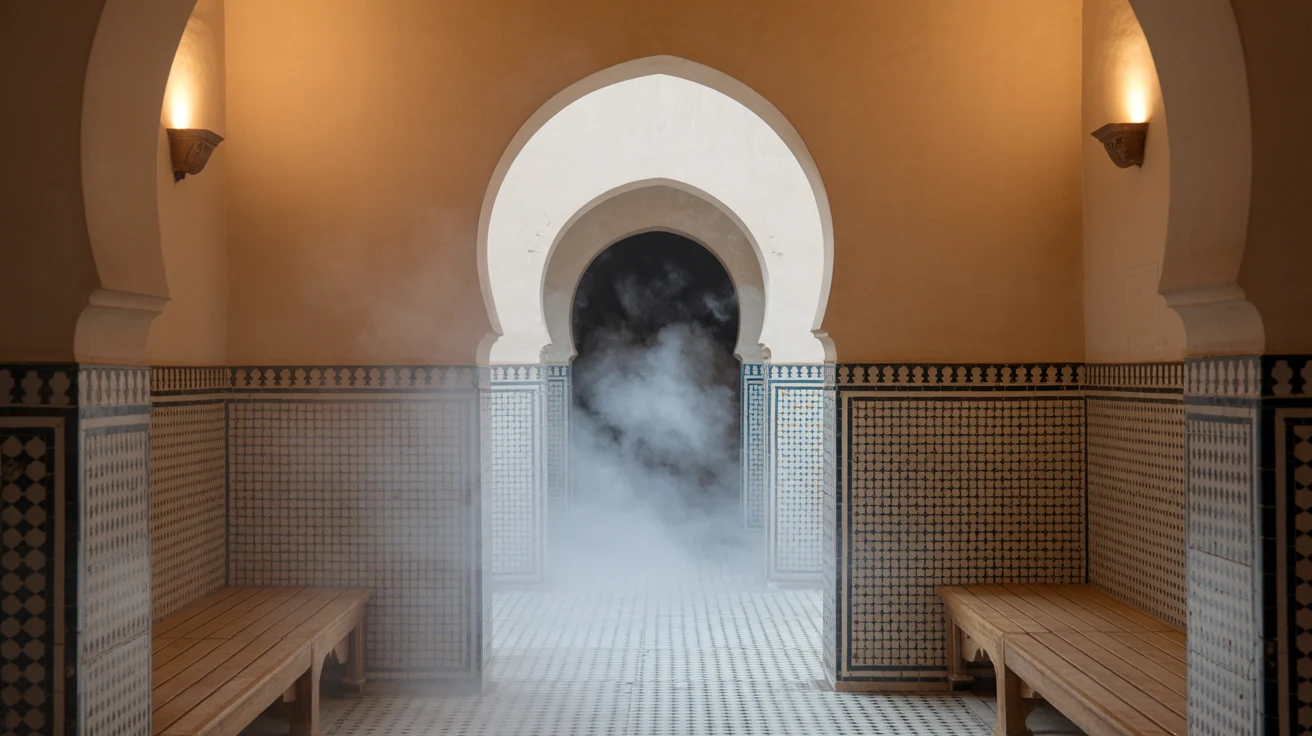
You undress in a changing room (called the goulsa in Fes), which in Maghreb hammams was often the only space given any real architectural decoration. Then come three steam rooms of rising temperature.
| Room | Local name | What happens |
|---|---|---|
| Changing room | goulsa (Fes) | Undress, leave clothes and valuables, collect bucket and mat |
| Cold room | el-barrani | Transition space, rinsing, cooling down at the end |
| Warm room | el-wasti | The main room in the Maghreb, and usually the largest; soaping and scrubbing happen here |
| Hot room | ad-dakhli | Sit and sweat to soften the skin before soap goes on |
The plumbing is where it really parts company with the Turkish hammam. There is no kurna basin with a copper bowl and, in the descriptions available, no central heated marble platform. You mix hot and cold water in a bucket at the taps and pour it over yourself with a smaller cup, sitting on a mat on the floor.
| Feature | Morocco | Turkey (Ottoman style) |
|---|---|---|
| Main room | The warm room | The hot room |
| Where you lie | Floor or mat, sources describe no central slab | The göbek taşı, a heated marble platform |
| Washing | Buckets filled at taps, poured with a cup | Kurna basin with a copper bowl |
| Scrub | Usually yourself or a friend; attendant optional | The attendant scrub is the core of the package |
| Soap | Beldi black soap, olive oil based | Olive oil soap, worked into foam with a cloth |
The furnace, and what else it cooks
Behind the hot room, set one level lower, sits a wood-fired furnace. It heats water in a large cauldron and pushes hot smoke under the floors through a hypocaust, the same principle the Romans used. The person who tends it is the fernatchi (Smithsonian spells it furnachi), and the job is neither clean nor comfortable. Historically these fires burned whatever was going spare: carpenters’ wood shavings, olive pits from the presses.
In Marrakech the furnace does double duty. Tanjia, the city’s slow-cooked meat stew, is sealed in a clay urn and buried in the residual embers under the baths for hours, and the Smithsonian reports that a few coins are enough to buy the cooking time. One fire heats the water, the room and the neighborhood’s lunch.
Soap, mitt and clay
Three products carry the whole ritual, and Morocco’s national tourist office lists them on its wellness page alongside henna, rose water, herbs and green clay.
Beldi black soap is a high-alkaline soap made from olive oil and macerated olives, which give it a gel-like consistency and a dark greenish-black color. It is not the same thing as West African black soap, despite the shared name and the shelf space they often share in export shops. A pinch is rubbed onto wet skin and left for five to ten minutes.
The kessa (also spelled kees or kiis) is the coarse scrubbing mitt that comes next. The scrub is vigorous and the grey rolls coming off your arms are the intended outcome, not a malfunction. If you have met the Korean body scrub, the sensation will be familiar, though here the default is that you do it to yourself.
Ghassoul, also written rhassoul, is a mineral clay mined along the Middle Atlas in the Moulouya valley, about 200 km from Fes. It goes on as a face mask, a body poultice or a hair wash, often mixed with rose water. There is little formal research on what it does beyond that, so treat it as part of the wash rather than a treatment.
Your first visit: public or spa
There are two very different experiences sold under the same word, and choosing badly is why some visitors come away confused. A neighborhood hammam is cheap, unstaged and largely self-service. A spa hammam is a booked treatment with towels, product and someone doing the work.
| Neighborhood hammam | Spa hammam | |
|---|---|---|
| Price | About 10 to 20 dirhams entry, around 50 dirhams more for an attendant scrub (2020 to 2024 sources) | From about 650 dirhams (roughly $70) for a one-hour treatment at Les Bains de Marrakech, September 2026 |
| Provided | Usually buckets and mats, and that is it | Everything, often including disposable underwear |
| You bring | Kessa, black soap, shampoo, towel, sandals, spare underwear | Yourself |
| Language | Darija helps a great deal | French and English are standard |
| Typical length | Around 45 minutes in one traveler’s account | An hour for the basic package, longer for multi-treatment ones |
The Les Bains de Marrakech menu is a fair example of how the spa end is priced: 650 dirhams for one treatment over an hour, rising through 1,000, 1,550 and 1,900 dirhams as you stack treatments and hours. Their traditional hammam is a black soap scrub with the mitt followed by a herbal clay mask, which is the neighborhood sequence with better lighting.
Keep your underwear bottoms on; that is what most Moroccan bathers do, and swim bottoms work equally well. National Geographic’s Marrakech hammam guide gives the useful word for the scrub itself: bshwiya, meaning gently, if the attendant is taking more skin than you were hoping to part with. Visitors are generally welcome at neighborhood baths, but they are harder to navigate without Darija, which is why many first-timers start with a spa or go with someone local. And leave the phone in the changing room, for the obvious reason that everyone around you is undressed.
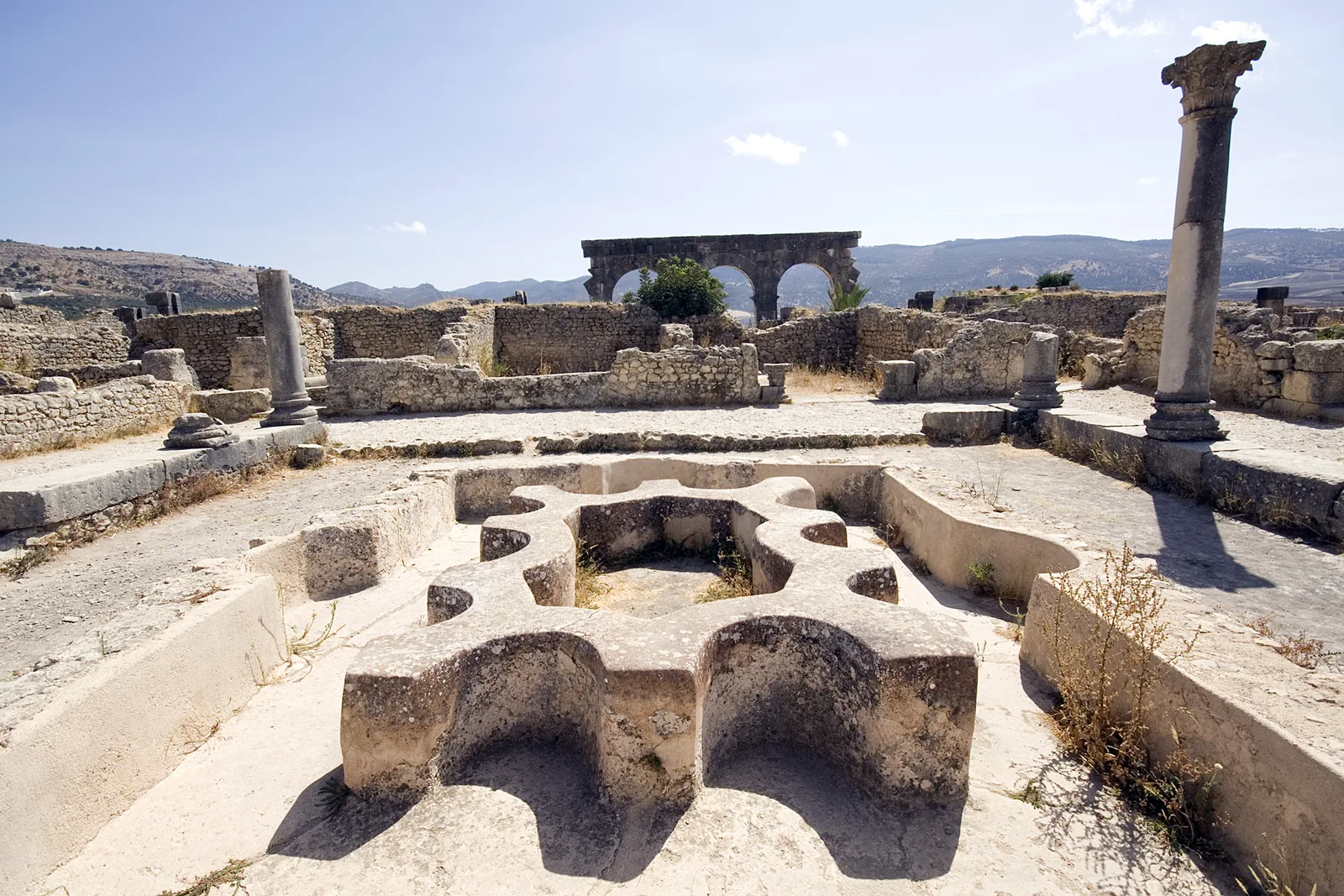
Photo: Prioryman, CC BY-SA 3.0, via Wikimedia Commons
A short history
The Moroccan bath descends from Roman practice, adopted after the seventh-century Arab conquest, and public hammams have existed in Morocco since at least the early Islamic period. The ruins of the oldest known Islamic hammam in the country, from the late eighth century, are at Volubilis.
Fes holds the best-preserved medieval examples. Hammam Saffarin dates to the fourteenth-century Marinid period and was probably built for the coppersmiths of Place Seffarine near the Qarawiyyin Mosque; it is one of the few with separate facilities for men and women, each with its own furnace, and it has been restored under architect Rachid Halaoui as part of an Austrian-led project on historic Mediterranean hammams. Hammam al-Mokhfiya dates from the middle of the same century, around or shortly after the reign of Sultan Abu Inan, and Hammam Ben Abbad, also fourteenth century and recently restored, belonged to the Qarawiyyin’s endowment. The medina of Fez has been a UNESCO World Heritage Site since 1981.
In Marrakech, the Saadian Mouassine complex, built between 1562-63 and 1572-73, bundled a hammam into a mosque, madrasa, library, Qur’anic school and fountain. Its bath had a changing room and the same succession of cold, warm and hot steam rooms, mostly brick-vaulted, though later restorations have replaced much of the original structure.
The wood problem
Those are the numbers published by the AHRC-funded Eco-Hammam project, which also puts average traffic at about a hundred clients a day per bath and notes that only 67 of the 12,000 have made progress on switching fuels. The smoke is a problem for the furnace keepers in particular, who work in it daily.
Between 2014 and 2018, the NGO Geres ran a Sustainable Hammams program with French FFEM funding, renovating demonstration baths with better insulation and efficient boilers. FFEM reports that five model hammams renovated in 2015 and 2016 saved their owners between 100,000 and 200,000 dirhams a year and cut CO2 emissions by 50 to 60 percent. Geres modernized ten baths and advised forty more, in a sector that employs around 200,000 people.
Common questions
What is a Moroccan hammam?
It is a public steam bath found in almost every neighborhood of a Moroccan medina, visited by many residents about once a week. You sweat in a sequence of rooms of rising heat, wash from buckets you fill at hot and cold taps, lather with olive-based black soap and scrub with a coarse mitt. Entry to a neighborhood bath ran about 10 to 20 dirhams (roughly $1 to $2) in 2020 to 2024 reporting, and hiring an attendant to scrub you is an optional extra.
What do you wear in a Moroccan hammam?
Keep your underwear bottoms on, or wear swim bottoms. That is the norm among Moroccan bathers, and spa hammams often hand out disposable underwear instead. Bring flip-flops or sandals for the wet floors and a dry set of clothes for afterward, including a spare pair of underwear, because the pair you bathe in will get soaked.
What is the difference between a Moroccan and a Turkish hammam?
The Moroccan bath centers on the warm room, has no heated central marble platform in the descriptions available, and has you wash from buckets on a mat on the floor. The Ottoman Turkish bath centers on the hot room with its heated marble slab and individual kurna basins. The bigger difference is cultural: in Morocco most people scrub themselves and the attendant is an add-on, while in Istanbul’s well-known baths the attendant scrub is the product being sold.
How much does a hammam cost in Morocco?
Sources from 2020 to 2024 put entry to a neighborhood hammam at around 10 to 20 dirhams, roughly $1 to $2, with about 50 dirhams more if you want an attendant to scrub you. A private spa hammam is a different market: Les Bains de Marrakech listed its one-hour, one-treatment package at 650 dirhams (about $70) in September 2026, rising to 1,900 dirhams for four treatments over four hours.
What is Moroccan black soap?
Beldi black soap is a high-alkaline soap made from olive oil and macerated olives, which give it a gel-like texture and a dark greenish-black color. In the bath a pinch is rubbed onto wet skin and left for five to ten minutes before the mitt goes on. It is a different product from West African black soap, which is made from plant ash and shares only the name.
Hero photo: R Prazeres, CC BY-SA 4.0, via Wikimedia Commons.