Norwegian Badstu: Fjord Saunas and the Oslo Revival
Badstu means, almost literally, “bath room” – the Norwegian Academy’s dictionary defines badstue as a small house where one takes a steam bath, and lists “sauna” as an alternate word on the same entry. What it does not mean, historically, is a weekly household ritual. Norway is the Nordic country that lost its sauna tradition, borrowed it back from its neighbors more than once, and then, in the last decade or so, rebuilt it from the waterfront up.
That last part is why anyone searches for Norwegian sauna at all. Oslo’s harbor now has wooden saunas floating at the quays, booked by the hour, with a ladder dropping straight into the fjord. The ladder is the point. The sauna is the warm-up. It is one of the more recent and most successful additions to the world’s sauna cultures, and it happened in a city that had no real domestic sauna habit to build on.
What badstu actually means – and how it relates to bastu
Two spellings circulate. Badstue is the standard Bokmål dictionary form; badstu is the short everyday version you’ll hear in speech and see on venue signage – the Oslo Badstuforening (“Oslo Sauna Association”) uses it in its own name.
The word is common-Germanic, not a Finnish loan. According to Det Norske Akademis ordbok, it descends from Old Norse baðstofa – bað (bath) plus stofa (room) – with cognates in Danish badstue, Middle Low German badstove, German Badstube, and Old English stofa. So Norwegian badstu and Swedish bastu are siblings from the same root, not borrowings from one another. Only “sauna” itself is the import, and that came later, along with the practice.
Norway’s sauna tradition lapsed – twice
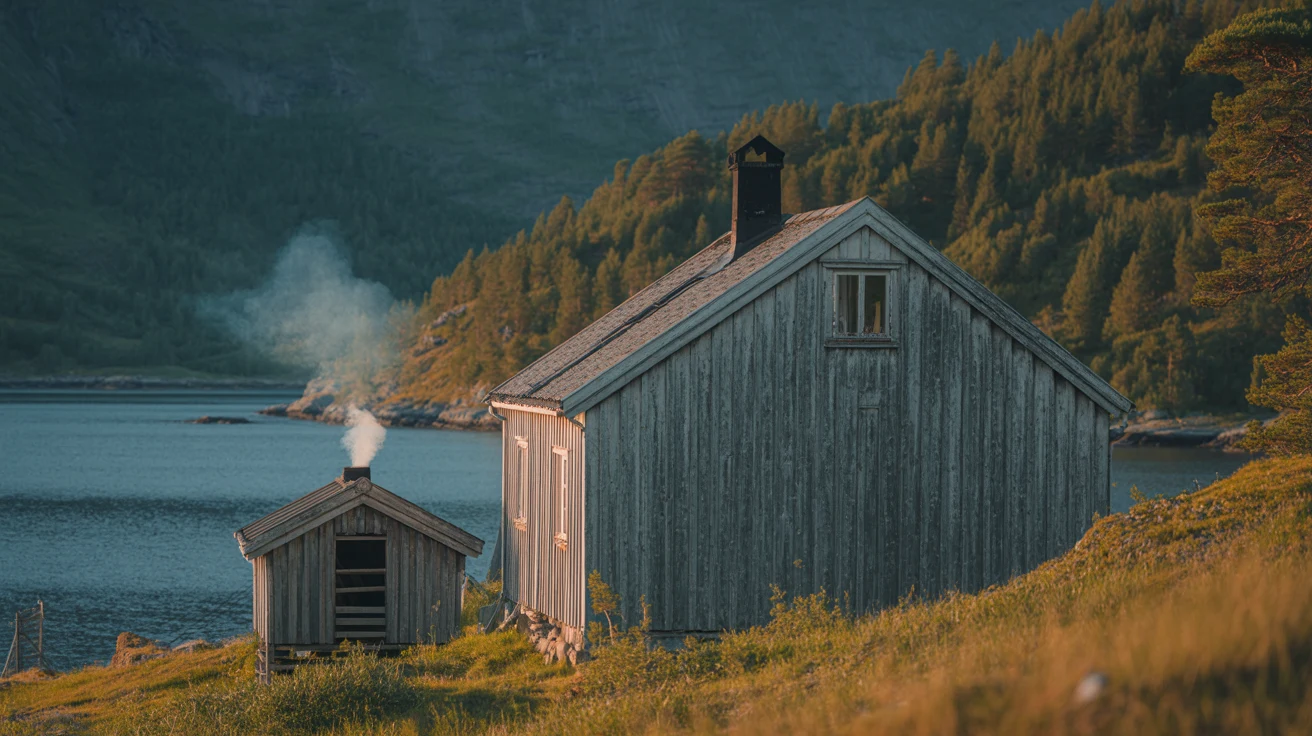
This is the fact that explains everything else about the modern Norwegian scene. Store norske leksikon records that Norwegian bathhouse traditions declined after the 1500s. The practice was then reintroduced to eastern Norway through Finnish immigration around 1600, and again to North Norway through Sámi immigration around 1700. A further wave of Finnish-style enthusiasm arrived in the 1930s, popularized by figures like the cross-country skier Trygve Brodahl.
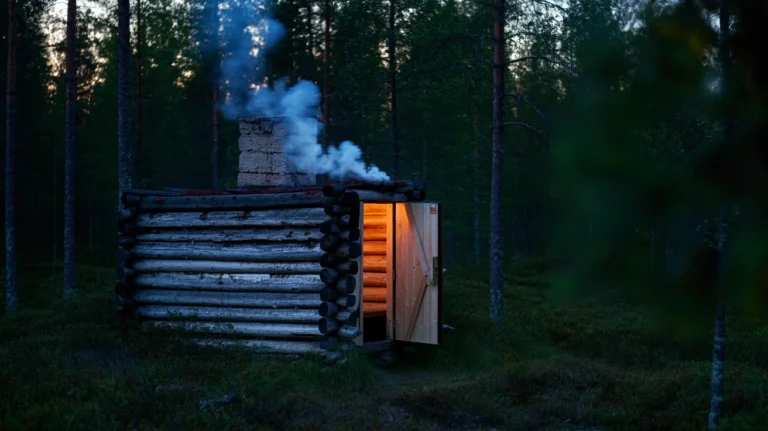
Compare that with Finnish sauna culture, which ran unbroken through the same centuries and stayed central to national life the whole way. Norway’s tradition had to be handed back to it from outside, more than once, which is why a Norwegian sauna has historically been an amenity rather than an institution: the cabin out by the water, the basement of the sports hall, the hotel wellness floor. Not the room you heat every Saturday because that’s what Saturday is.
Two consequences follow. First, there is no strong Norwegian home-sauna norm to compare against the Finnish one. Second, the revival that did arrive had to be built as public infrastructure – shared, urban, scheduled – because there was no private habit to scale up. In Finland the sauna is inherited. In Norway it’s booked, three weeks out, with a card.
The Oslo fjord sauna revival
The engine of the revival is Oslo Badstuforening, a voluntary non-profit membership association running public saunas around the city. It now operates seven locations: Sukkerbiten and Langkaia on the central harbor, Sagene Folkebad, Kroloftet, Hvervenbukta and Grefsenkollen further out, and FOLK i Storgata in the center. The network is open daily from 07:00 to 23:00, which tells you what kind of institution this is – a swimming-pool-style utility, not a spa appointment.
The commercial counterpart is KOK, which runs floating and dockside saunas at Langkaia by the Opera House and at Aker Brygge, with views across to Akershus fortress. KOK offers private dockside sauna hire, shared sessions for up to eight people, and sauna boat trips out onto the fjord itself – a heated wooden cabin that moves, with the water available on all sides.
Prices are transparent and modest by Oslo standards. Oslo Badstuforening charges 150 NOK ($16) for a drop-in shared session if you’re a member and 260 NOK ($27) if you’re not; new membership is listed at 400 NOK ($42) for 2026. The association notes that it became liable for VAT on 1 January 2025, and that the 25% is already baked into those figures. KOK sells a “Badstuklubb” subscription starting from 150 NOK ($16) per person per month.
Winter bathing is the actual attraction
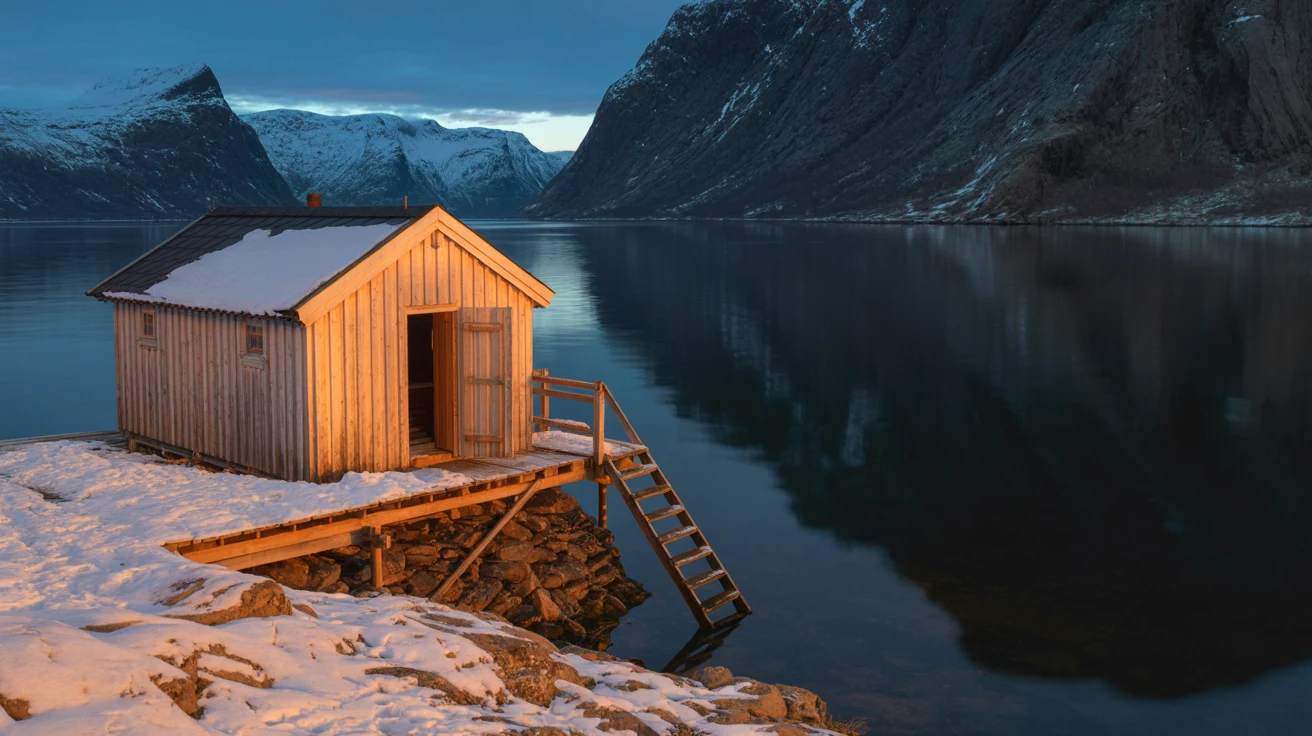
Norwegian venues are sited on the water on purpose. The sauna sits at the end of a quay or floats beside it, and the ladder goes down into the fjord – cold, dark, and available in February. Isbading (ice bathing, the Norwegian term for winter dipping) is the pairing that made the revival work commercially; the hot room on its own would have been a much harder sell in a country full of well-heated bathrooms.
Be honest about what’s known here: I could not find reliable published figures for how many Norwegian winter-bathing clubs exist, how many members they have, or what share of sauna guests actually take the dip. Venue siting is strong circumstantial evidence that the plunge is the draw – circumstantial rather than measured, but it points one way.
What is documented is the safety side. Norges Livredningsselskap, the Norwegian Life Saving Society, publishes cold-water and ice rules that are worth reading before your first fjord entry: respect the ice; don’t go onto ice without the ability to swim; carry proper safety equipment, ice awls in particular; watch for snow-covered ice and seasonal change. Its bathing guidance is blunter still – stay on land if you feel cold or unwell – and it flags hypothermia as a risk that arrives sooner than people expect while swimming. The society also runs an ice-safety awareness day at Kadettangen on 8 February, so the outreach is organized rather than incidental.
Commercial operators layer their own controls on top. KOK states that all its sauna hosts hold water rescue certification and can remove visibly intoxicated guests, and caps alcohol at private bookings to a maximum of two units per person. If you have a heart or circulatory condition, cold-water immersion is a medical question, not a hospitality one – ask your doctor before you take the ladder.
Booking and visiting a public badstu
Everything runs on advance online booking. Oslo Badstuforening opens shared-sauna slots 21 days ahead, single tickets are non-refundable, and you can move your time up to 48 hours before the session. Shared tickets are valid for 1.5 hours including a 15-minute changing window at the end – the same 1.5-hour shape KOK uses. Private hire at Oslo Badstuforening runs two hours, or 90 minutes at some locations, with guests changed and out 15 minutes before the slot ends.
Bring two towels. That instruction is universal across the venues I checked: one to dry off with, one to sit on, and at KOK the sitting towel is mandatory rather than suggested. Add swimwear, a large water bottle, a bag for wet clothes, and something on your feet – wool socks or sandals – for the walk between the hot room and the ladder. Food isn’t allowed inside KOK’s saunas.
Sessions are essentially unguided. Nobody leads the room, nobody fans the steam, and there’s no scented pour on a schedule – if you want that kind of choreography, you want German Aufguss or Danish saunagus, not a Norwegian quayside badstu. Here it’s you, whoever else booked the same slot, and the water.
Swimwear norms vary by venue and, at Oslo Badstuforening, by session. The association runs both clothed and nude slots depending on time and location, and for nude sessions it publishes explicit etiquette: respect other people’s boundaries, and sexual behavior is not accepted. KOK requires swimwear at all times (“Husk badetøy!”), as does Heit in Bergen. Check the specific booking, not the venue in general.
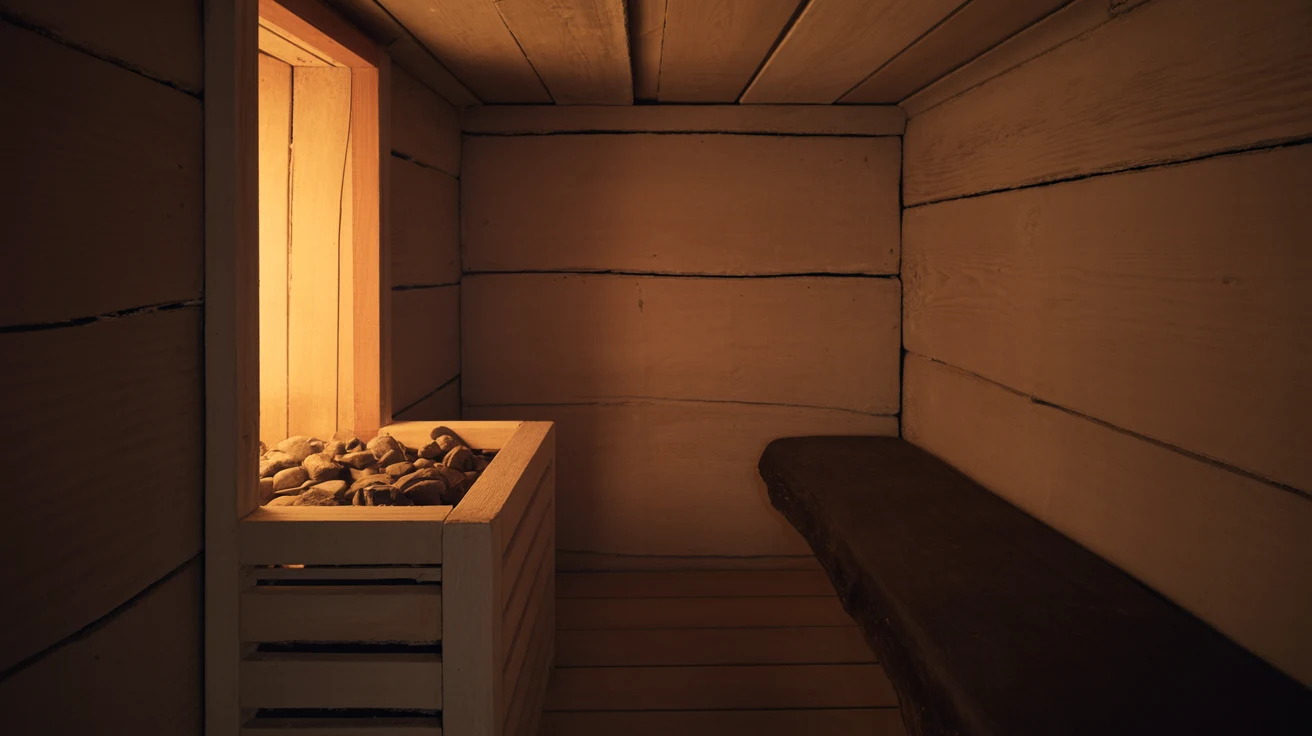
How a Norwegian badstu compares with a Finnish sauna
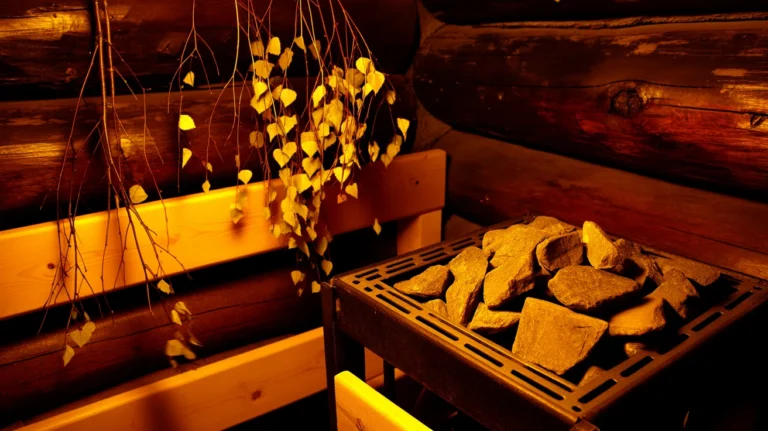
The honest comparison is qualitative, because it has to be. Store norske leksikon describes Finnish saunas as running at 100°C (212°F) and above, with steam thrown onto stones and the round often closed out with a birch whisk (vasta in eastern Finland, vihta in the west) and a cold dip afterward. No Norwegian public operator I could source publishes an operating temperature, so any numerical head-to-head you read elsewhere is someone’s guess.
Where the difference is real is in the social frame. A Finnish sauna session is domestic and unscheduled by default: your building has one, your relatives’ cabin has one, you go. A Norwegian session is a booking with a start time, a shared bench, a mandatory sitting towel, and eight strangers. That produces a friendlier, chattier, more public room than the Finnish norm – and a shorter one, because the slot ends.
| Venue | Where | Shared session | Private hire | Swimwear |
|---|---|---|---|---|
| Oslo Badstuforening | 7 sites around Oslo, daily 07:00–23:00 | 150 NOK ($16) members / 260 NOK ($27) non-members, 1.5 hrs incl. changing | 2 hrs (90 min at some sites) | Both clothed and nude sessions, varies by slot |
| KOK | Langkaia by the Opera House; Aker Brygge | Up to 8 people, 1.5 hrs incl. changing | Dockside sauna and fjord sauna-boat trips | Required |
| Heit | 4 sites in Bergen, daily year-round | 139–169 NOK ($15–18), 60- or 90-minute slots | From 600–700 NOK ($63–74)/hr, 2-person minimum | Mandatory |
Across the venues I could verify, drop-in shared sessions land in a band of roughly $15–27, and private hire in Bergen around $63–74 an hour.
Beyond Oslo: Bergen
Bergen is the second confirmed sauna city. Heit runs four sites there – Kongen in Paradis, Marineholmen, Sandviken, and Laksevåg – open daily year round, with a Tripadvisor Travelers’ Choice Award in 2025. Shared sessions run 169 NOK ($18) at Sandviken and Marineholmen, 149 NOK ($16) at Laksevåg and from 139 NOK ($15) at Kongen; private hire starts at 600 NOK ($63) an hour at Kongen and Laksevåg, 650 at Sandviken and 700 at Marineholmen, with a two-person minimum. Swimwear is mandatory in the sauna, and the towel rules are the same as Oslo’s: one to sit on, one to dry with.
Tromsø and Trondheim both come up in travel write-ups, and I couldn’t confirm a single operating venue in either city from an official source – so I’m not going to name one. Check locally when you’re there; the scene is expanding faster than anyone’s directory.
Common questions
What does badstu mean?
Badstu (formally badstue) is the Norwegian word for a sauna – literally a small house or room for taking a steam bath. It comes from Old Norse baðstofa, “bath room,” the same root that gave Swedish its own word for sauna. Norwegians use “badstu” and “sauna” more or less interchangeably today.
Is sauna popular in Norway?
It is now, but recently. Norway’s own bathhouse tradition declined after the 1500s and was reintroduced twice from outside – through Finnish immigration around 1600 and Sámi immigration around 1700 – with a further wave of popularity in the 1930s. The current boom is urban and public: floating and quayside saunas in Oslo and Bergen, booked by the hour, usually paired with a cold dip in the sea.
Can you use a sauna in Oslo without booking?
Practically, no. Oslo’s public saunas run on timed slots reserved online, and Oslo Badstuforening opens its shared-sauna bookings 21 days in advance. Popular harbor slots on winter weekends go early. Single tickets are non-refundable, though you can change your time up to 48 hours before.
How much does an Oslo sauna session cost?
A drop-in shared session at Oslo Badstuforening is 150 NOK ($16) for members and 260 NOK ($27) for non-members, with new membership listed at 400 NOK ($42) for 2026. KOK sells a monthly sauna-club subscription starting from 150 NOK ($16) per person. Shared sessions across the Norwegian venues I verified sit in roughly the $13–24 range.
Do you wear swimwear in a Norwegian sauna?
Usually yes, and always at KOK in Oslo and Heit in Bergen, where swimwear is explicitly required. Oslo Badstuforening is the exception: it runs both clothed and nude sessions depending on the time and location, with published etiquette rules for the nude slots. Read the individual booking page rather than assuming a house rule.
What should I bring to a badstu in Oslo?
Two towels – one to dry off with and one to sit on, which is mandatory at several venues – plus swimwear, a large water bottle, and a bag for wet clothes. Wool socks or sandals help on cold, wet decking between rounds. Food isn’t allowed inside KOK’s saunas, and alcohol at private bookings there is capped at two units per person.