The Sauna World Championships: Heinola’s Endurance Contest and How It Ended
The Sauna World Championships ran in Heinola, Finland, every summer from 1999 to 2010. They ended on 7 August 2010, when both men in the final collapsed on the bench about six minutes in. Vladimir Ladyzhensky of Russia died of third-degree burns. Timo Kaukonen, the Finn who had won the title five times, spent weeks in a coma with burns over roughly 70 percent of his body. There has been no edition since.
If you have arrived here after seeing the contest described as a Finnish tradition, it wasn’t one. It was a town event with international entrants, and the country’s main sauna organization had publicly distanced itself from endurance contests a year before anyone died. What follows is what the competition actually was, what the prosecutor found, and what replaced it.
How the competition worked
The format was simple and that was the point. Competitors sat in a purpose-built sauna heated to 110°C (230°F), well above the 70–90°C (158–194°F) range Finns actually bathe at, and a judge poured half a liter of water onto the stones every 30 seconds. The last person to stay on the bench and then walk out unaided won. Being carried out meant no placing.
| Rule | Detail |
|---|---|
| Starting temperature | 110°C |
| Water on the stones | 0.5 liters every 30 seconds |
| Winning condition | Last competitor to leave the bench and exit unaided |
| Posture | Sit upright, buttocks and thighs on the bench |
| Clothing | Standard swimwear, long hair tied back |
| Skin | No creams or lotions; no touching or brushing the skin |
| Alcohol | Banned before and during |
| Check-in | Competitors gave judges a thumbs-up to show they were alright |
| Penalties | Two violations meant disqualification |
Organizers required a medical certificate from entrants, watched them at set intervals, and stated that everyone competed at their own risk. Competitors signed a waiver.
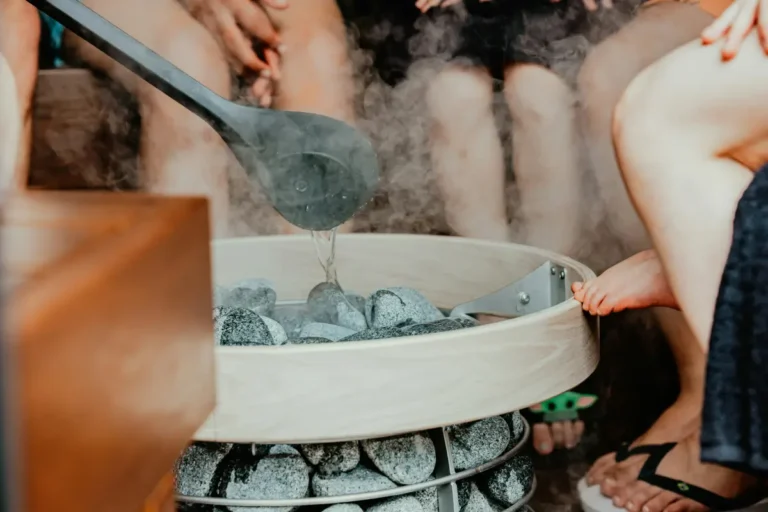
That half-liter every 30 seconds is the detail people underestimate. The rate of water on the stones matters more than the air temperature, because löyly (the burst of steam that rises when water hits hot stones) carries heat to skin far more efficiently than dry air does. Dry air and wooden benches are poor conductors, which is why a person can sit comfortably at 90°C. Keep steam coming every half minute and the skin has no chance to shed heat between bursts.
The scale of the event
By 2010 the championships drew about 130 competitors from 15 countries, and nearly 1,000 spectators watched the final. There were men’s and women’s titles. Timo Kaukonen of Lahti was the dominant male competitor, taking the title in 2003, 2005, 2006, 2007 and 2009, five wins, though not consecutive ones; Bjarne Hermansson won in 2008. Women’s champions over the years came from Finland, Belarus, Russia and Germany.
The event was organized in Heinola, a town about 138 km northeast of Helsinki, under the name Sauna Heinola, with the town itself involved. It had a festival character: local attraction, international curiosity, television crews.
The 2010 final
Kaukonen had already been through two rounds that Saturday. He told Yle before the final that his eyelids were red and his fingers had blistered, and that he intended to grit his teeth and go one more time.
He and Ladyzhensky, a Russian amateur wrestler in his 60s who had also competed in Heinola in 2009, entered the sauna together. Roughly six minutes in, judges saw that something was wrong and pulled both men out. Ladyzhensky was resuscitated at the scene but died; the cause of death was third-degree burns. Kaukonen was unconscious and was taken to the burns unit at Töölö Hospital in Helsinki, where he was treated for burns over about 70 percent of his body, worst on the legs, along with lung and kidney damage. He was in a coma for weeks.
Because the final was stopped, neither finalist’s result counted. The 2010 men’s title went to Ilkka Pöyhiä as the last man out unaided.
Kaukonen later spoke about responsibility without blaming the organizers, noting that he had signed the waiver, and said he wished he had stepped out earlier.
What the investigation found
Police investigated whether negligence by the organizers had caused the death. In March 2011 the prosecutor decided the evidence did not support charges, and there was no trial. The findings, as reported by Yle, covered four points.
- Temperature. The sauna was at 117°C when the final began, above the 110°C the rulebook specified.
- The sauna. An electrical and technical inspection found no defects, and the cabin’s dimensions matched the manufacturer’s instructions.
- Medication. Investigators concluded medication may have been a contributory factor. A tube of anaesthetic cream, banned under competition rules, was among Ladyzhensky’s belongings.
- The medical certificate. Organizers asked every competitor for one. Ladyzhensky did not hand his in despite repeated assurances that he would, but the prosecutor found the missing certificate could not be conclusively linked to his death.
No one was found criminally responsible, and nothing in the findings suggests a single mechanical failure. The fatal combination was a room hotter than the rules allowed, steam every 30 seconds, and a competitor with an incentive to stay put.
What happened afterwards
The organizers said on the night that the championships were finished. Heinola’s cultural secretary, Saija Jäppinen, told Reuters that after the incident the decision was that the event was over and done. On 20 April 2011 the town confirmed it would not hold the competition again, on the grounds that the playful character of the event could not be restored.
There was one attempt at a revival. In August 2010 the Tuuri retailer Vesa Keskinen announced he would continue the championships in Tuuri the following summer, with the rules reviewed by doctors. It never happened, and no official edition has been held since. Elsewhere in Finland, clubs that had started their own heat contests reconsidered. The Kotka club Kipakka, which had run its first such event that same summer with a 110°C final, said afterwards it would think again about repeating it.
Why Finnish sauna culture never claimed it
A year before the fatal final, the chair of the Finnish Sauna Society, Lasse Lehtonen, said publicly that the society did not organize heat contests and regarded them as foreign to sauna culture, a sauna being a place to relax rather than compete. He also warned that the format risked burns.
After 2010, Pekka Tommila of the society’s research and culture committee put it more bluntly: competitive sauna bathing has very little to do with actual sauna bathing, because all it measures is who stays conscious longest. Tommila has also said that sauna was deliberately left out of Finland’s country-brand work in late 2010 because of the publicity the death generated.
This is the part most international coverage missed. In the tradition the contest borrowed its name from, there is no scoring and no winner. Finnish sauna culture is built around leaving when you want to, going back in when you want to, and taking as many rounds as the evening allows.
The sauna competition that does exist
There is an international sauna championship running today, and it judges the opposite skill. At the Aufguss World Championships, the competitor is the sauna master at the stove, not the people on the benches. Performers are scored on heat and steam control, towel technique, fragrance, music, theme and the atmosphere they create for the guests, with a traditional category judged on heat management, fragrance, rhythm and atmosphere by a professional jury. The 2026 edition ran in September at a resort in Germany.
The guests in an Aufguss routine sit in a sauna at ordinary temperatures. Nobody is trying to outlast anyone. The skill being measured is control: how much heat to give, when, and how to bring people back down.
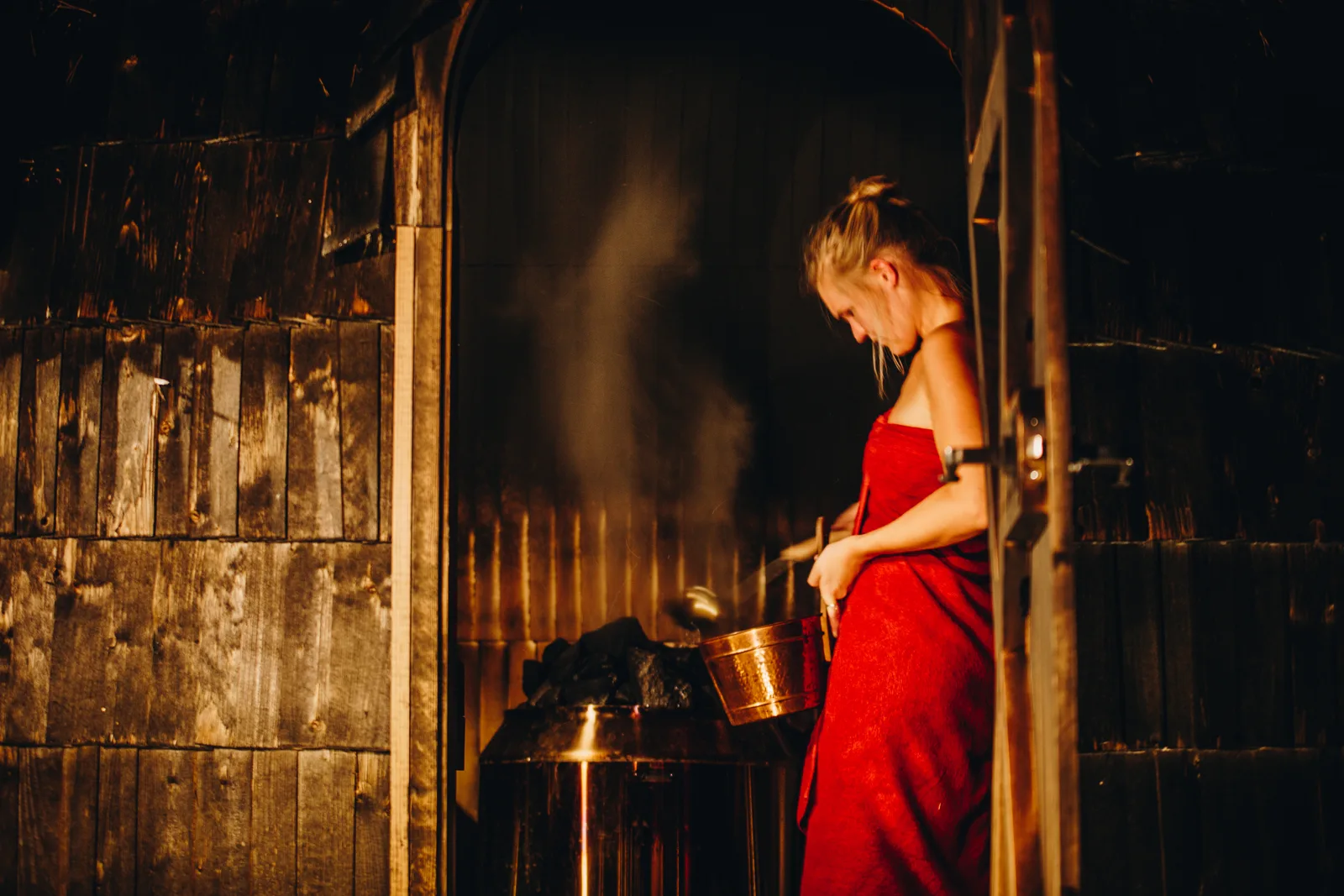
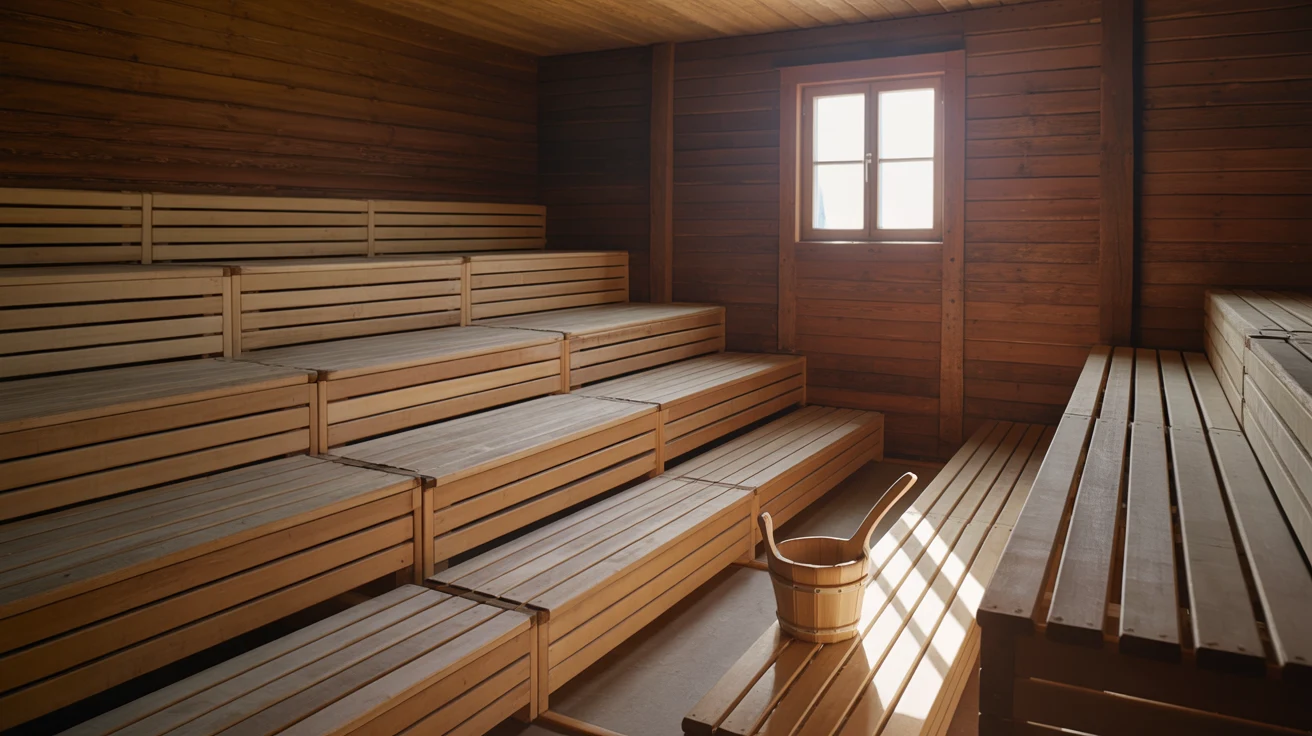
Photo: Estoniansaunas, CC BY-SA 4.0, via Wikimedia Commons
The lesson for everyone else
Heinola is an extreme case, but the failure mode it demonstrates is ordinary: treating a sauna as something to endure. Heat tolerance is not a skill worth developing, and the signals your body sends, dizziness, nausea, a headache starting, skin that has gone from hot to stinging, are instructions, not obstacles.
Get out when it stops feeling good. Cool down properly, drink water, and go back in if you want another round. If you have a cardiovascular condition, are pregnant, or take medication that affects blood pressure or heat regulation, read up on who should not use a sauna and talk to your doctor before starting. A sauna is not a test, and there is no prize for the last person on the bench.
Common questions
What was the Sauna World Championship?
It was an annual endurance contest held in Heinola, Finland, from 1999 to 2010. Competitors sat in a sauna starting at 110°C while half a liter of water was poured on the stones every 30 seconds, and the last person to leave the bench and walk out unaided won. It had men’s and women’s titles and drew international entrants, but it was never part of traditional Finnish sauna practice.
What happened at the 2010 Sauna World Championships?
In the final on 7 August 2010, both competitors, Vladimir Ladyzhensky of Russia and Finland’s Timo Kaukonen, collapsed about six minutes in. Ladyzhensky, in his 60s, died of third-degree burns despite resuscitation. Kaukonen suffered burns over roughly 70 percent of his body plus lung and kidney damage, and spent weeks in a coma at a Helsinki burns unit.
Was anyone charged over the death in Heinola?
No. In March 2011 the district prosecutor decided the evidence did not support negligence charges against the organizers, and there was no trial. The investigation found the sauna technically sound, recorded a starting temperature of 117°C, and concluded that medication may have been a contributory factor.
Is there still a sauna world championship?
Not an endurance one. The town of Heinola confirmed in April 2011 that it would not hold the event again, and an announced revival in Tuuri never took place. The Aufguss World Championships do continue, but they judge sauna masters on steam control, towel work, fragrance and staging rather than on how long anyone can sit in the heat.
How hot is a normal Finnish sauna compared to the competition?
Finnish saunas are typically run at 70–90°C, with around 80°C a common sweet spot, and bathers come and go freely across 2–3 rounds of 10–20 minutes. The competition started at 110°C with water added every 30 seconds, which is far outside normal bathing conditions in both temperature and humidity.
Did the Finnish Sauna Society support the championships?
No, and it said so before the 2010 final. In 2009 its chair stated that the society did not organize heat contests and considered them foreign to sauna culture, warning of burn risk. After the death, a society representative described competitive sauna bathing as measuring only who stays conscious longest.