Electric Sauna: How It Works and Why It’s Standard
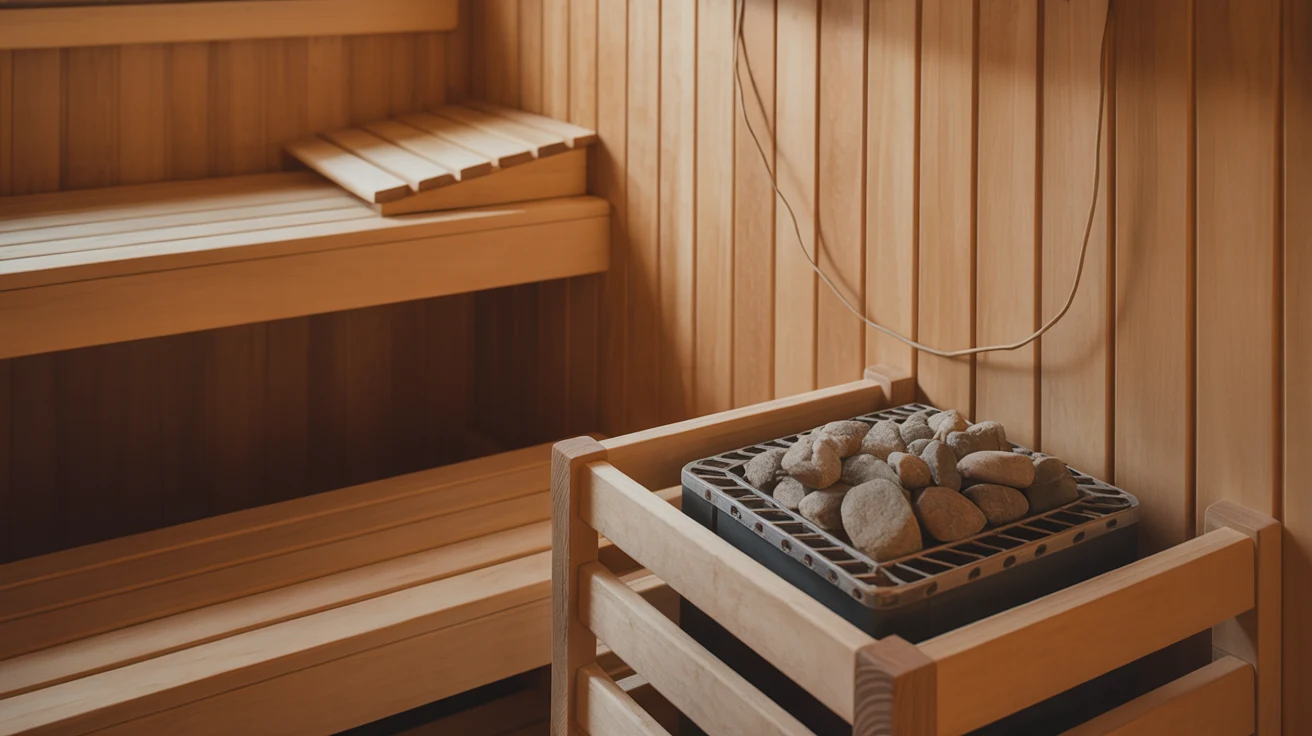
Walk into almost any home sauna built in the last twenty years and you’ll find an electric heater bolted to the wall. Around 90% of new residential saunas use one, and the reason is simple: it heats up on a timer, needs no chimney, and works in a basement, a spare bathroom, or a garage. No firewood, no ash, no smoke. You flip a switch and thirty minutes later you have a proper sauna.
The trade-off people worry about is löyly (the burst of steam and heat that rises when you throw water on hot stones) – the sense that electric heat is somehow thinner or more clinical than a fire. That worry is half-right and half-outdated. It depends almost entirely on one number, and I’ll get to it.
How an electric sauna heater actually works
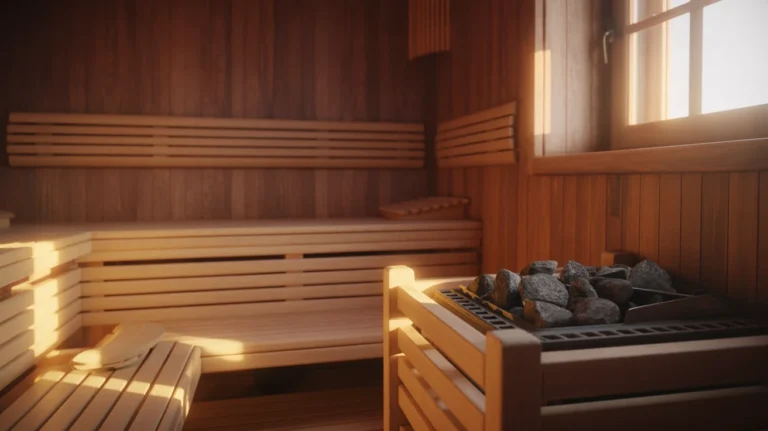
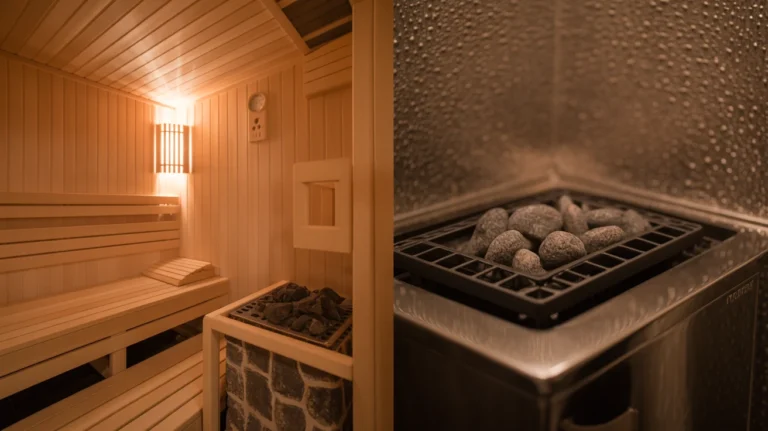
An electric heater is a resistance element and a pile of stones. Current runs through a coiled resistance wire sealed inside a steel sheath, and the wire’s resistance turns electrical energy into heat, the same physics as a kettle or a space heater. The wire sits in a magnesium oxide insulating layer that carries heat outward to the sheath, which glows at around 500°C (932°F) in operation.
That heat then moves two ways: into the sauna stones by direct conduction, and into the room by convection and radiation. In a standard enclosed heater, roughly 70–75% of the output reaches you as convected hot air and 25–30% as radiant heat. A thermostat cycles the elements on and off to hold your target temperature, which is why electric heat is so steady. Premium units add programmable timers and WiFi start.
Why electric became the standard
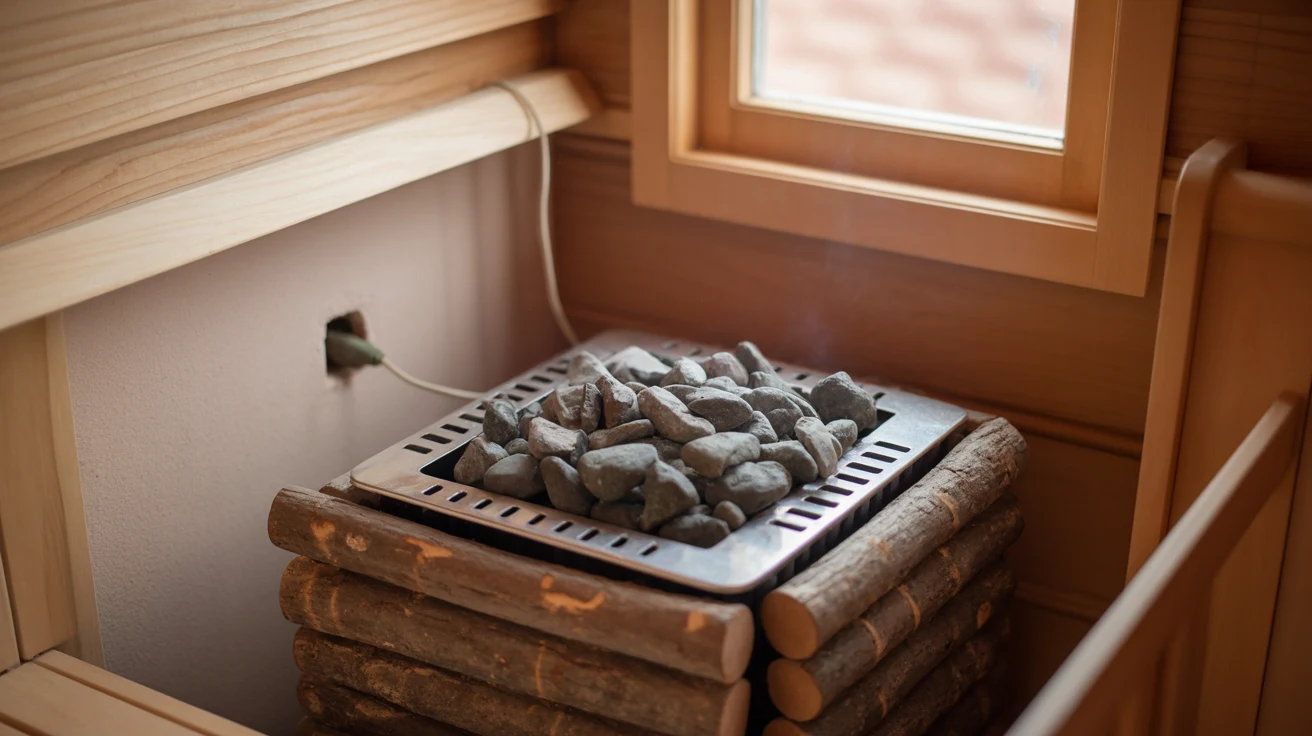
Convenience won. A wood stove needs a chimney, floor protection, fuel storage, and in many cities a permit. An electric heater needs a wire. That single difference is why virtually every prefab sauna kit shipped to a home in North America comes with an electric heater, typically a Harvia 6–8 kW unit, and why electric slots into rooms a fire never could.
The rest of the case follows from there. You can check Harvia’s heater range to see how thoroughly the market has standardized around this format.
- No combustion – no flue, no ash removal, no burn permits in most jurisdictions
- Set-and-forget control – thermostat accuracy within a few degrees, plus timers
- Low upkeep – roughly 2–4 hours of maintenance per year
- Installs anywhere indoors – basement, apartment, garage, spare room
Wood still has a devoted following, and for good reason, but for a room inside a house the electric heater removed nearly every obstacle. In Finland this problem got solved by building the sauna into the apartment block from the start. In America it got solved by making the heater portable enough to retrofit into a closet.
Stones and löyly: the part that actually matters
Here’s the thing people get wrong: the electric element is not what makes your steam. The stones do. Steam should come off hot stone, never off the steel sheath, and the stones need to sit somewhere around 150–400°C (302–752°F) to produce löyly worth the name. The elements just keep the stone mass hot.
That means the quality of your steam depends on how much stone your heater holds. Small, cheap heaters carry 20 kg of stone and produce sharp, thin, bone-dry heat that drives you out of the room. A heater built for löyly holds at least 50 kg, and closer to 100 kg is where a modern electric heater genuinely rivals a wood stove for the softness of its steam. Stone mass is the single biggest variable separating mediocre electric heat from excellent electric heat.
Use volcanic stone – olivine diabase, gabbro, or peridotite. Avoid porous or non-volcanic rock that cracks under repeated thermal shock. And know that ventilation matters as much as stone: even a well-stoned heater gives you heavy, stagnant air if the room can’t breathe. The Finnish Sauna Society has written plenty on why airflow makes or breaks a session.
Voltage and electrical needs
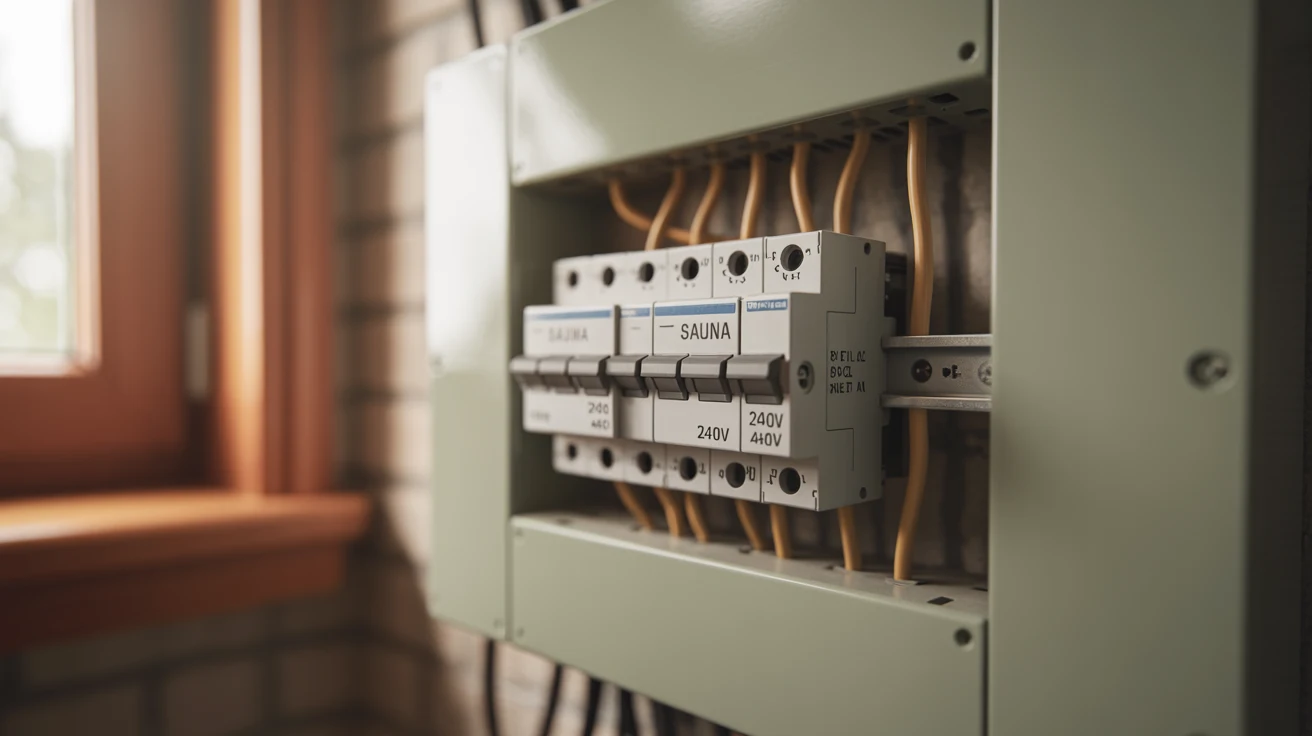
Nearly every home electric sauna heater runs on 240V single-phase power, hardwired to a dedicated circuit by a licensed electrician. It is not a plug-in appliance and it cannot share a circuit. The old 120V heaters are no longer made. The amperage you need scales with heater size, and the formula is simply watts divided by volts.
| Room size | Heater | Voltage | Circuit |
|---|---|---|---|
| 1–3 person | 2–3 kW | 240V | 15–20A dedicated |
| 3–5 person | 4–6 kW | 240V | 30–40A dedicated |
| 6+ person | 7–9 kW | 240V | 40–60A dedicated |
As real examples: a 4.5 kW heater at 240V draws about 19 amps, a 6 kW unit about 25 amps, and a 9 kW unit about 38 amps. The breaker should be rated at 125% of that continuous load under the NEC rule, so it lands one size above the draw, and wire gauge runs from 10 AWG on small units to 4 AWG on large ones. For sizing the heater itself, figure roughly 1 kW per 45–50 cubic feet of well-insulated room, adding 20–30% for outdoor, barrel, or poorly insulated builds.
Heat-up time and what to expect
A properly sized 240V heater brings a well-insulated room to 82–88°C (180–190°F) in about 20–30 minutes. Larger rooms, outdoor cabins, or poorly insulated builds stretch that toward 45–90 minutes. If your heater is correctly sized to the room, expect the shorter end; if you’re regularly waiting an hour, the heater is probably undersized or the room is leaking heat.
One ceiling to know: US-market electric heaters carry a UL safety limiter that caps them near 90°C (194°F). It’s rarely a problem for home use, but it’s real, and it’s part of the wood-versus-electric conversation.
How it compares to wood-fired heat
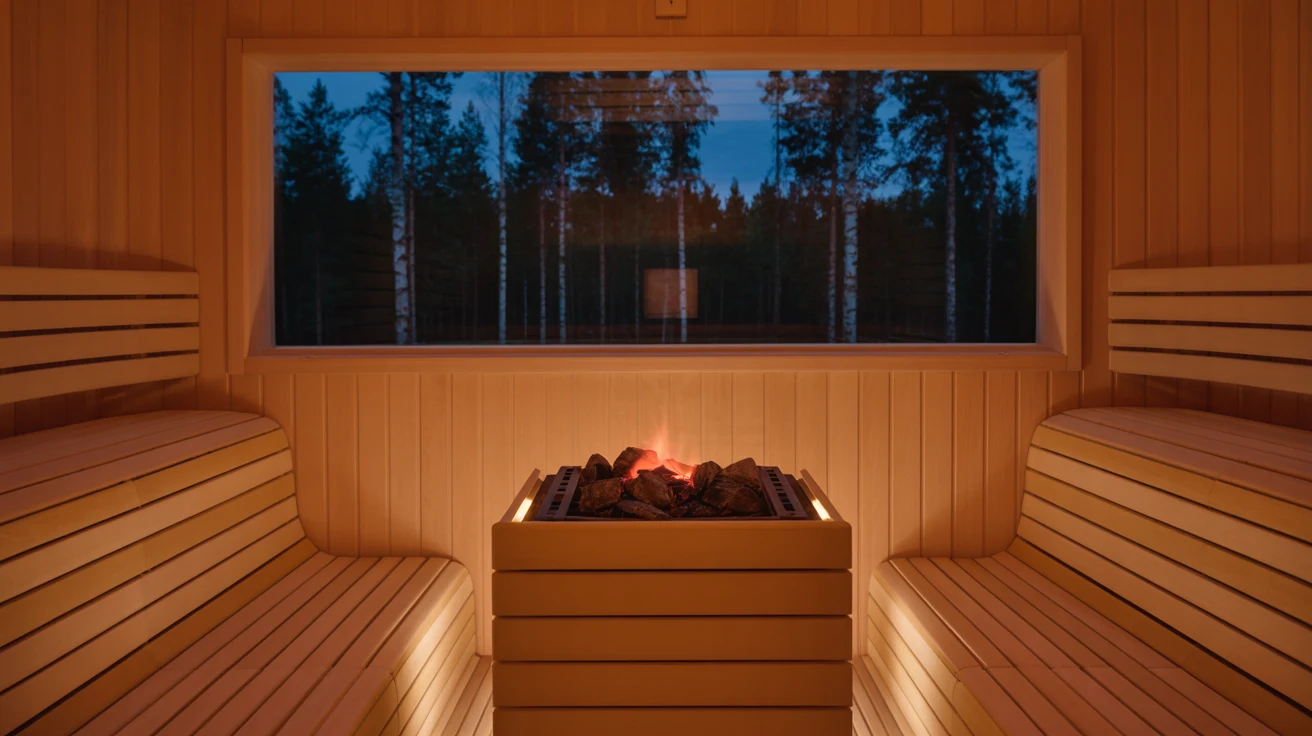
Electric heat is convection-dominant and thermostat-steady; wood heat is more radiant and, to many people, subjectively warmer at a lower air temperature. Wood can also run hotter and gives you the fire, the smell, and the ritual. What it costs you is real work: 15–30+ hours of maintenance a year against electric’s 2–4, plus a chimney system running $1,000–2,000, floor protection, and permits, and in most cities it can only go outdoors or in a dedicated outbuilding. If you’re weighing the two seriously, I’ve broken the full wood-fired versus electric decision down elsewhere, along with the roundup of the best electric heaters and how electric fits among all the sauna types.
Cost and accessibility
Electric is the accessible option at nearly every price point. The heater alone runs $500–1,500 for budget units, $1,500–2,000 mid-range, and $2,000–2,500+ for premium Finnish smart heaters (2025 prices, unit only). Electrical installation, meaning the dedicated 240V circuit, breaker, and electrician labor, adds $800–2,500 depending on how far your panel sits from the sauna.
For a complete room, a 2–3 person prefab kit with pre-cut panels, benches, door, and heater runs $3,500–8,000, while custom indoor builds range from $5,000 to $25,000+. The typical homeowner spent around $4,500 in 2025. Running it is cheap: at roughly $0.16 per kWh, a session costs $0.70–1.10 for a 4.5 kW heater, $0.90–1.40 for a 6 kW, and $1.20–2.00 for a 9 kW, which works out to about $20–60 a month for regular use.
FAQ
How does an electric sauna heater work?
Electrical current runs through a resistance wire sealed in a steel sheath, which converts the energy to heat. That heat transfers into the sauna stones by conduction and into the room by convection and radiation, with a thermostat cycling the elements on and off to hold your target temperature.
Can an electric sauna produce real steam?
Yes, but only from the stones, not the metal heater surface. Ladle water onto the hot stones and it flashes to steam. The quality depends heavily on stone mass: heaters holding 50–100 kg of stone produce soft, full steam, while small heaters with little stone give sharp, dry heat.
What voltage does an electric sauna need?
Almost all home electric sauna heaters run on 240V single-phase power on a dedicated circuit, hardwired by a licensed electrician. Amperage ranges from about 15–20A for small heaters up to 40–60A for large ones. The old 120V heaters are no longer manufactured.
How long does an electric sauna take to heat up?
A correctly sized 240V heater reaches 82–88°C (180–190°F) in about 20–30 minutes in a well-insulated room. Larger, outdoor, or poorly insulated rooms can take 45–90 minutes. Consistently slow heat-up usually means the heater is undersized or the room is losing heat.
Is an electric sauna cheaper to run than a wood-fired one?
Electric costs roughly $0.70–2.00 per session and $20–60 a month depending on heater size and use, with only 2–4 hours of maintenance a year. Wood has no electricity cost but demands 15–30+ hours of annual upkeep plus firewood, ash removal, and chimney sweeping.