Steam Room vs Sauna: Critical Differences
A steam room and a sauna are not two versions of the same thing. One runs at 40-50°C (104-122°F) with the air fully saturated at nearly 100% humidity; the other runs at 80-100°C (176-212°F) with the air bone-dry at 5-20%. They are built from different materials, powered by different equipment, and they do different things to your body. Calling a steam room a “wet sauna” is the single most common mistake in this whole subject, and it erases a real distinction.
Most American gyms install one of each, side by side, and members treat them as interchangeable. They aren’t. If you know what each does, you can pick the right one for what you actually want, whether that’s clearing your sinuses or building long-term cardiovascular resilience.
The core difference: dry air vs. saturated air
The whole comparison comes down to one variable: how much water is in the air. A sauna heats a mass of stones and warms the air around them, keeping humidity low so your sweat can evaporate. A steam room pumps in continuous water vapor until the air holds no more, which stops sweat from evaporating entirely. Everything else, the temperature, the materials, the health effects, follows from that.
| Feature | Sauna (Finnish) | Steam room |
|---|---|---|
| Air temperature | 80-100°C (176-212°F) | 40-50°C (104-122°F) |
| Humidity | 5-20% baseline | 95-100% constant |
| Heat source | Heater with stones, inside the room | Steam generator, outside the room |
| Materials | Softwood (cedar, hemlock, spruce) | Tile, stone, glass |
| Humidity control | User-controlled (water on stones) | None, mechanically fixed |
| Typical session | 10-20 minutes | 10-15 minutes |
Here’s the counterintuitive part: the steam room runs at roughly half the air temperature but can feel just as punishing. At 100% humidity your sweat can’t evaporate, so your body loses its main cooling mechanism. A 45°C steam room can feel like a much hotter room precisely because you can’t cool down.

Heat source: boiler vs. heater
A steam room is fed by an electric steam generator installed outside the room. Cold water enters the generator tank, electric elements bring it to a boil, and pressurized steam travels through an insulated line into the sealed space. A digital panel governs temperature and session length. Residential units run roughly 6-15 kW depending on room size, from a 6-8 kW unit for a small shower-sized enclosure up to 12+ kW for a six-person spa room.
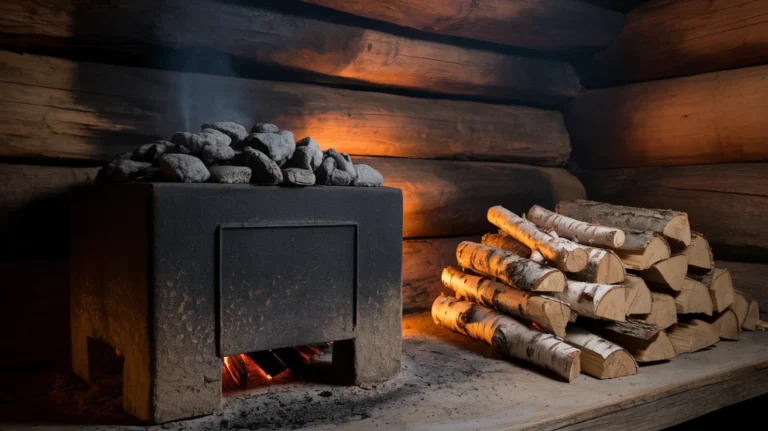
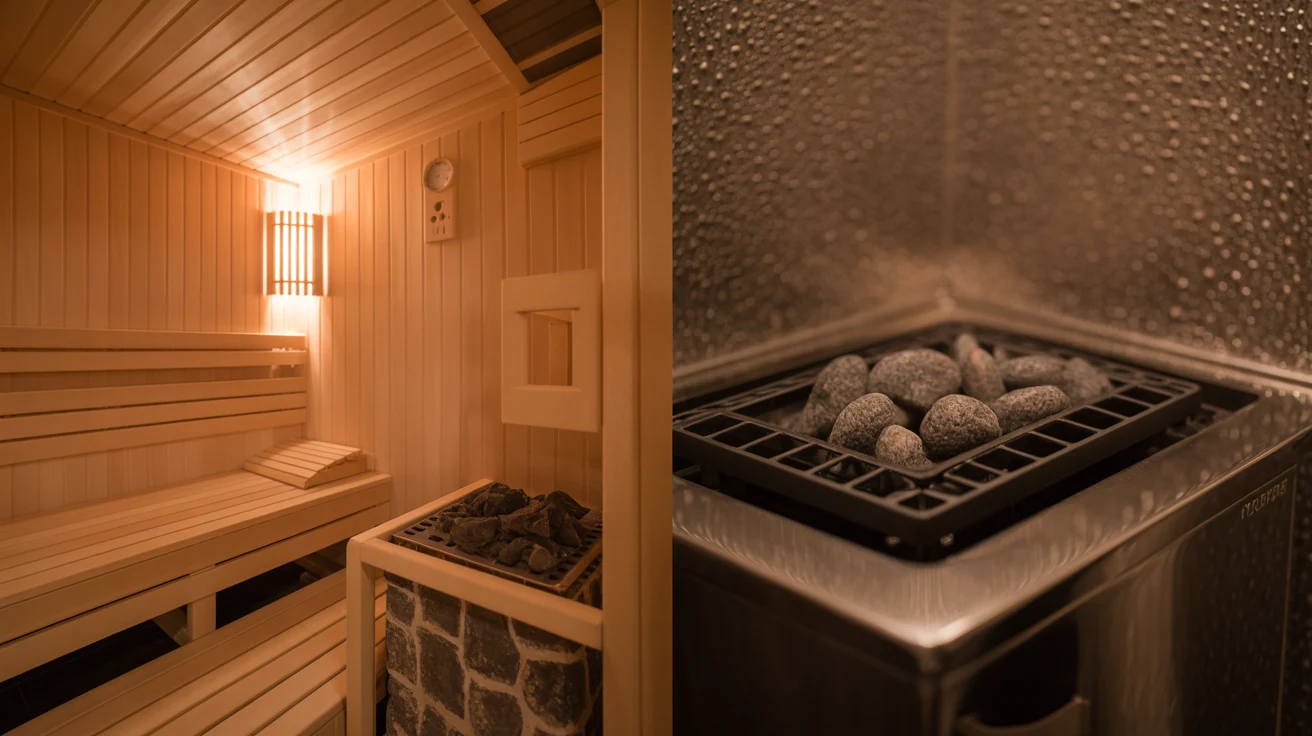
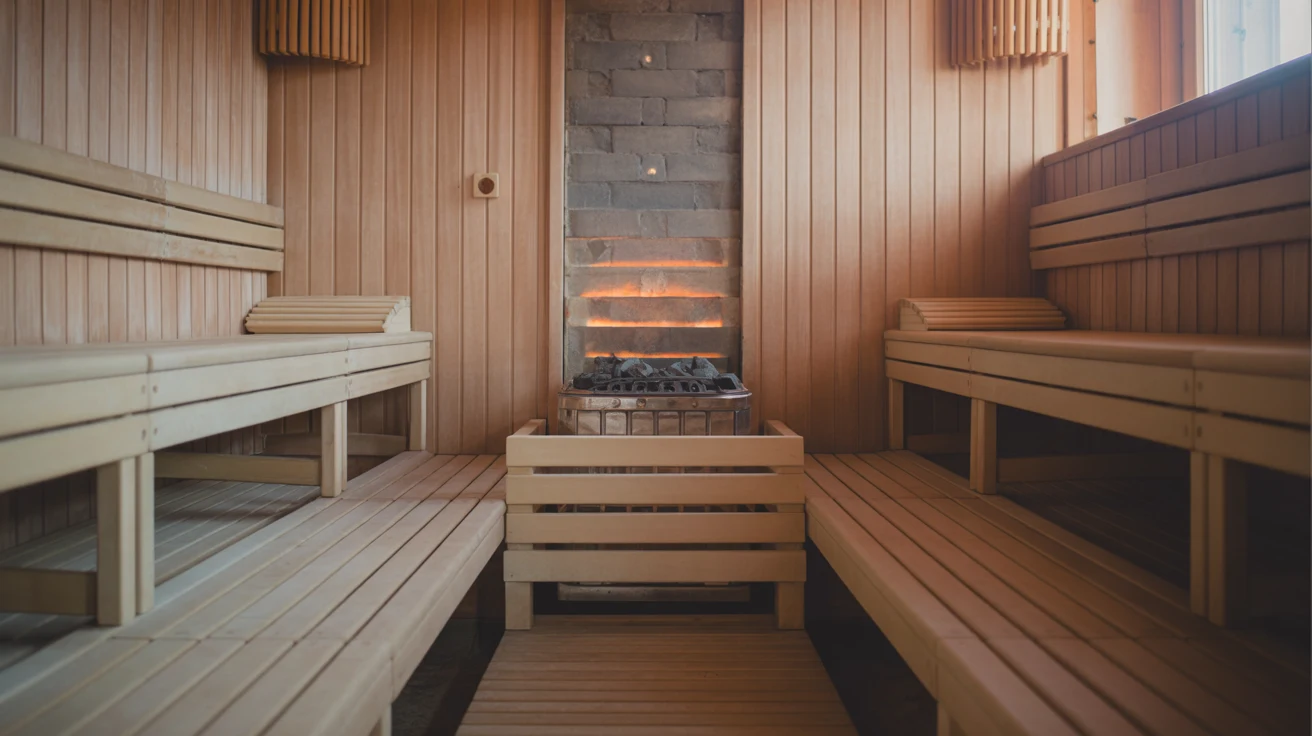
A sauna heater sits inside the room. In most US homes this is an electric kiuas (sauna heater) warming a basket of stones; in traditional Finnish setups it’s a wood-burning stove. The stones store thermal mass and radiate heat, and pouring water over them produces löyly (the burst of steam that rises when water hits hot stones). That’s a brief, controllable humidity spike, not a permanent state. You throw water, humidity jumps to 40-60% for a minute or two, then it drops back. You are in charge of it.
Why a steam room can’t be made of wood
This is the structural reason the two are different built environments, not variations on a theme. A steam room is lined with non-porous surfaces: porcelain tile most often, sometimes ceramic, natural stone, or quartz composite. Everything behind the tile must be waterproofed, the ceiling is sloped so condensation runs off instead of dripping on you, and a floor drain is mandatory. Wood is off the table entirely. Under constant 100% humidity, porous wood would absorb moisture and rot, warp, and grow mold within a few years.
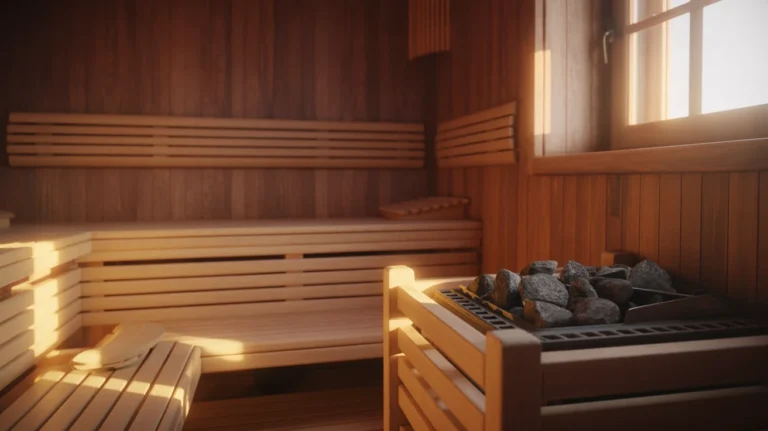
A sauna is the opposite. It’s built from softwood, western red cedar, hemlock, or spruce, precisely because wood works with dry heat. Wood has low thermal conductivity, so a bench stays comfortable to sit on at 90°C without scorching your skin (try that on a tile bench). It also absorbs micro-moisture, buffering the humidity swings from a löyly pour. A steam room can’t maintain 100% humidity in wood, and a sauna can’t be sealed airtight with tile. They solve different physics problems.

What each does to your body
The health picture splits cleanly, and it’s worth being honest about where the evidence is strong and where it’s thin.
For cardiovascular health, the sauna has by far the stronger case. A 2015 JAMA Internal Medicine study following 2,315 middle-aged Finnish men for about 21 years found that men who used a sauna 4-7 times a week had a 63% lower risk of sudden cardiac death and a 50% lower risk of fatal cardiovascular disease compared with once-a-week users. It’s observational, an association rather than proven cause, but it’s a large, long cohort. Dry heat raises heart rate to roughly 100-160 BPM, similar to moderate exercise, and drives the vasodilation that underlies those effects. No equivalent long-term data exists for steam rooms alone; steam-room cardiovascular claims are mostly extrapolated from dry-sauna research.
For respiratory relief, the steam room is the one people reach for, though the evidence is softer than the marketing suggests. Moist heat is widely reported to loosen mucus and soothe congested airways. But a 2016 pragmatic RCT in CMAJ of 871 patients found that steam inhalation did not significantly improve chronic sinus symptoms, while nasal saline irrigation did. Short-term subjective relief is real for many people; durable treatment of chronic sinusitis is not well supported. And if your asthma is triggered by high humidity, or the room harbors mold, a steam room can make things worse.
| Goal | Better choice | Evidence strength |
|---|---|---|
| Long-term cardiovascular health | Sauna | Strong observational (KIHD cohort) |
| Respiratory congestion (short-term) | Steam room | Anecdotal; weak RCT support |
| Skin surface hydration | Steam room | Mechanistic/anecdotal |
| Heat acclimation for athletes | Sauna | Multiple studies |
| Deep sweating, pore cleansing | Sauna | Mechanistic |
Why a steam room is not a “wet sauna”
In the US, “wet sauna” and “steam room” get used interchangeably, on gym signs and in product listings alike. It’s wrong, and it erases a real distinction. When an American says “wet sauna,” they almost always mean a steam room: a mechanically generated, sealed, tile-lined space at constant 100% humidity and 40-50°C.
A real wet sauna is something else. In Finnish tradition, a wet sauna is simply a wood-lined sauna used with active löyly, water poured over the stones. It still runs at 80-100°C, it’s still made of wood, and the bather controls the steam, which rises to 40-60% briefly and then falls back. The difference between wet and dry sauna is how much water you throw, not what the room is made of.
| Dry sauna | Wet sauna (löyly) | Steam room | |
|---|---|---|---|
| Temperature | 80-100°C | 80-100°C | 40-50°C |
| Humidity | 5-20% | 40-60% briefly | 95-100% constant |
| Material | Wood | Wood | Tile/stone/glass |
| Who controls humidity | User | User | Nobody, it’s fixed |
The closest cultural cousin to the steam room isn’t the sauna at all. The Turkish hammam and the broader steam-bath tradition, described by GoTürkiye, are their own lineage. The Finnish sauna, documented by the Finnish Sauna Society, is a separate one. Treating a steam room as a wet sauna collapses two distinct histories into a single gym amenity.
Which should you choose?
Pick the steam room for short-term congestion relief, skin hydration, gentle heat exposure, or if dry air bothers your throat and lungs. Pick the sauna for cardiovascular benefit, heat acclimation, deep sweating, stress reduction, and the traditional practice with all its cultural weight. If you want the genuine article at home rather than the gym’s fixed-humidity box, a proper wood-lined room with a stone-topped heater is what delivers the real experience the steam room can’t. If a hot tub is also on the shortlist, the sauna vs hot tub comparison covers buoyancy, running costs and the weekly water chemistry. And if you’re still mapping the landscape, it helps to see where each fits among the other sauna types.
FAQ
What’s the difference between a steam room and a sauna?
A sauna uses dry heat at 80-100°C (176-212°F) with low humidity of 5-20%, powered by a heater with stones inside a wood-lined room. A steam room uses moist heat at 40-50°C (104-122°F) with constant 95-100% humidity, generated by an external boiler in a tile-lined space. The sauna lets your sweat evaporate; the steam room does not.
Is a steam room or sauna better?
It depends on your goal. The sauna has the strongest long-term evidence for cardiovascular health and is better for deep sweating and heat acclimation. The steam room offers short-term relief for respiratory congestion and skin hydration, and its lower temperature is more accessible for heat-sensitive people.
Can a steam room replace a sauna?
Not fully. They produce different physiological effects. The long-term cardiovascular research supporting regular heat exposure comes almost entirely from dry sauna studies, and no equivalent long-term data exists for steam rooms. If your main interest is cardiovascular benefit or heat adaptation, a steam room is not a substitute.
Why is a steam room not called a wet sauna?
A true wet sauna is a wood-lined Finnish sauna at 80-100°C used with water thrown on hot stones, where the bather controls brief humidity spikes. A steam room is a sealed tile space at 40-50°C with fixed 100% humidity from a boiler. They are built from different materials and run at different temperatures, so the terms are not interchangeable despite common US usage.
Is a steam room good for congestion and sinuses?
Many people report short-term relief from congestion in a steam room, but the research is weak. A 2016 randomized controlled trial of 871 patients found steam inhalation did not significantly improve chronic sinus symptoms. Subjective relief is common, but it is not a proven treatment, and high humidity can worsen symptoms for some asthma sufferers.