How to Choose the Right Sauna Heater
Some links on this page are affiliate links. If you buy through them, I earn a small commission at no extra cost to you. As an Amazon Associate I earn from qualifying purchases.
The heater is the heart of your sauna. Get it right and you’ll have decades of proper löyly (the burst of steam when you throw water on the stones). Get it wrong and you’ll have an expensive closet that gets sort of warm. The difference between a $500 heater and a $2,500 one isn’t just price – it’s stone capacity, build quality, and whether you’ll still be happy with your choice five years from now.
This guide covers everything you need to pick the right sauna heater: fuel type, sizing, brands worth considering, electrical requirements, and the specs that actually matter for a good sauna experience. No filler, just the information you need to make a decision.
Electric vs Wood-Fired vs Gas: Which Fuel Type?
For most home saunas in the US, this decision comes down to electric vs wood-fired. Gas heaters exist but are uncommon in the residential market and have limited model selection. Your choice depends on where your sauna is, how much work you want, and what kind of experience you’re after.
| Factor | Electric | Wood-Fired | Gas |
|---|---|---|---|
| Best for | Indoor saunas, convenience | Outdoor/off-grid, tradition | Commercial, high-use |
| Temperature control | Precise (thermostat) | Manual (damper/fuel) | Thermostat |
| Chimney/venting | None required | Required | Required |
| Installation complexity | Dedicated 240V circuit | Chimney + fire clearances | Gas line + venting |
| Stone capacity | Varies (10–100+ kg) | Often higher | Varies |
| Ongoing cost | Electricity | Firewood | Natural gas/propane |
| Permits typically needed | Electrical | Chimney + building | Gas + building |
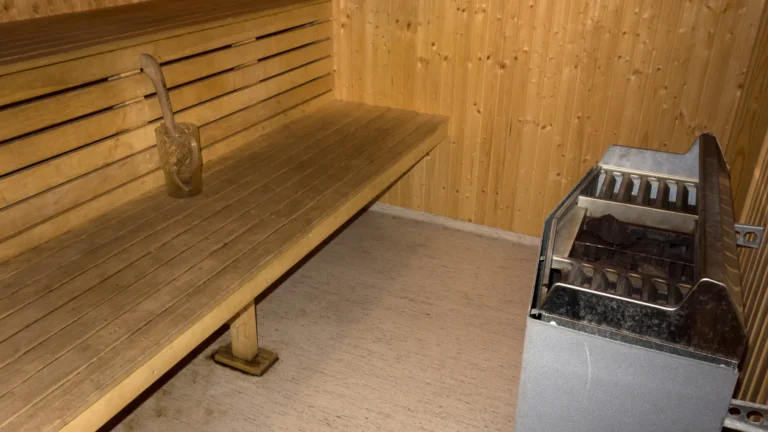
Electric heaters are the default choice for indoor residential saunas. They’re the easiest to install (no chimney), offer precise temperature control via thermostat, and come in the widest range of sizes and styles. Most residential models run on 240V and range from 4.5 kW to 10.5 kW. Small 2 kW units can run on standard 120V household circuits, but they’re only suitable for very compact saunas.
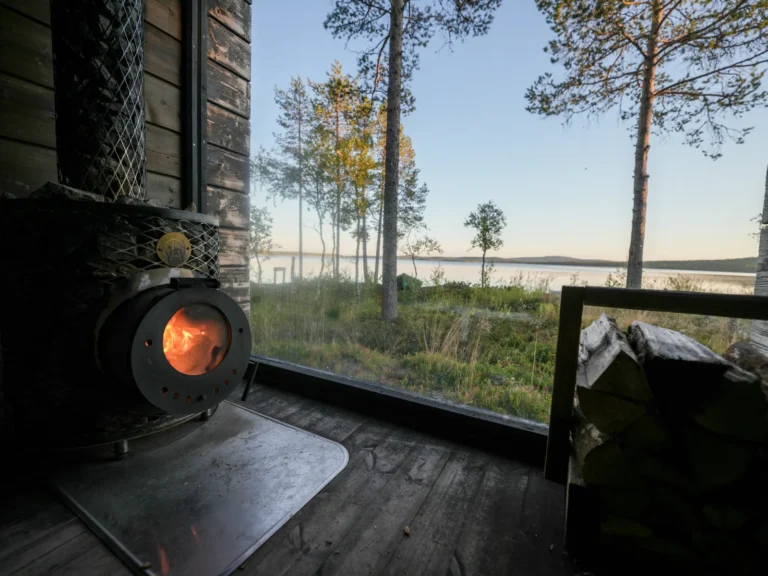
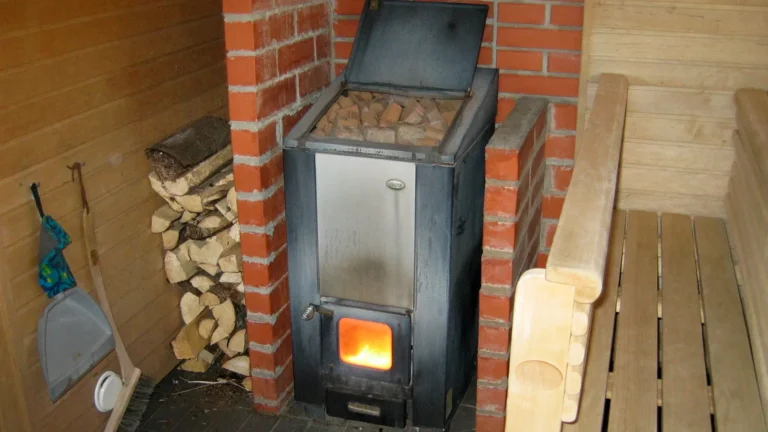
Wood-fired stoves are the traditional Finnish choice and the best option for outdoor or off-grid builds. They typically offer higher stone capacity, and many sauna enthusiasts consider wood-fired löyly superior – softer and more enveloping. The trade-off is real work: you need a chimney installation, regular ash removal, chimney cleaning, and you’ll manage temperature by feel rather than thermostat. Permits and code compliance for the chimney are required in most jurisdictions.
Gas heaters are a niche option, most common in commercial settings. If you’re building a residential sauna, you’re almost certainly choosing between electric and wood.
How an Electric Heater Works
An electric heater is a set of resistance elements under a pile of stones. Current runs through a coiled resistance wire sealed inside a steel sheath, and the wire’s resistance turns electrical energy into heat, the same physics as a kettle. The wire sits in a magnesium oxide insulating layer that carries heat outward to the sheath, which glows at around 500°C (932°F) in operation.
From there the heat moves two ways: into the stones by direct conduction, and into the room by convection and radiation. In a standard enclosed heater, roughly 70 to 75% of the output reaches you as convected hot air and 25 to 30% as radiant heat. A thermostat cycles the elements on and off to hold the target temperature, which is why electric heat stays so steady.
The elements never make the steam. Water should always go on hot stone, never on the steel sheath, and the stones need to sit somewhere around 150 to 400°C (302 to 752°F) for löyly worth the name. The elements simply keep that stone mass hot. Use volcanic stone: olivine diabase, gabbro, or peridotite, and avoid porous or non-volcanic rock that cracks under repeated heating and cooling. Ventilation counts too, since even a well-stoned heater gives heavy, stagnant air if the room cannot breathe. The Finnish Sauna Society has written plenty on why airflow makes or breaks a session.
Heater Sizing: The Formula That Actually Works
An undersized heater struggles to reach temperature. An oversized one cycles on and off constantly, creating uneven heat. Getting the size right is straightforward if you know the formula.
The baseline rule: 1 kW per approximately 1 cubic meter (35.3 cubic feet) of well-insulated sauna room. Measure your sauna’s length, width, and height in feet, multiply them together for cubic footage, then divide by 35.3 to get cubic meters. That number is your target kilowatt rating.
Adjustments for Real-World Conditions
The 1 kW per cubic meter formula assumes good insulation with a vapor barrier on all surfaces. Most real saunas have at least one element that leaks heat, so you need to adjust upward:
- Glass door or window: Add 1.2 cubic meters (42 cubic feet) of equivalent volume per square meter of glass surface
- Uninsulated stone, brick, or concrete walls: Same adjustment – add 1.2 cubic meters per square meter of uninsulated surface
- Log walls (not insulated): Logs absorb significant heat; add 50% to your calculated volume
- Cold climate with exterior walls: Round up to the next heater size
Common Room Sizes and Heater Matches
| Sauna Size (ft) | Volume (cu ft) | Approx. Cubic Meters | Recommended kW |
|---|---|---|---|
| 4×4×7 | 112 | 3.2 | 4.5 |
| 4×6×7 | 168 | 4.8 | 6 |
| 6×6×7 | 252 | 7.1 | 8 |
| 6×8×7 | 336 | 9.5 | 9–10 |
| 8×8×7 | 448 | 12.7 | 10.5+ |
Most residential saunas fall in the 4×6 to 8×8 foot range, which means you’re typically looking at heaters between 6 kW and 10 kW. If your calculated need falls between standard sizes, round up – a slightly oversized heater with a good thermostat will perform better than an undersized one straining to reach temperature.
Stone Capacity: The Spec Most People Overlook
Here’s the thing that separates a mediocre sauna from a great one: stone capacity matters more than raw wattage for löyly quality. A 6 kW heater loaded with 80 kg of stones can produce better, softer steam than a 9 kW heater holding only 15 kg. The reason is physics – more stone mass stores more thermal energy and releases it more evenly when you throw water on the stones.
Compact wall-mount heaters like the Harvia KIP hold about 20 kg of stones, though larger wall models such as the Harvia Virta and HUUM DROP take 50 to 55 kg. Tower and pillar heaters – like the Harvia Cilindro or HUUM HIVE – can hold 50–100+ kg. That difference is enormous in practice. With a small stone mass, you get a quick burst of harsh steam that dissipates fast. With a large stone mass, you get a rolling wave of soft, humid heat that lingers.
Stone Capacity Guidelines
| Stone Capacity | Category | Löyly Quality | Typical Heater Type |
|---|---|---|---|
| Under 20 kg | Minimal | Quick, dry, harsh | Budget wall-mount |
| 20–50 kg | Good baseline | Decent steam, moderate duration | Standard wall-mount, small tower |
| 50–100+ kg | Excellent | Soft, long-lasting, traditional | Tower/pillar heaters |
Top Brands Worth Considering
The sauna heater market has a clear hierarchy. A handful of Nordic and European manufacturers dominate the quality end, while a growing number of budget imports compete on price. Here’s what you need to know about the brands that matter.
Harvia (Finland)
The largest sauna heater manufacturer in the world, and for good reason. Harvia offers the widest product range from entry-level to premium, with models for every sauna size and style. The Cilindro tower heater (about $1,520 to $1,625 for 8 to 9 kW with built-in controls) is one of the best values in the mid-range – high stone capacity in a cylindrical design that fits against a wall. The Virta wall-mount ($1,490–$1,540 for 8–9 kW) is their premium wall-mount option, and the Spirit line ($1,595–$1,930) adds WiFi controls. For those wanting a combined sauna and steam room experience, the Virta Combi ($3,080–$3,590) does both.
HUUM (Estonia)
HUUM is the design-forward option. The DROP ($1,672–$1,751 for 7.5–9 kW) is a wall-mount with a distinctive teardrop shape and WiFi controls – it looks like nothing else in the market. The HIVE Mini ($2,657 for 9 kW) is their flagship: a floor-standing, beehive-shaped heater with enormous stone capacity that produces exceptional löyly. HUUM commands premium prices, but the build quality and aesthetics justify it for many buyers.
Finlandia (USA)
The value leader for the North American market. Finlandia uses Finnish-origin designs manufactured at more accessible price points. The FIN-80 with external controls ($870 for 8 kW) is one of the most affordable reputable heaters you can buy, and their FLB-80 with built-in controls ($1,003) is a solid step up. The stainless steel variant ($1,093) adds durability. If you want a quality heater without spending $1,500+, Finlandia is where to look.
Other Notable Brands
| Brand | Country | Known For | Price Position |
|---|---|---|---|
| Tylö | Sweden | Premium residential and commercial heaters | Premium |
| Saunum | Estonia | Air-mixing technology that reduces temperature stratification | Premium |
| Narvi | Finland | Traditional Finnish designs, growing North American presence | Mid-range to premium |
| EOS | Germany | German-engineered, commercial-grade build quality | Premium |
| Helo | Finland (Sauna360 group) | Finnish heater brand from the group behind Tylö and Finnleo | Mid-range |
| Scandia | — | Premium-positioned electric heaters | Premium ($1,910–$2,073) |
Budget Tiers: What You Get at Each Price Point
Sauna heaters span a wide price range, and the differences between tiers are real. Here’s what your money buys at each level. All prices are for the heater unit only – controllers, stones, and installation are additional costs.
| Tier | Price Range | What You Get | Notable Models |
|---|---|---|---|
| Entry | $500–$1,100 | Basic electric heaters. Reliable options from established brands at the upper end; unverified imports at the lower end. Watch for missing UL/ETL certifications on ultra-cheap units. | Finlandia FIN-80 ($870), Finlandia FLB-80 ($1,003) |
| Mid-range | $1,100–$2,000 | Quality heaters from established Nordic and European brands. Better materials, higher stone capacity, more refined controls. This is the sweet spot for most home saunas. | Harvia Cilindro 8 kW ($1,519), Harvia Virta 8 kW ($1,490), HUUM DROP 7.5 kW ($1,672), Harvia Spirit 8 kW ($1,595) |
| Premium | $2,000–$4,500+ | High-end design, maximum stone capacity, advanced features (WiFi, combi steam). Premium materials and build quality for decades of use. | HUUM HIVE Mini 9 kW ($2,657), Harvia Virta Combi 8 kW ($3,080), Scandia 9 kW ($2,073) |
A word on ultra-cheap heaters: you’ll find Amazon listings for heaters at $130–$340 from brands like VEVOR and Mxmoonant. Some of these may lack UL or ETL safety certification, which is a real concern for a device pulling 30–50 amps in a wet environment. The stone capacity on these units tends to be minimal, meaning weak löyly. If budget is tight, the Finlandia FIN-80 at $870 is a vastly better investment than a $200 import.
Wall Mount vs Floor-Standing: Placement and Style
The mounting style of your heater affects how much space it takes, how much stone it holds, and where it can go in the room. This isn’t just an aesthetic choice.
Wall-Mount Heaters
Mounted on the wall typically 6–12 inches above the floor. These are the most compact option and the default for smaller saunas. Models like the Harvia Virta, HUUM DROP, and Finlandia FLB series all mount to the wall. Pros: saves floor space, easy to clean underneath. Cons: compact models hold only about 20 kg of stones (the Virta and DROP are exceptions at 50 kg or more), requires structurally sound mounting with proper standoffs from the wall.
Floor-Standing Tower Heaters
Free-standing pillar or tower heaters that sit on the floor, surrounded by stones on all sides. The Harvia Cilindro, HUUM HIVE Mini, and Scandia models all use this format. The big advantage is stone capacity – these heaters hold 50–100+ kg of stones, which translates directly to better löyly. They take up floor space and cost more, but for anyone who prioritizes steam quality, a tower heater is the way to go.
Heater Placement Guidelines
Regardless of mounting style, follow these placement principles:
- Place the heater on the same wall as the door or an adjacent wall for proper air circulation
- Keep the clearances to combustible surfaces that your heater’s manual gives for its mounting position; they differ by model, so never copy them from another heater
- Position benches so bathers sit at or above stone level for the best heat
- Install a guard railing if the heater is accessible to bathers to prevent accidental contact
- Use a non-combustible surface under and around the heater for floor protection
Voltage and Electrical Requirements
This is the section that separates planning from actually installing a sauna. A heater is a large electrical load running for hours in a hot room, and in the US the requirements are not negotiable.
Most residential sauna heaters (4.5–10.5 kW) require 240V single-phase power with a dedicated circuit. This is the same voltage as your clothes dryer or electric oven, not something you can plug into a standard wall outlet. Small 120V heaters exist for very compact rooms, but even a 2 kW model draws about 16.7 amps (2,000 W divided by 120 V, calculated), more than a 15-amp household circuit is rated for, so it still needs its own circuit sized by an electrician.
Amps and Wire Size: What the Manual Says
Your heater’s installation manual is the authority here, because current draw and wire size are set per model. As an example, this is what Harvia prints for its KIP wall heaters on single-phase 240V:
| Model | Output | Current at 240V | Supply Wire (copper) |
|---|---|---|---|
| KIP-45-B1 | 4.5 kW | 18.8 A | #10/2 |
| KIP-60-B1 | 6.0 kW | 25.0 A | #10/2 |
| KIP-80-B1 | 8.0 kW | 33.3 A | #8/2 |
Figures from the Harvia KIP installation manual (US edition).
Harvia lists the current and the wire, not a breaker size. Breaker sizing is your electrician’s job under the National Electrical Code and your local code, and the manual is specific about the rest: the heater is wired by a licensed electrician with no plug or pigtail, and the wire inside the sauna walls must be copper rated for 194°F (90°C).
Harvia’s manual also says the heater “must be connected to a standard 2-pole breaker, no GFI may be used”, warns that a GFI breaker may trip and that connecting one voids the warranty on internal components. If your inspector asks for ground-fault protection, settle it with your electrician and the heater maker before installation, not after. A disconnect within sight of the heater and an inspection after installation may also be required locally, so check with your building department before work starts.
When to Call an Electrician (Hint: Almost Always)
This isn’t a section where I tell you to save money with DIY. Electricity kills, and a sauna heater pulls serious amperage in a hot, wet environment. Here’s the clear line:
You need a licensed electrician for:
- Any 240V heater installation – this requires a dedicated circuit from your electrical panel
- Running new wire from the breaker panel to the sauna location
- Installing a new 240V breaker in the panel
- Any installation requiring a permit (most jurisdictions require permits for new 240V circuits)
You might handle yourself:
- Connecting a low-voltage control unit to the heater body, if manufacturer instructions are clear
Expect to pay for the electrician’s work on top of the heater cost. It’s typically a half-day job if the panel has capacity and the run isn’t too long. If your panel is already maxed out, you may need a panel upgrade – that’s a bigger project. Get an electrician’s assessment before buying your heater so you know the full installation cost.
Warranty and Lifespan: What to Expect
Quality electric sauna heaters typically last 10–20 years with proper use. The heating elements are the most common failure point and may need replacement every 5–10 years depending on how often you sauna and your local water quality – mineral buildup from hard water accelerates element wear.
When evaluating warranties, look at these separately:
- Heating element warranty: The most important coverage, since elements are the first thing to fail. Terms differ by brand: Harvia covers its heaters, elements included, for 2 years in home use, plus a third year when you register an electric heater, and gives elements only 6 months in commercial use.
- Body/enclosure warranty: Usually longer than the element warranty, since the enclosure rarely fails.
- Controller/electronics warranty: May be covered separately, especially for WiFi-enabled models.
- Professional installation requirement: Some warranties require proof of licensed installation.
- Residential vs commercial use: Warranties often differ – commercial use typically gets shorter coverage.
Budget heaters often come with shorter or vaguer warranties, which tells you something about the manufacturer’s confidence in their product. A 3-year warranty on a $1,300 heater is a better deal than a 1-year warranty on a $400 one: the warranty cost is baked into the price difference.
Controls: Built-In vs External vs WiFi
Heater controls come in three flavors, and this choice affects both price and convenience.
Built-in controls are mounted on the heater body itself. Simple, no extra wiring, but you have to reach the heater (which is low on the wall and hot) to adjust settings. Models like the Finlandia FLB-80 ($1,003) and Harvia Cilindro built-in ($1,519) use this approach. Fine for most home saunas.
External controls mount on the wall outside the sauna, typically near the door. More convenient – you can adjust temperature and set timers without entering the hot room. The Harvia Cilindro external-control version ($1,270) is slightly cheaper than the built-in version because the controller is sold separately. External controllers add $100–$300 to the total cost depending on features.
WiFi-enabled controls let you preheat your sauna from your phone. The HUUM DROP and Harvia Spirit lines include WiFi. It’s a genuine convenience – start heating from work and walk into a ready sauna when you get home. Whether it’s worth the premium depends on how impatient you are.
Making Your Decision
If you’ve read this far, here’s the summary of what matters most, in order:
- Size correctly – 1 kW per cubic meter of well-insulated space, adjusted for glass and uninsulated surfaces
- Prioritize stone capacity – at least 20 kg, more if you care about löyly quality
- Buy from established brands – Harvia, HUUM, Finlandia, Tylö, and Narvi all make heaters that will last
- Budget for installation – the heater price is only part of the cost; a licensed electrician is not optional for 240V
- Check the warranty – especially on heating elements, and whether professional installation is required
For most home saunas in the 150–350 cubic foot range, an 8 kW heater in the $1,100–$2,000 range from Harvia or HUUM will serve you well for a decade or more. If budget is tight, the Finlandia FIN-80 at $870 is the best entry point from a reputable brand. If you want the best possible löyly, invest in a tower heater with maximum stone capacity.
FAQ
What size sauna heater do I need?
Use the formula of 1 kW per approximately 1 cubic meter (35.3 cubic feet) of well-insulated sauna room. For a typical 6×6×7 foot sauna (252 cubic feet, roughly 7 cubic meters), you’d need about an 8 kW heater. Add extra capacity for glass doors, windows, or uninsulated surfaces – each square meter of glass or uninsulated wall adds the equivalent of 1.2 cubic meters to your calculation.
How does an electric sauna heater work?
Electrical current runs through a resistance wire sealed in a steel sheath, which converts the energy to heat. That heat transfers into the sauna stones by conduction and into the room by convection and radiation, with a thermostat cycling the elements on and off to hold your target temperature.
Electric or wood-fired sauna heater?
Electric is the practical choice for indoor residential saunas – no chimney required, precise temperature control, and simpler installation (though you still need a licensed electrician for the 240V circuit). Wood-fired is better for outdoor or off-grid builds and offers a more traditional experience with typically higher stone capacity. Most US home saunas use electric.
How long do sauna heaters last?
Quality electric sauna heaters from established brands typically last 10–20 years with proper use. Heating elements are the most common component to fail and may need replacement every 5–10 years, depending on how frequently you use the sauna and your water quality. Hard water with high mineral content accelerates element wear.
Can I install a sauna heater myself?
For 240V heaters – which includes most residential models from 4.5 kW and up – you need a licensed electrician. The work involves running a dedicated circuit from your electrical panel, installing a high-amperage breaker, and using properly rated wiring. Most jurisdictions require permits for new 240V circuits. The only exception is small 120V plug-in heaters (2 kW), which can use a standard outlet but are limited to very small saunas.