A Backyard Sauna and Cold Plunge: Planning the Setup
Some links on this page are affiliate links. If you buy through them, I earn a small commission at no extra cost to you. As an Amazon Associate I earn from qualifying purchases.
You know the sequence from the gym or the bathhouse: hot room, cold water, back again. Somewhere on the drive home you started measuring the patio in your head. At home the walk between the two matters more than the gear. Keep that walk short and dry, give each side its own circuit, and budget over $10,000 for a small electric pair and up to about $17,300 for a family one, before the pad and the electrician.
At a glance
- Layout: a few steps on a dry, direct path, with 3 ft (91 cm) of clear space around the chiller.
- Power: 240 volts on its own circuit for an electric heater, a separate dedicated circuit for the chiller.
- Main items: about $9,600 to $10,500 for a two-person electric setup before the tub, $16,200 to $17,300 for a family one.
My picks
- Small yard, electric: SaunaLife CL3G cube sauna
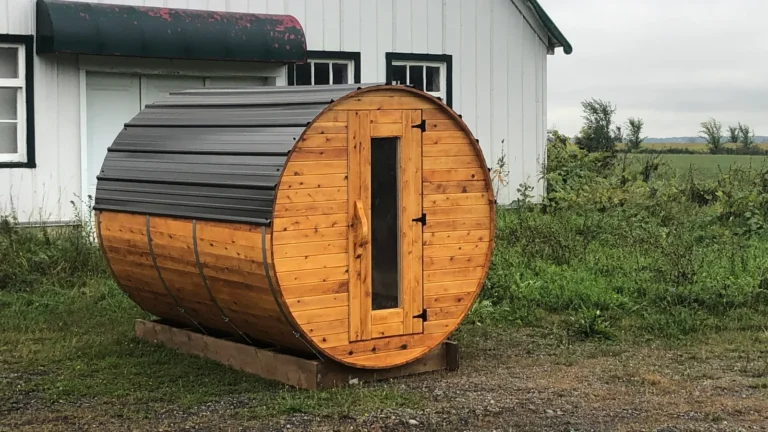
- Family yard: Dundalk Serenity barrel sauna
Will you use both?
Probably not equally. Maria Gonzalez-Blanch put a sauna and a cold plunge in a backyard every designer told her was “too small for all that.” Eight months in, she uses the sauna every morning after lifting and most nights before bed. The plunge gets the mornings only: “I don’t use the cold plunge at night.”
A homeowner on the TigerDroppings forum added a cold plunge first and a custom sauna later the same year, and uses the sauna “every single day.” Michael Kummer, who blogs from Georgia, uses his chiller tub “on an almost daily basis.”
It can also become where friends gather. Gonzalez-Blanch calls hers “the perfect gathering spot for family, friends, and neighbors” and hosts wellness nights. When Kummer has friends over for back-to-back plunges, his tub can creep up to 41°F (5°C) before the chiller catches up.
How far apart, and what goes between them
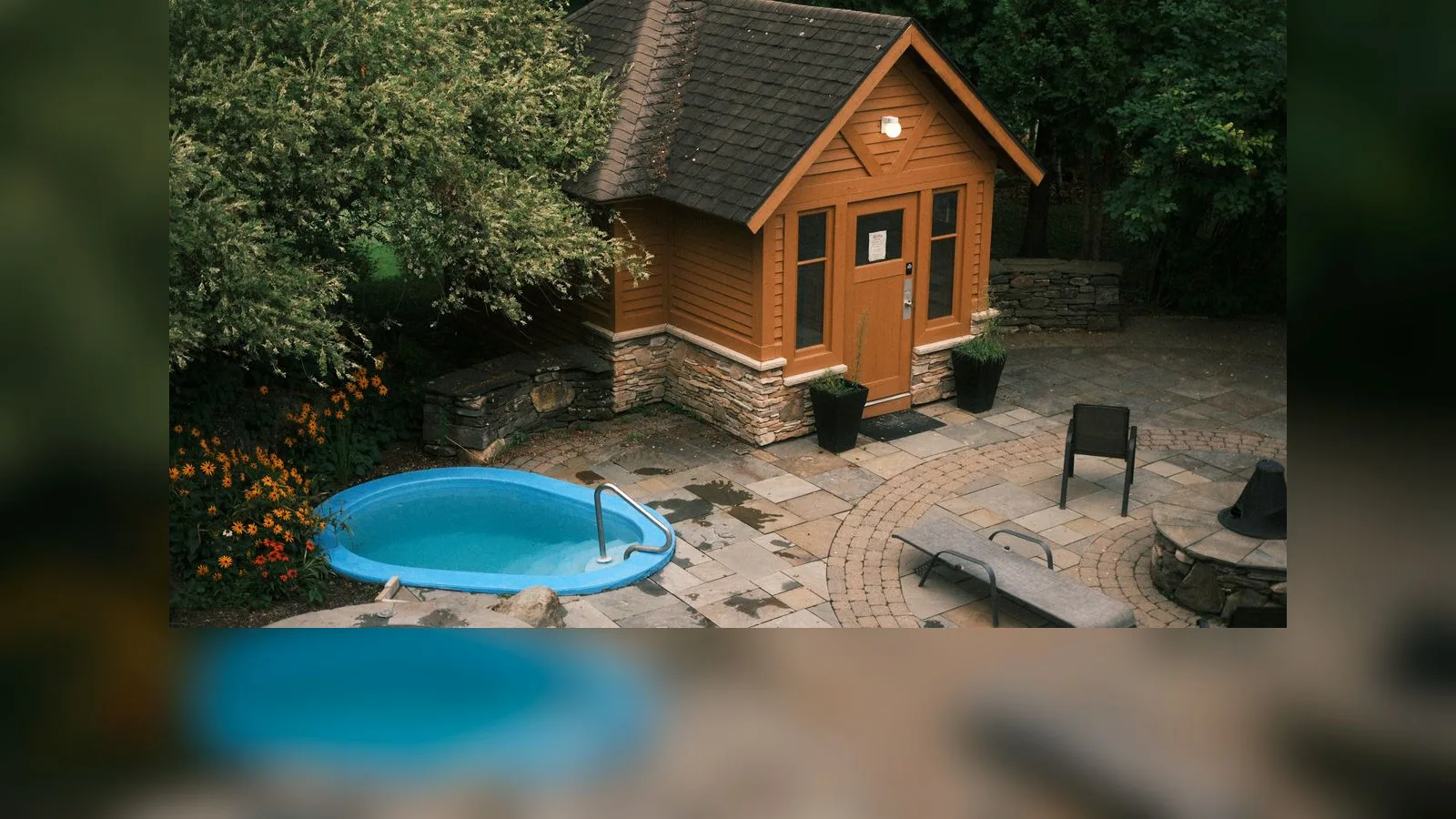
Put the tub where you can reach it barefoot without thinking about it: a few steps, straight line, dry footing, and a bench at the end to sit on while you cool down. The forum owner’s plunge sits under a patio cover “about 5-10 steps away from the Sauna.” Kummer’s tub stands on the back patio beside his infrared sauna.
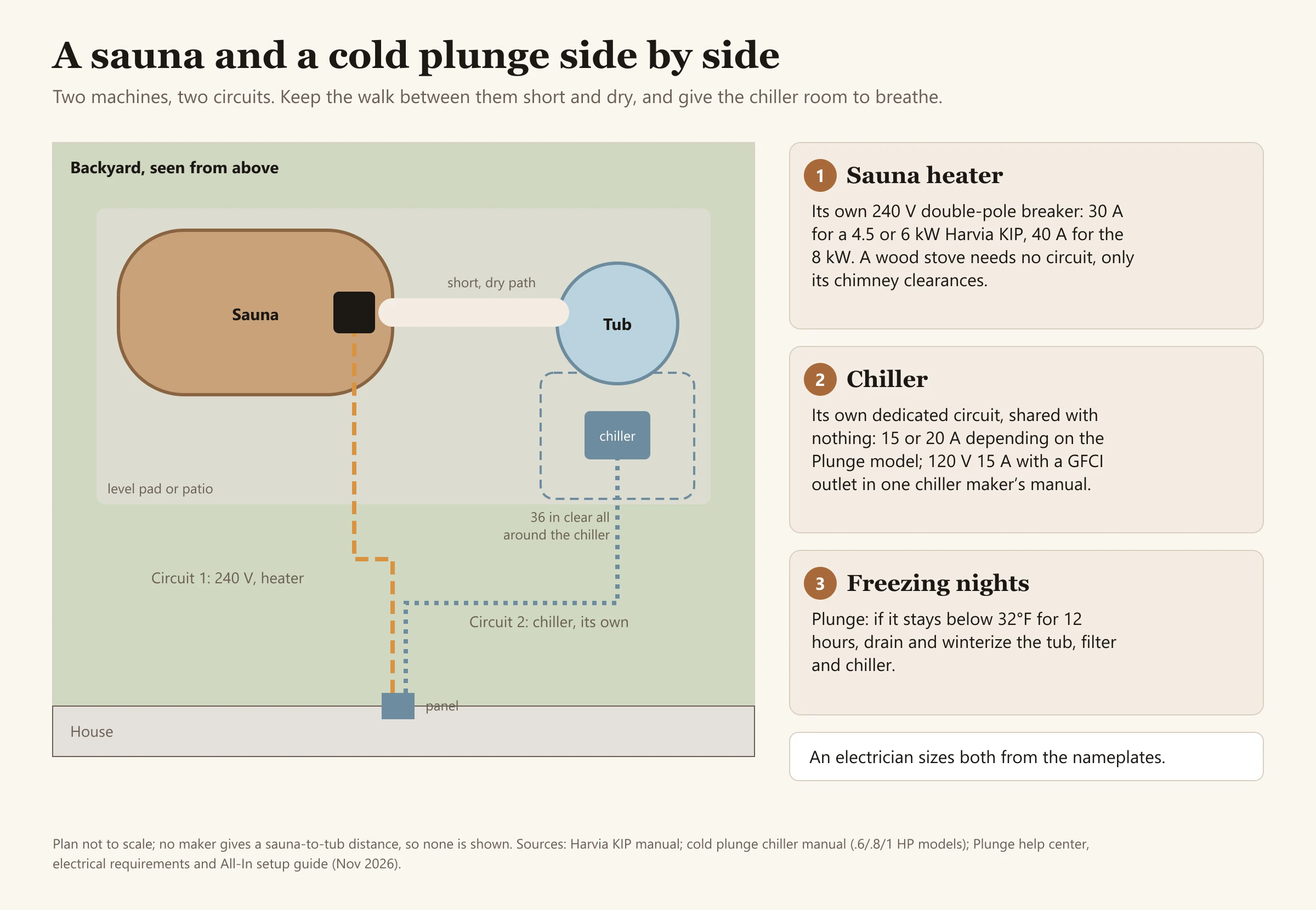
The chiller sets the only hard numbers in the layout. Its manual asks for 3 ft (0.9 m) of clearance between every component and the nearest wall or object, at least 36 in (91 cm) of open air in front of the cooling fan, and no enclosed cupboard.
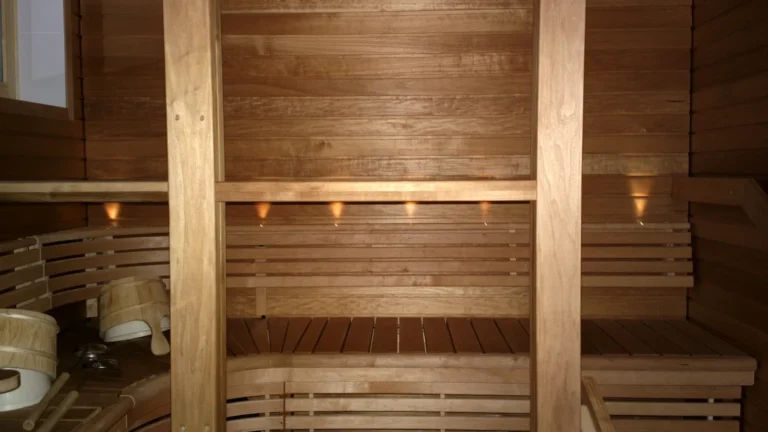
Add a hose or an outdoor shower so you rinse before you get in, and plan a floor drain in the sauna: a blocked one shows up as a room that will not heat properly. The shower can be the cold side, too. Jeff Waldman’s friends on his weekly sauna night cool off by cold “plunging” under the outdoor shower, and you can tell someone is out there “by the muffled hoots and yelps.”
Power: one circuit each, and an electrician
An electric heater needs 240 volts on a circuit of its own. Harvia’s 6 kW Virta runs on 240 V single phase. The widely sold KIP heaters need a 30-amp breaker up to 6 kW and 40 amps at 8 kW.
The cold side gets its own circuit too. Plunge asks for 20 amps for the All-In and Evolve Pro and 15 for the Evolve Standard; a generic chiller wants a dedicated 120 V, 15-amp GFCI circuit.
A wood stove deletes the heater circuit and adds a flue: Harvia asks for at least 100 mm (about 4 in) between the chimney’s outer casing and anything combustible. Panel capacity and breaker sizes come from a licensed electrician reading your two nameplates; that part is not a DIY job.
Chiller, ice or a cold shower?
A chiller keeps the water at a set temperature with no effort on the day. Kummer’s, in Georgia, usually hovers between 39 and 40°F (about 4°C).
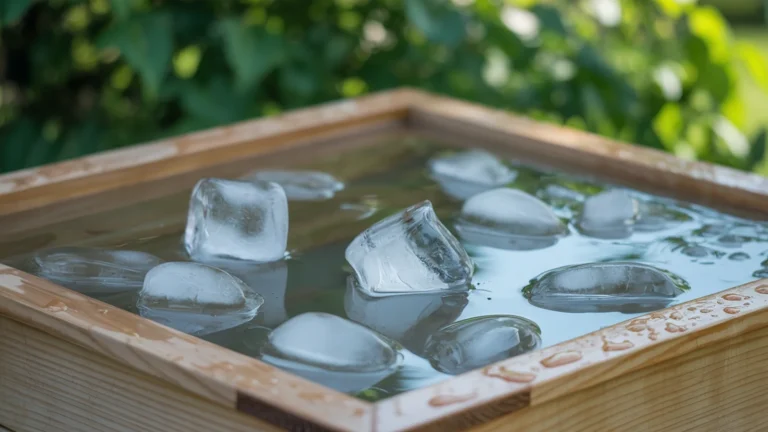
Ice is cheap to start and a supply job after that. Kummer fills his ice barrel with 120 to 140 pounds (54 to 64 kg) of ice, and he warns that the icemaker in a kitchen freezer “won’t produce enough.” On a sunny 75°F (24°C) day, his ice was almost completely melted within 3.5 hours.
Reuben Saltzman, a Minnesota home inspector, fills his tub from a hose on a sprinkler timer and settles for 58°F (14°C): “cold enough for me.”
Three setups that get built
| Situation | Sauna | Cold side | Power and water | Sauna, heater, cold side (Nov 2026) |
|---|---|---|---|---|
| Small yard, electric | SaunaLife CL3G two-person cube, $3,990 plus $950 freight, no heater | Chiller-fed tub | 240 V circuit for a 4.5 kW heater; dedicated 120 V GFCI circuit for the chiller; hose fill | $9,600 to $10,500 plus the tub |
| Family yard | Dundalk Serenity barrel, 3-5 people, $6,127 | All-in-one chiller tub | 240 V, 30-40 amp double-pole for an 8 kW heater; dedicated circuit for the built-in chiller; hose fill | $16,200 to $17,300 |
| Wood-fired, off grid | Wood stove sauna | Ice-fed barrel, or a lake | No circuit on either side; chimney clearances for the stove; water to fill, ice to chill | Tub from $1,299; structure depends on the build |
The totals are added up from the gear prices below, checked in November 2026; a level pad and the electrician’s visit come on top. One retailer estimates an ice-fed barrel wants 20-40 lb (9 to 18 kg) of ice per session to reach 50-59°F (10-15°C). A sauna for two is the setup most small yards end up with.
How much work is the water, and what about winter?
Fill from municipal water. Plunge says not to fill from a well unless the water has been through an ion-exchange filter, and to leave the system running around the clock, because stagnant water is not sanitary.
Kummer’s routine on his chiller tub is light but regular: he replaces the water about once every six months and the sediment filter once a month. For an ice barrel he recommends fresh water every four weeks. One reader who runs a community sauna, Mark Anderson, wrote in a comment on Waldman’s post that changing out and sanitizing the cold plunge is “a lot of work.” Filter media, sanitizer and dosing live in the cold plunge guide.
Plan for the first freeze. For the holidays in 2022, Kummer drained the tub and unplugged the chiller but “forgot to also drain and remove the filter cartridge.” The filter housing cracked in a cold spell. Saltzman moved his tub into the utility room, next to the floor drain, because he did not want “to mess around with snow and ice” outside.
The maker’s threshold is published: if it stays below 32°F (0°C) for twelve hours, drain the tub, filter and chiller, and winterize with the one antifreeze the maker approves. Any cover helps, too: the forum owner’s advice is that with a garage or patio cover over the tub, “you are set.”
What it costs all in
The sauna, the heater and the cold side come to about $9,600 to $10,500 for a small electric setup before the tub itself, and $16,200 to $17,300 for a family one. The pad or deck under both units and the electrician come on top, and those need local quotes.
| Item | Cost (Nov 2026) |
|---|---|
| The sauna | $3,990 plus $950 freight for the two-person cube; $6,127 for the family-size barrel |
| The heater package | $1,214 for a 4.5 kW KIP with built-in controls; $1,090 to $2,148 for the 8 kW, by controller |
| The cold side | $3,490 to $4,299 for a chiller on its own; $8,990 for an all-in-one tub, about $3,000 less in the Black Friday 2026 sale |
Is there a sauna with a cold plunge built in?
No, not in the sense of one shell. Everything sold as a combo or a 2-in-1 turns out to be a sauna and a separate tub shipped together under one price, such as Redwood Outdoors’ Duo sauna paired with its Alaskan all-in-one plunge at $11,199. The word “combo” describes the invoice, not the carpentry. Bundles can price well, but you are still placing two structures in the yard and running two sets of utilities to them.
Safety
Do not do the hot-cold routine alone, and never leave someone who has been drinking in the sauna. Professor Lasse Viinikka of the Finnish Sauna Society told Yle that a few dozen people a year die in saunas in Finland, and clearly more than half of them were strongly intoxicated: alcohol blunts the body’s sense of overheating. If you have a heart condition or uncontrolled blood pressure, ask your doctor before you add the cold water. A tub needs a locking cover if there are children around; Kummer’s came with keys.
How it is done in Finland
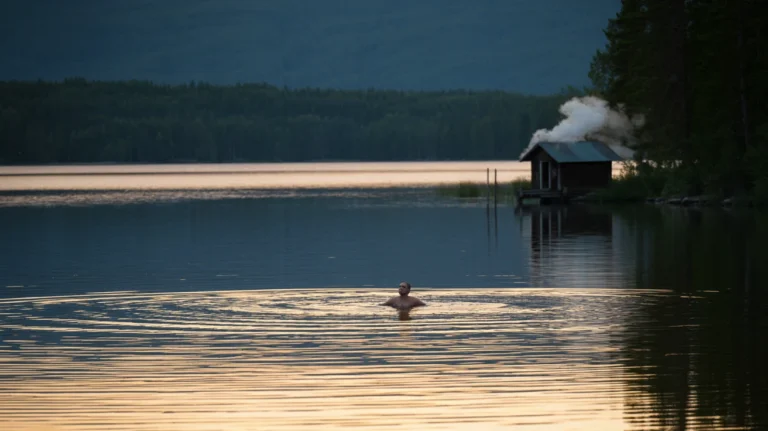
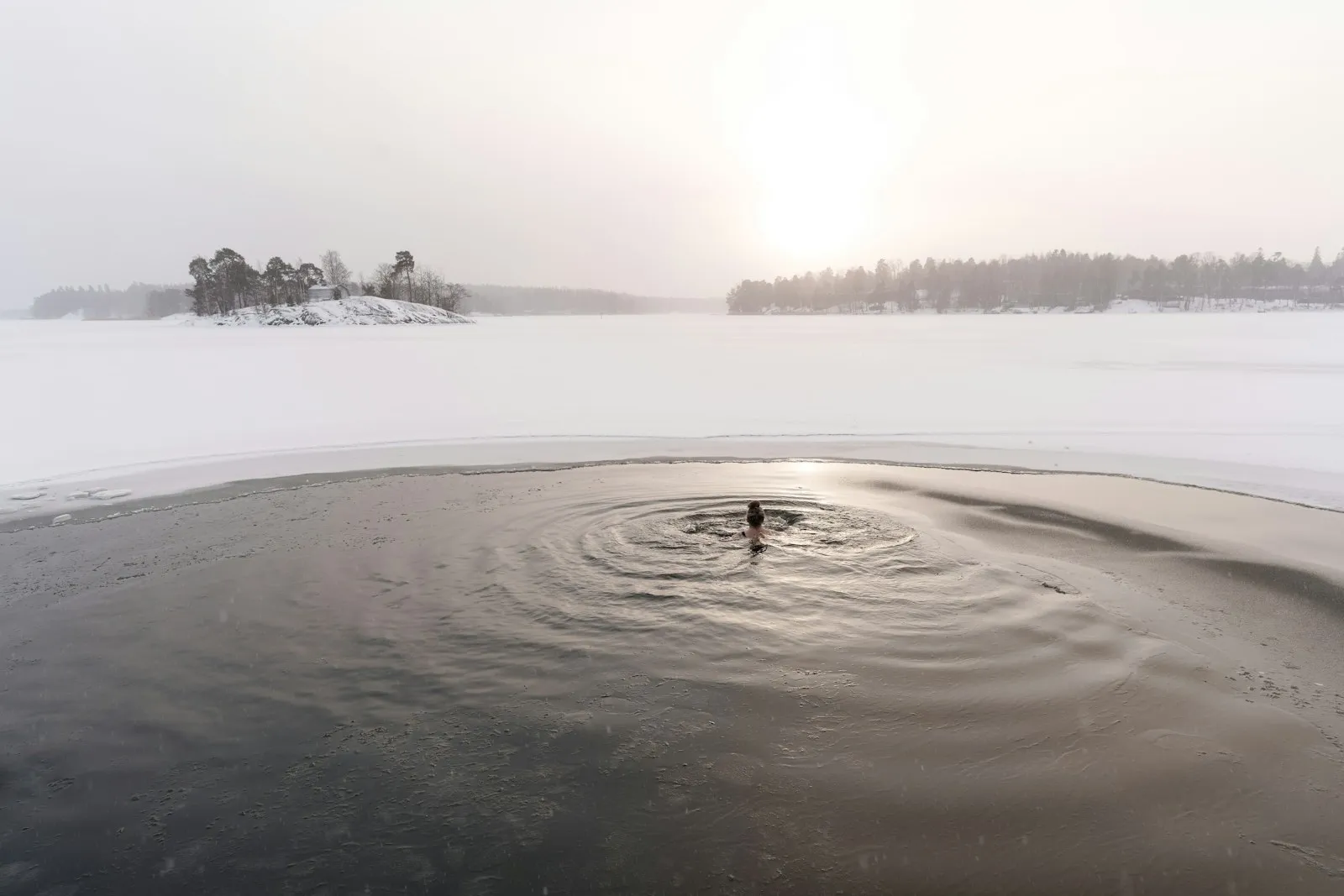
In Finland the cold half of the routine is usually the lake or the sea, reached by walking out the sauna door. At Uunisaari, the Helsinki island sauna, you cool off in the sea in summer and in a hole cut in the ice in winter, which is the standard arrangement rather than a stunt. A backyard tub is the American substitute for water that is already there.
FAQ
How far should a cold plunge be from a sauna?
No manufacturer publishes a distance, so judge it by feel: close enough to walk barefoot in a few steps on a dry, direct path. The one fixed requirement is spacing around the chiller, at least 3 ft (0.9 m) to walls and objects and 36 in (91 cm) in front of its fan.
What does a home sauna and cold plunge cost?
About $9,600 to $10,500 for a two-person electric sauna, heater and chiller before the tub itself, and $16,200 to $17,300 for a family barrel sauna with an all-in-one tub, on list prices checked in November 2026. A pad for both units and the electrician’s work are extra.
Do a sauna and a cold plunge need separate circuits?
Yes. An electric heater takes its own 240 V circuit, and the chiller takes a dedicated circuit of its own, typically 120 V and 15 or 20 amps with a GFCI outlet. Manufacturers specifically forbid sharing the chiller’s circuit with other equipment.
Is a chiller better than ice for a home cold plunge?
For regular use, it is less work. One owner who runs both, Michael Kummer, keeps his chiller tub around 39 to 40°F (about 4°C), while his ice barrel takes 120 to 140 pounds (54 to 64 kg) of ice per fill that melts within hours on a warm day. In warm months, he writes, expect to add ice daily.
Is there a sauna with a built-in cold plunge?
Not as a single structure. The combo products on the market are a sauna and a standalone tub sold as one package, like Redwood Outdoors’ Duo with the Alaskan all-in-one plunge at $11,199. You still site and service two separate units.
Top photo: Aida Sam on Unsplash. Article photo: Mika Ruusunen on Unsplash. Diagrams: Heat and Birch, from the makers’ own figures.