Outdoor Saunas for a Family or a Group of Friends
Some links on this page are affiliate links. If you buy through them, I earn a small commission at no extra cost to you. As an Amazon Associate I earn from qualifying purchases.
The whole family piled into a sauna together somewhere, a spa, a ski lodge, a friend’s cabin, and the kids asked to go again. Now the question at the kitchen table is how big. Four on the label does not mean four people with room to move: makers count bench space, shoulder to shoulder, nobody lying down. A family of four who wants to spread out is really shopping the six-person size. Expect $9,000 to $13,000 for a cabin that size, plus a few thousand for the base and the power.
At a glance
- What a seat means: four seats is four adults sitting upright; room to stretch out means buying the six-person size.
- Heater and power: rooms this size take a 7.5 to 9 kW electric heater on its own 240 V circuit, wired by an electrician.
- All in: kits run $5,990 to $15,190 plus freight, and a finished 4 to 6 person setup lands around $10,000 to $14,000.
My picks
- Cheapest room that seats six: SaunaLife E8 barrel
- Four people, glass front and a porch: SaunaLife GL4
- Six people with a real changing room: Dundalk Georgian cabin
- Eight people, two rooms: SaunaLife G11
How many of you will it really seat?
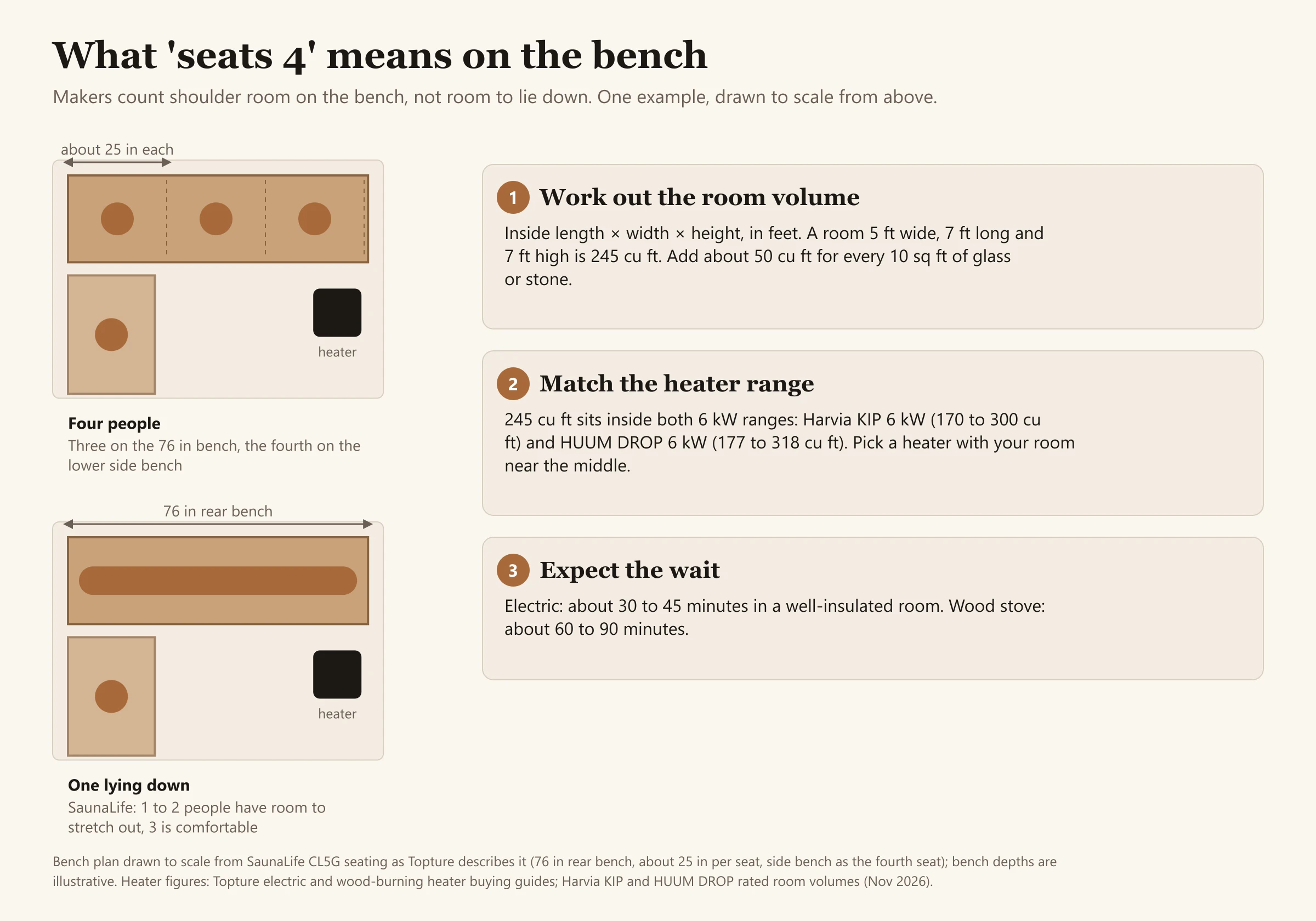
Read the maker’s bench drawing. In the SaunaLife GL4, both tiers run 54 inches (137 cm) across the room. The upper bench is 23.6 inches (60 cm) deep; the lower one is 12.5 inches (32 cm), a perch for your feet more than a seat.
SaunaLife’s four-person cube seats three on the rear bench at about 25 inches (64 cm) each, and the fourth seat is the side bench down low. The same page calls three comfortable. Published seat counts assume everyone is sitting upright and on good terms.
Michael Kummer, who blogs from Georgia, bought Redwood Outdoors’ six-person barrel for a family of four. His verdict: it “only fits four people comfortably.” His cylinder heater stands on the floor, and he writes, “I wouldn’t want to sit right in front of the heater.” If he ordered again, he would go for an extra-wide barrel with a second level of seating.
Children take up far less than 25 inches (64 cm), so a six-person room swallows a family of five easily. If the real answer is two adults most evenings, a two-person sauna costs thousands less to buy and to heat.
Will the kids actually use it?
Not always at first. Julian, who built his own wood-fired sauna and writes a sauna-building blog, brought his daughter in at seven and his son at three. The first few times the heat was too much for her, and the steam off the stove “freaked her out.”
What both kids liked was the changing room: snacks and cartoons on a TV. What won his daughter over was the cold, getting warm and then going outside to pour cold water on herself. By eight she was taking friends in, and Julian looked through the window to find the girls on the top bench, some lying down, his daughter throwing spoons of water on the stove. His rule for small kids is no more than five minutes at a time in the hot room until you see how they do.
Kummer’s kids are slower converts: they “aren’t big into sauna bathing (yet).”
Bigger rooms help: the lower tier is cooler, and there is somewhere to sit away from the stove. Kits like the GL4 ship a wooden heater guard that goes on once the heater is in place; fit it. In Finland, parents and children bathing together is so ordinary that it does not even count as communal bathing in the ethnographic sense; it is just the family’s sauna evening. Ages and round lengths are on the page for sauna with kids.
Porch, changing room, or just the hot room?
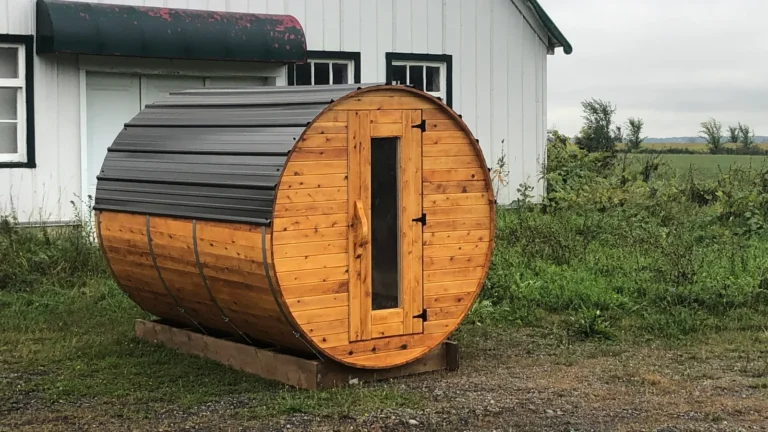
A barrel is the cheapest seat in the yard. The SaunaLife E8 gives six people a 213 cubic foot (6 m³) interior with 6 feet 5 inches (1.96 m) of standing height for $5,990, and you add the heater yourself. The trade-off is the curve: no flat floor, and the walls lean away from your shoulders.
Cabins fix that with a flat floor, full standing height and two-tier benches along two walls. The Georgian comes two ways: an open porch, or a 48-inch (122 cm) enclosed changing room on an 8 by 12 foot (2.4 by 3.7 m) footprint for $10,099.
With guests and kids, that second room is what makes the sauna usable: clothes stay dry, people cool down out of the wind, and the hot room’s door is not also the door to the yard. It is also where Julian’s kids camped out with their cartoons. A porch does part of the job. Kummer only got one because the version without it was out of stock, and now uses it “every time I get out of the sauna to cool down.”
The SaunaLife G11 goes further, pairing an eight-person barrel room with a changing room of the same size and a covered porch. A porch is also where a cold plunge ends up sitting.
How long will everyone wait for the heat?
Jeff Waldman and Molly keep a standing Wednesday sauna night: friends know the sauna will be hot, and on any given week “a friend, or two, or ten” may show up. Theirs is wood-fired; they do a few 15-minute rounds and cool off in the yard.
On electric, Kummer heats his barrel for about 45 minutes before he gets in. It runs a 9 kW Harvia Cilindro, and his electrician put in a 50-amp breaker box for it.
To size your own, work out the room volume: length by width by height. A room 5 by 7 feet (1.5 by 2.1 m) with a 7-foot (2.1 m) ceiling is 245 cubic feet (6.9 m³), which needs a 6 kW heater.
Rooms for four to six people usually need a step up: Dundalk recommends 9 kW for the Georgian, and True North pairs the Pod with a 7.5 kW DROP.
Glass costs capacity. Add about 50 cubic feet (1.4 m³) for every 10 square feet (0.9 m²) of glass or stone. A glass door in a January wind is a lovely thing to look through and a heater’s least favorite feature.
An electric heater needs its own 240 V circuit from the main panel, put in by a licensed electrician. The HUUM DROP 9 kW calls for a 50-amp breaker. Get the heater sizing right before you pick a cabin.
Six worth a look
| Model | Seats | Size | Heater | Price |
|---|---|---|---|---|
| SaunaLife E8 barrel | up to 6 | 213 cu ft (6 m³) interior, 6’5″ (1.96 m) height | None included; electric or wood | $5,990 to $7,190 + $950 freight |
| SaunaLife GL4 cabin, porch | up to 4 | 58.9″ x 79.5″ (150 x 202 cm) | Packages: Harvia KIP 8 kW, HUUM HIVE Mini 6 kW (240 V, 25 A), Saunum Air 7 | $9,490 to $9,690 + $950 freight |
| True North Pod | 4 to 8 (retailer’s rating) | 8, 9 or 10 ft (2.4, 2.7 or 3 m) lengths | HUUM DROP 7.5 kW, or a Harvia M3 wood kit | $9,604 to $13,624, free delivery |
| Dundalk Georgian w/ Changeroom | 5 to 6 plus changing room | 8′ x 12′ (2.4 x 3.7 m) | 9 kW electric or wood, sold separately | $10,099 |
| SaunaLife GL6 cabin, porch | up to 6 | 90.2″ x 90.2″ (229 x 229 cm) | None included; 240 V | $12,790 to $12,990 + $950 freight |
| SaunaLife G11 two-room barrel | up to 8 | Sauna room, equal-size changing room, covered porch | Harvia Cilindro 9 kW package | $14,990 natural, $15,190 black, + $1,990 freight |
Topture’s listed prices, checked November 2026; the G11 figure is the retailer’s listing and moves with the finish.
What it costs all in
Topture’s 2026 estimate for a four to six person cabin or pod with heater, outdoor electrical and a proper base is $10,000 to $14,000 all in, and $15,000 to $25,000 at the top end. The sauna itself is about two thirds of that.
| Item | Typical cost |
|---|---|
| Freight | $950 for standard SaunaLife models; $1,990 for large or pre-assembled ones |
| Pad | $300 to $800 for gravel you lay yourself; $800 to $2,500 for a concrete slab |
| 240 V circuit | $450 to $900 with the panel in the same building; $1,500 to $3,800 or more for a run of 25 to 75 feet (8 to 23 m), with trenching and conduit at $15 to $40 per foot |
| Crew to place and unbox | $300 to $800 |
Delivery day and the build
Kits come by freight, and on big crates you arrange the offload yourself, with a long-fork forklift, a tilt tow truck or a crane. Kummer’s courier left an 800-pound (363 kg) box at the end of the driveway and would not help. With no pallet jack, the family opened the crate and hauled the pieces with a lawn tractor, then built it together, kids included, in “a couple of hours.”
The blogger behind Deuce Cities Henhouse put a six-person barrel kit at the family’s northwoods cabin. The road there is rural, so the crate was unloaded piece by piece onto a trailer at a highway intersection. The blogger’s 12-year-old, Finn, did most of the stave install. The build took about four days, and the electrician took about three weeks to show up.
Look at the view before the pad goes in: Kummer’s panorama window faces a brick wall, which he calls “a bummer.” The Deuce Cities family used the wait for the electrician to add step lights along the walkway.
Winters, summers, and the base underneath
In a cold state, insulation and heater headroom decide whether the sauna gets used in February. A wood-fired stove skips the trench entirely at the cost of 60 to 90 minutes of heat-up. In hot, humid places, put it in shade and keep the vents working so the wood dries out between sessions.
The base is where people lose money. Anything set on bare lawn sinks unevenly as the ground settles, freezes and thaws: barrel stave gaps open up, cabin doors fall out of alignment, glass cracks. Topture says it has seen $7,000 saunas warped beyond repair inside 18 months.
Gravel is fine under about 1,500 pounds (680 kg) of in-use load, and deeper gravel or pavers carry up to 3,000 pounds (1,360 kg). Above that it is a concrete slab. A full family on the benches counts toward that load. The North American Sauna Society has more on siting.
Do you need a permit?
Probably, and the bigger the sauna the sooner it crosses your town’s size limit for an accessory structure. Ask your building department whether running power to it needs its own permit. HOA review and setback rules come on top, so read the covenants before you choose a model. The rules are local, and the limit that matters is yours.
Common questions
How big is a 4-person outdoor sauna?
Smaller than the number suggests. The SaunaLife GL4 is roughly 58.9 by 79.5 inches (150 by 202 cm) outside, with two tiers of bench 54 inches (137 cm) wide: the upper 23.6 inches (60 cm) deep, the lower 12.5 inches (32 cm). That is four adults sitting upright, not four adults reclining.
How many people really fit in a 6-person sauna?
Fewer adults than the label, if everyone wants room. One owner of a six-person barrel, Michael Kummer, writes that his fits four people comfortably, partly because he would not sit right in front of the floor-standing heater. Children take far less bench, so a family of five or six with young kids fits better than six adults.
How much does a 6-person sauna cost?
The barrel route starts at $5,990 for the SaunaLife E8, without a heater. A six-person cabin runs $10,099 for Dundalk’s Georgian with a changing room up to $12,790 for the GL6. Add freight, a base, the electrical run and a heater, and the finished number is usually $10,000 to $14,000.
What size heater does a 6-person sauna need?
Usually 7.5 to 9 kW on 240 V. Work out the interior volume in cubic feet, add about 50 cubic feet (1.4 m³) for every 10 square feet (0.9 m²) of glass or stone, and match that to the heater’s published volume range. Dundalk recommends 9 kW electric for the Georgian.
Is a changing room worth it?
With guests and children, yes. It gives people somewhere to undress and leave clothes dry, somewhere to cool down out of the wind between rounds, and it keeps the hot room’s door off the yard. On the Georgian, the enclosed changing room adds a 48-inch (122 cm) room on an 8 by 12 foot (2.4 by 3.7 m) footprint.
Top photo: Lucjan Morawski, CC BY-SA 3.0, via Wikimedia Commons. Diagrams: Heat and Birch, from the makers’ own figures.