Wood-Burning Sauna Stoves: Which One Fits Your Sauna
Some links on this page are affiliate links. If you buy through them, I earn a small commission at no extra cost to you. As an Amazon Associate I earn from qualifying purchases.
You are building or buying a sauna at home in the US, and you want to know whether a wood stove is worth the trouble, and if so which one. I am Finnish. I grew up with a wood-fired sauna, and every summer cottage I have ever been to has one, so my answer is short: if you can source the wood, use wood. If you live in a big city where firewood is expensive or a hassle, or there is no chimney, then you can’t, and electric is the right call. The shortlist and the sizing advice below come from a lifetime of using them. The American part, inspectors, listing and chimney kits, is something I have no idea about, so there I stick to what the makers and the codes say.
At a glance
- Size first: measure the hot room in cubic feet and buy a stove whose rated range covers it; 212 to 459 cu ft (6 to 13 m³) fits most home and cabin rooms.
- Only Kuuma has a US listing: the Classic and External Feed are listed to UL 1482, while Harvia, Narvi and Kastor wood stoves carry CE marking only.
- Stove-only budget: $969 for a Harvia M3 up to $4,495 for the largest Kuuma, before chimney, stones, shields and a water tank.
My picks
- Typical home or cabin room: Harvia M3
- Loading from outside the hot room: Harvia M3 SL
- Bigger rooms: Harvia Pro 20
- Large stone load in a small room: HUUM Hive Wood 13
Start with the room, not the stove
If I were putting a stove in my own cottage sauna tomorrow, the first things I would check are the sizing advice, how much stone the stove takes, by weight, and the plain dimensions, so it physically fits. Bigger is definitely not better. A stove too big for the room takes too long to heat, or the heat is simply too much in a small sauna.
Every maker rates its stoves by hot-room volume, so measure the inside of the hot room in feet, length by width by height, and multiply. The ratings assume an insulated room; a drafty cabin or a wall of glass wants a bigger stove than the table says. Wood against electric is a separate decision, covered in how to choose a sauna heater.
| Stove | Rated room volume | Stone load | US price |
|---|---|---|---|
| Harvia M3 | 212 to 459 cu ft (6 to 13 m³) | 66 lb (30 kg) | $969 |
| Harvia M3 SL (through-wall) | 212 to 459 cu ft (6 to 13 m³) | 66 lb (30 kg) | $1,416 |
| HUUM Hive Wood 13 | 212 to 459 cu ft (6 to 13 m³) | 198 lb (90 kg), included | see Amazon |
| Harvia Pro 20 | 283 to 706 cu ft (8 to 20 m³) | 88 lb (40 kg) | $1,559 |
| Harvia Legend 240 | 353 to 848 cu ft (10 to 24 m³) | 440 lb (200 kg) | $1,765 |
| Narvi NC 24 | 353 to 847 cu ft (10 to 24 m³) | 180 lb (80 kg) | $1,795 to $2,295 (NC range, US dealer) |
| Kuuma Classic (Small, Medium, Large) | 336 to 1,000 cu ft (9.5 to 28 m³) | 80 to 140 lb (36 to 64 kg) | $2,395 to $2,795 |
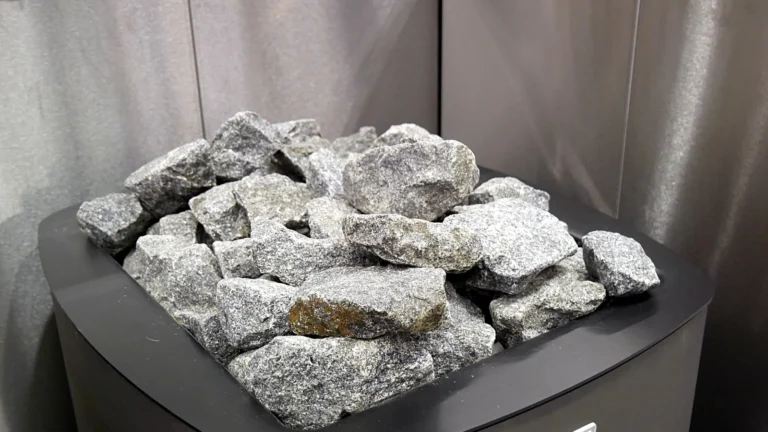
US retail prices as of October 2026, stove only. All of these take rounded stones of 4 to 6 in (10 to 15 cm), and the sauna stones you load decide how the room holds steam.
The stoves worth shortlisting
Harvia is the famous name here, and in my experience it is famous for a reason. HUUM makes the most stylish stoves of the lot. Past that, I sort them by fit, stone load and, in the US, the listing question.
Harvia M3: the compact entry point for a small room
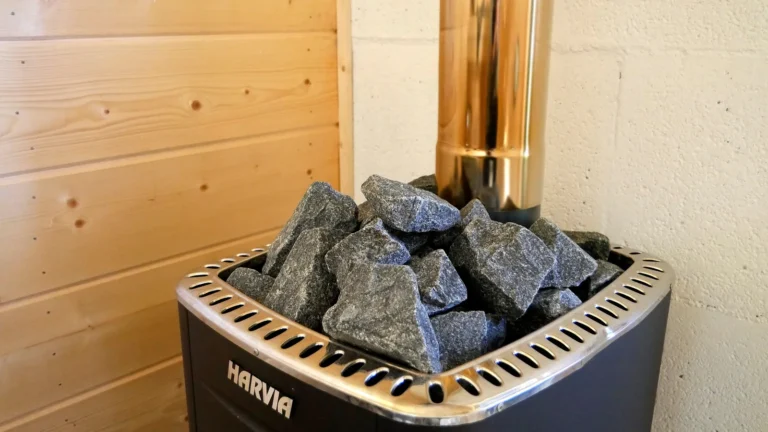
The M3 is the plain answer for a small room: compact and the cheapest stove here. Harvia puts it at 16.5 kW for 212 to 459 cu ft (6 to 13 m³), with 66 lb (30 kg) of stones, a glass door and a 4.5 in (115 mm) flue from the back or top. It loads from inside the hot room; full specs are on Harvia’s US site.
Harvia Pro 20: a step up in room size
The Pro 20 is for when the M3’s range runs out: 24.1 kW for 283 to 706 cu ft (8 to 20 m³), with 88 lb (40 kg) of stones and a ceiling of at least 82 in (2,090 mm).
Harvia Legend 240: a lot of stone
The Legend 240 is 21 kW for 353 to 848 cu ft (10 to 24 m³), but the number that matters is the stone load: a steel frame carrying 440 lb (200 kg), more than six times the M3’s. Let the fire die down and the room stays usable, so the evening goes on after the last log. It is the stove for the stones-first camp I belong to, if you accept the longer wait.
Kuuma: made in Minnesota, and listed
Kuuma stoves come from Lamppa Manufacturing in Tower, Minnesota, and they are the odd one out twice over: American, and listed (more below). The name is Finnish for “hot”, which most of their buyers will never know. Three lines: the Classic, the shorter Low Profile and the BluFlame, which burns the wood gases a second time, at $2,395 to $4,495 for the stove alone. Every Kuuma has a 6 in (150 mm) flue collar, so it fits US chimney parts without an adapter, and Kuuma says a well-insulated room is ready in 45 to 60 minutes with the Classic. Details are on the Kuuma stove pages.
Narvi NC 24: the biggest of the NC family
Narvi’s NC 24, from the other Finnish maker here, covers 353 to 847 cu ft (10 to 24 m³) with 180 lb (80 kg) of stones and a 4.7 in (119 mm) flue, loaded from inside the room. Narvi’s listed North American dealer sells the NC range for $1,795 to $2,295; get a quote that includes freight. Specs and the manual are on the Narvi NC page.
HUUM Hive Wood 13: stone mass in a small footprint
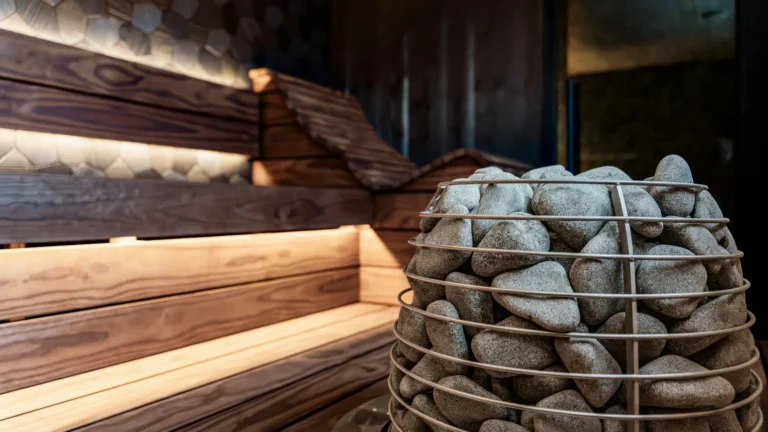
The Estonian-made Hive Wood 13 from HUUM is an open stone-cage stove rated for the same 212 to 459 cu ft (6 to 13 m³) as the M3, and it ships with 198 lb (90 kg) of rounded olivine stones, three times the M3’s load: a big exposed stone surface, and softer steam, in a stove sized for an ordinary room. It is also the best-looking stove here.
Loading from inside or through the wall
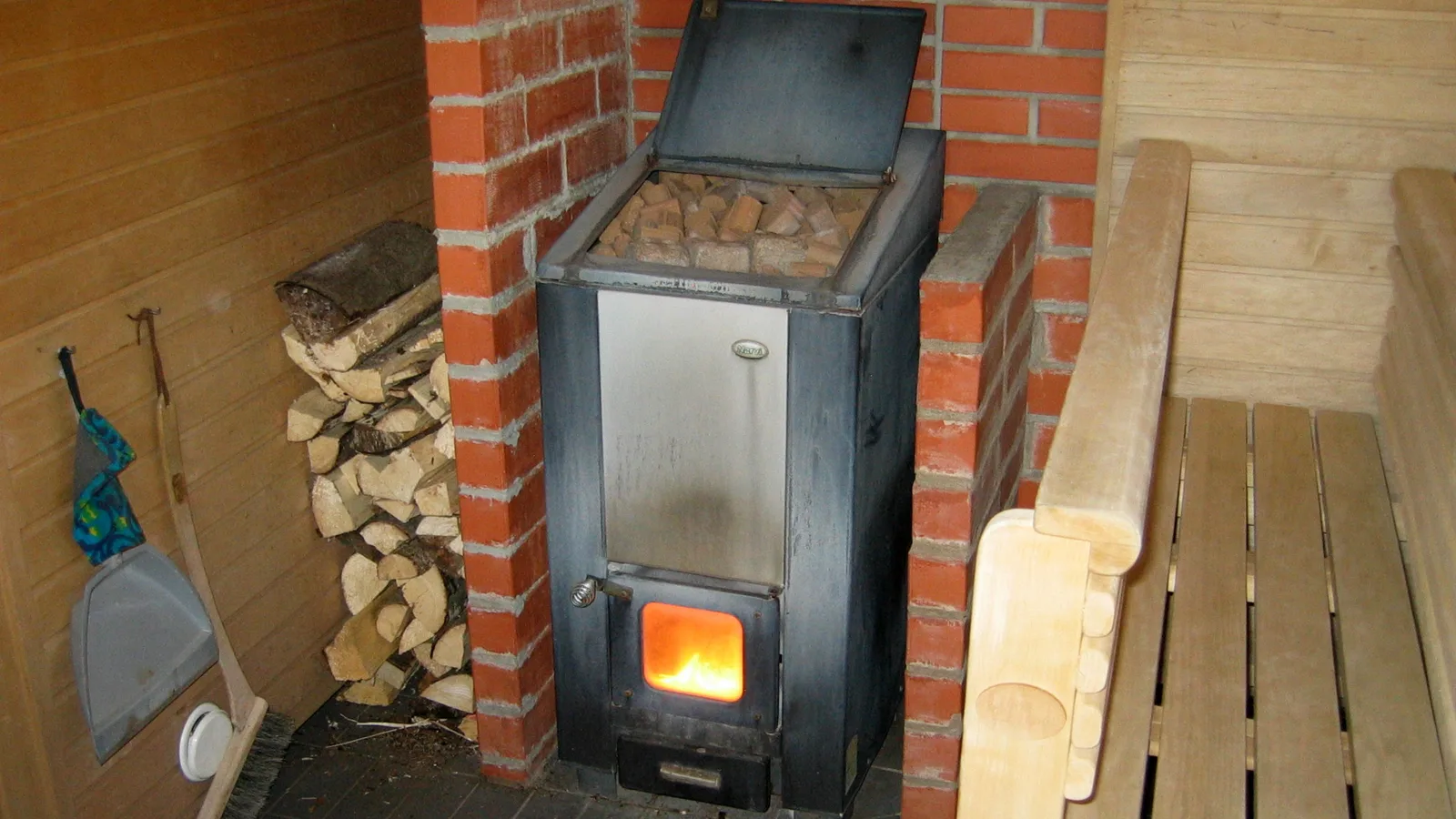
An inside-feed stove opens into the hot room, so you lay the fire from the bench. For me that is half the pleasure of a wood sauna: sorting the small pieces from the big ones, setting up the kindling, watching it catch. Then you come back two or three times over the next 30 to 50 minutes to add wood, and you know it is ready when you walk in and it feels ready, or the thermometer says so.
One thing I look at that spec sheets skip: the door. I want the hatch easy to open, and the handle not to get so hot that you need a piece of wood to open it, which is how the older stoves at Finnish cottages work.
A through-wall stove has an extended firebox that passes through the wall, so you feed it from the changing room or outdoors and the mess stays out there. The Harvia M3 SL is the small-room version; Kuuma’s External Feed is the Classic with an 8 in (20 cm) or 12 in (200 or 300 mm) throat extension. Kuuma is blunt about the trade-off: roughly 25% of the usable heat ends up outside the sauna room, and the arrangement adds about $1,000 to building costs. Clean floor or faster sauna: pick one.
The listing question your inspector will ask
This is the codes and the makers talking, not me. Only the Classic Kuuma and the Kuuma External Feed are listed to UL 1482, the standard for solid-fuel room heaters, with a serialized label on each stove. Kuuma’s Low Profile and BluFlame are not listed. Harvia, Narvi and Kastor wood stoves carry CE marking, a real certification, just not an American one.
That matters because the US model codes require solid-fuel room heaters to be listed, labeled and installed per their listing, while the sauna-heater section points to UL 875, an electric-heater standard. Wood sauna stoves fall into the gap, and your local building official decides what happens in the gap. Some wave a CE stove through. Some do not. None of them enjoys being asked after the stove has arrived.
Clearances, floor protection and chimney
Clearances vary far more between brands than the stoves do. Harvia’s M3 needs 47 in (1,200 mm) to a combustible ceiling and 10 to 12 in (250 to 300 mm) at the sides, back and front. Kuuma’s listed Classic needs 48 in (1,220 mm) in front of the loading door and 38 in (965 mm) at the sides unshielded, far less with shields. Use the manual for the exact stove you buy, not this table.
Floors need the same care: a concrete slab with no pipes or wires beneath, or a non-combustible base over tile and wood, since tile adhesive and waterproofing are not heat-resistant, plus a sheet-metal apron around the stove sized by the manual.
Chimney: the US standard is a 6 in (150 mm) insulated Class A chimney listed to UL 103 HT, following the 3-2-10 rule, at least 3 ft (0.9 m) above the roof and 2 ft (0.6 m) above anything within 10 ft (3 m). More in the sauna chimney requirements guide.
Hot water from the stove
No hot water means someone carries buckets. Every maker here sells a tank that bolts to the stove or wraps the flue, so order it with the stove. Fill it before you light the fire, keep it at least half full while the stove burns, and drain it before frost.
Running it safely
My strongest sauna memory is a burn. I was about 10, everyone had left the sauna and it was cooling down, and we were playing hide and seek. I ran in, fell, and put my palm flat on the stones. A decent burn, no lasting mark, and a rule I still repeat: kids do not run in a sauna, even one that is “off”. The stones stay dangerous long after the fire does.
The rest of this list comes from the manuals.
- Burn dry, natural firewood only. Narvi wants moisture below 20%; Kuuma says season it at least a year.
- Never use gasoline, kerosene or lighter fluid, and never burn painted or treated wood, chipboard, plastic, pellets, coal or garbage.
- Keep the firebox door closed while the fire burns.
- Do not overfire: the stove and pipe must never glow red, and Narvi says no more than three hours of continuous heating.
- Run the first burn outdoors to cure the paint, before the stove goes into the room.
- Empty ashes into a lidded metal container on a non-combustible surface.
- The stove needs combustion air, so never install one in an air-tight room. Vent placement is covered in the sauna ventilation guide.
- In a chimney fire, close the firebox door and the air control and call the fire department.
FAQ
What size wood-burning sauna stove do I need?
Multiply the hot room’s interior length, width and height in feet and match that figure to the maker’s rated range. A 6 by 7 ft (1.8 by 2.1 m) room with a 7 ft (2.1 m) ceiling is 294 cu ft (8.3 m³), inside the Harvia M3’s 212 to 459 cu ft (6 to 13 m³) band.
Do wood sauna stoves need to be UL listed?
Your local building official decides. The model codes require listed solid-fuel heaters, and among the stoves here only the Kuuma Classic and External Feed carry a UL 1482 listing. Ask about the specific model before buying, not after.
Can I load a sauna stove from outside the sauna?
Yes, with a through-wall model such as the Harvia M3 SL or the Kuuma External Feed. Kuuma requires the extension to be surrounded by at least 16 in (400 mm) of non-combustible material.
Hero photo: Riisipuuro, CC BY-SA 3.0, via Wikimedia Commons