A Sauna in an Apartment: What Is Allowed and What Works
Some links on this page are affiliate links. If you buy through them, I earn a small commission at no extra cost to you. As an Amazon Associate I earn from qualifying purchases.
The lease is open in one tab and a sauna blanket ad in the other, and the only free floor is the corner by the window. People in this spot usually price a cabin, read the word “electrician” and give up. You can have a sauna in an apartment, as long as it runs on a normal outlet and makes no steam, which in practice means infrared. After that, the choice comes down to where it lives between sessions and whether it makes it up the stairs.
At a glance
- Short answer: yes, if it runs on a standard outlet and makes no steam, which in practice means infrared.
- Smallest to biggest: a blanket at $699, a pop-up tent around $200 to 400, a one-person cabin at $2,798 to 4,695.
- Clear first: written permission from the landlord or HOA on electrical load, moisture, floor weight and insurance.
My picks
- Smallest footprint, folds away: HigherDOSE infrared sauna blanket
- A cabin on a normal outlet: SunRay Sedona 1 to 2 person
- Full-spectrum, 120 V plug: Finnmark FD-1
What your lease and your outlet allow
First, the lease or the HOA. Anything bolted, wired or vented changes the building, and that needs the owner’s written consent. Second, the outlet. A standard 120-volt circuit rules out the 240-volt heater a traditional sauna room wants, and installing one means new wiring by a licensed electrician plus the owner’s approval.
Third, moisture: throwing water on stones in a room with no real exhaust path is how you get damage and complaints. A wood-burning stove is out of the question: it needs a chimney and clearances no apartment has. What is left is dry, plug-in infrared: a sauna blanket, a tent, or a small cabin.
Blanket, tent or cabin: what each asks of your place
| Type | Floor space | Power | Heat | Setup and storage | Price |
|---|---|---|---|---|---|
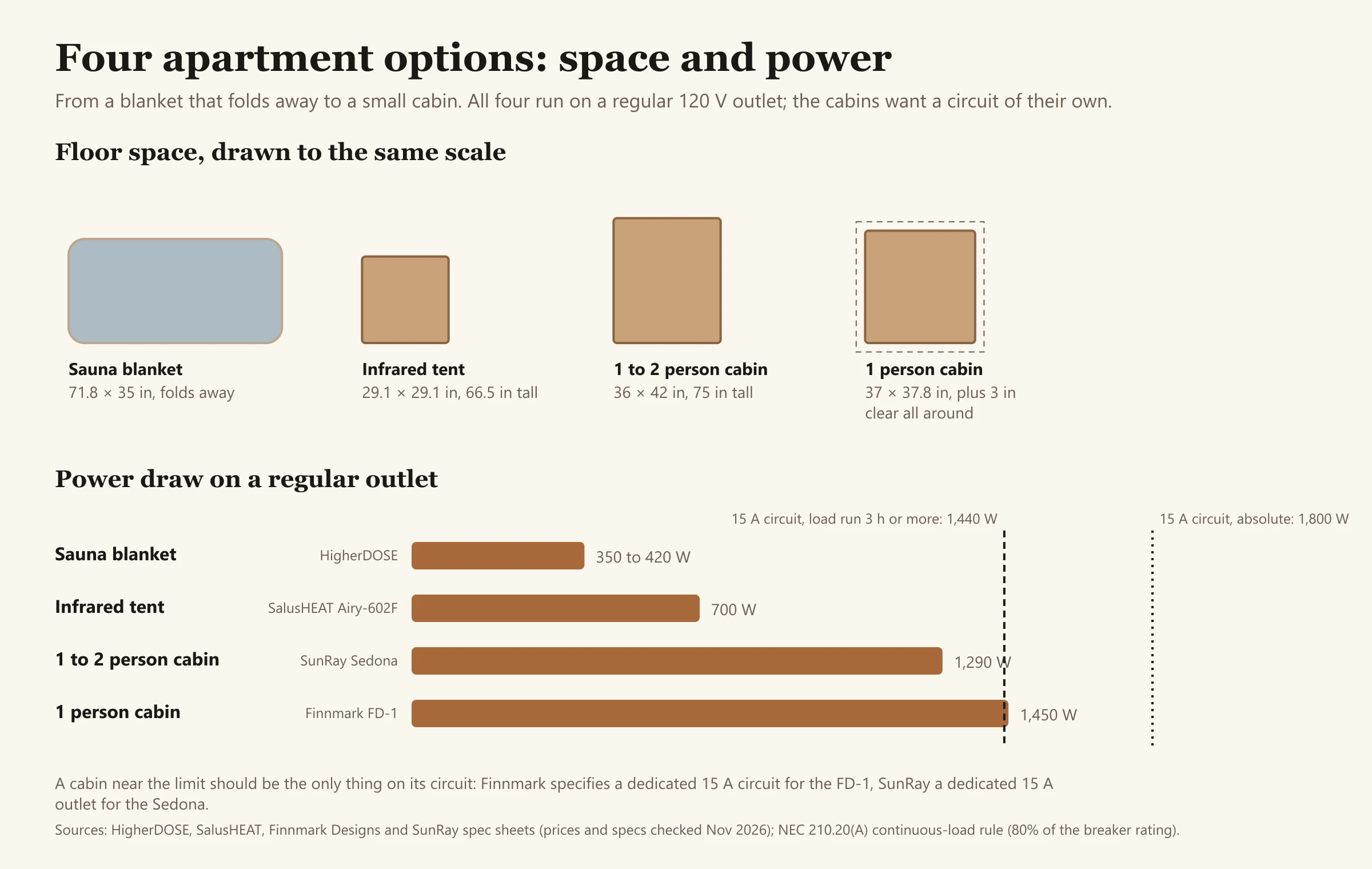
| Sauna blanket | None fixed; 71.8″ × 35″ (182 × 89 cm) unfolded | 120 V, 350 to 420 W, 4 to 5 A | Far infrared on your body, dry | Unfolds on a bed or mat, folds flat; one-hour timer | $699 |
| Portable infrared tent | About 29″ × 29″ (74 × 74 cm), 66.5″ (169 cm) tall | 120 V / 15 A, 700 W | Four far-infrared panels plus a foot pad, 131 to 149°F (55 to 65°C) in warm months | Pop-up frame, zip entry, folds down | About $200 to 400 |
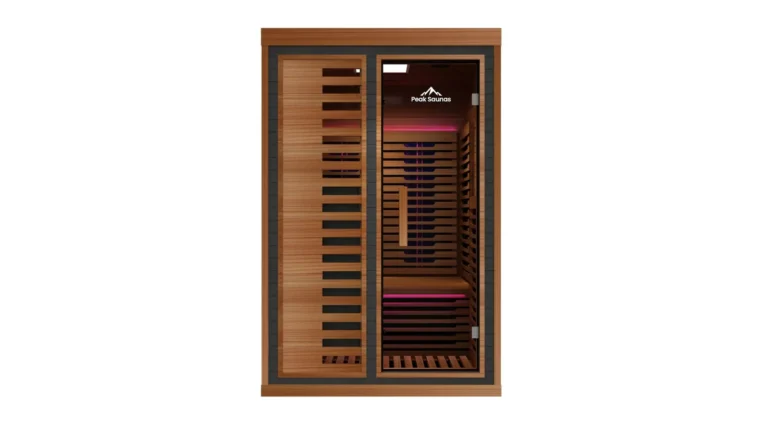
| One-person cabin, models compared on the one-person sauna page | 36 to 38″ (91 to 97 cm) wide, 38 to 42″ (97 to 107 cm) deep, 75 to 78″ (191 to 198 cm) tall, plus 3″ (8 cm) clear on all sides and above | 120 V, dedicated 15 A, 1,290 to 1,450 W | Infrared, dry, up to 140 to 170°F (60 to 77°C) | Assembled and stays put; about 300 lb (135 kg) | $2,798 to 4,695 |
| Small traditional room on 120 V | A closet-sized built room with a vapor barrier and vents | 120 V limits the heater badly; most need 240 V | Stones, real steam | Construction, not a purchase; needs the owner’s consent | Varies |
Specs and prices are the makers’ own, checked November 2026; the tent figure is typical street pricing rather than one maker’s list. For most renters the honest choice is the blanket or the cabin. A blanket heats you and not the room, and nobody downstairs knows it exists. A cabin heats a space you sit in, which feels far more like a sauna. The SunRay Sedona is $2,798 and the full-spectrum Finnmark FD-1 is $4,695.
Will you still use it in a month?
That is the fair question about anything that folds away. Carleigh Ferrante, a commerce editor at mindbodygreen, has used her HigherDOSE blanket at least three times a week for two years, in the evening once work is done.
Tim Steward, who writes the home-gym blog GymCrafter, bought a pop-up infrared tent on his doctor’s recommendation. He reviewed it after almost nine months of thirty minutes a day, five days a week.
Mia Maguire reviewed a one-person cabin for The Daily Beast from her one-bedroom walk-up and used it almost daily for a month. Ferrante lays the blanket straight on her wood floor, and Maguire switches the cabin on 10 to 15 minutes before she gets in.
Where does it live between sessions?
A blanket takes the most floor while you are in it and the least afterwards. Ferrante’s complaint: “storage is limited in my New York City apartment,” and she wishes the HigherDOSE came with a zip-up bag, as the other blankets she has tested do. Let it cool before you fold it: she finds that takes about 30 minutes.
Samantha Holender, testing blankets for Marie Claire from a 700-square-foot (65 m²) New York apartment, found one of the bigger ones “almost too generously sized for my small apartment.”
A tent folds down too; Steward lists that among its pros. A cabin does not move. Maguire’s living room already held a treadmill, a vibration plate and red light panels, so before ordering she measured, re-measured and reconsidered. The cabin now has a permanent spot, and she admits the room no longer looks like her Pinterest board.
Will it get up the stairs?
A blanket arrives, in Ferrante’s words, in “a fairly compact box, considering its size.” A cabin is freight. Maguire, in a walk-up, warns that you may need to “call in reinforcements just to get the box inside,” and she brought in a helper for the assembly, which took about 25 minutes. The glass door, she adds, is heavy.
What to ask your landlord or HOA before you buy
Ask before the box ships, and get the answer in writing. Rules differ by lease, building and state, so this is a conversation, not a lookup.
- Electrical load: may you use a dedicated 15-amp circuit, and does one already exist in that room?
- Moisture and ventilation: is any steam-producing unit allowed at all, and is the room’s exhaust fan vented outside?
- Floor weight: a cabin of about 300 lb (136 kg) plus a person sits on a footprint of roughly 38 by 38 inches (97 by 97 cm).
- Insurance: whether a plug-in heating appliance affects your renter’s policy or the building’s.
Will it trip the breaker?
A US 15-amp, 120-volt outlet gives 1,800 watts on paper, but the National Electrical Code limits anything running three hours or more to 1,440 watts. That is the whole reason apartment saunas are infrared.
The Finnmark cabin draws 1,450 watts and its spec asks for a dedicated circuit, not the outlet your TV shares. A blanket at 350 to 420 watts is a non-issue. For heating an actual room this way, see what a wall outlet can heat.
Sweat, smell and the neighbor’s ceiling
Dry heat is why infrared works in a rented apartment: no water, no steam heading into the drywall and your neighbor’s ceiling. Finnmark’s manual runs the risk the other way and tells owners to keep the cabin in a dry area, because moisture damages the wood.
The water you do bring is your own sweat. Steward wipes his tent down after every session, because skipping it leads to “a smelly sauna that you stop using.” Ferrante would rather toss a cotton insert in the wash than sop up the blanket after each use.
Steam is another matter. It needs real air movement: for a sauna room with a built-in heater, Harvia specifies six complete air changes an hour. A bathroom fan on a timer is not that, and a converted closet never is.
Can it go on the balcony?
Usually not. Weather alone disqualifies most cabins, since their manuals want a dry location, and balcony load limits are set per building: the residential code floor is 40 pounds per square foot (195 kg per m²) for houses, while apartment balconies are engineered under the commercial code and amended state by state. Ask the building management what your balcony is rated for and what they allow out there.
Is infrared the same as a Finnish sauna?
No. An infrared cabin warms your body with radiant panels and stays dry. A Finnish sauna is a hotter room with a stone-topped heater and water thrown on the stones, which gives you löyly (the burst of steam that hits when water meets hot stones).
Steward is candid about his tent: the highest he has been able to get it is 130°F (54°C), and the first con on his list is that it “doesn’t get as hot as a traditional sauna.” He uses it anyway. Infrared is pleasant, and it is not löyly, so know which one you are buying. The long version is in infrared or traditional sauna.
Common questions
Can you have a sauna in an apartment?
Usually yes, as long as it is a dry, plug-in unit: a blanket, a pop-up tent or a small infrared cabin. A built room with a stone heater needs new wiring and ventilation, which means the owner’s written consent.
Can a sauna plug into a regular outlet?
Infrared units can. Blankets draw 350 to 420 watts, tents about 700, and one-person cabins 1,290 to 1,450 watts on a dedicated 15-amp, 120-volt circuit. Traditional electric heaters generally need 240 volts and an electrician.
Do I need my landlord’s permission for a sauna?
For anything wired, bolted or vented, yes, and you want it in writing. A freestanding appliance on an existing outlet is a grayer area that still depends on your lease and HOA rules, so ask first.
Where do you store a sauna blanket in a small apartment?
It folds flat once it has cooled, which one long-term owner finds takes about 30 minutes. Check whether yours comes with a zip-up bag; the HigherDOSE does not, and its owner in a New York apartment wishes it did.
Can you put a sauna on a balcony?
Rarely. Cabin manuals call for a dry location, and balcony load ratings and building rules are specific to each building. Ask management what the balcony is rated for before you shop.
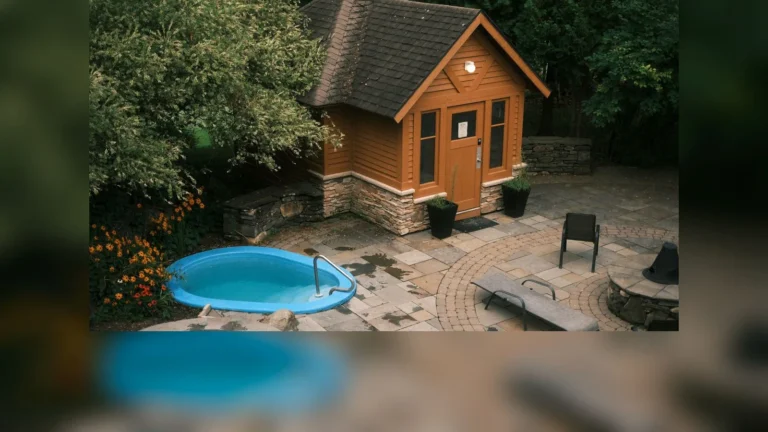
Top photo: Arto J, CC BY-SA 3.0, via Wikimedia Commons. Diagrams: Heat and Birch, from the makers’ own figures.