One-Person Saunas: The Smallest Real Sauna for Home
Some links on this page are affiliate links. If you buy through them, I earn a small commission at no extra cost to you. As an Amazon Associate I earn from qualifying purchases.
You sauna alone, after a workout at the gym or not at all since you stopped going, and the spot you have in mind is a corner, a deep closet or the basement. You do not need a four-person room. You need something that fits that corner and still feels like a sauna, not a phone booth with a heater. A one-person cabin is roughly 3 feet (91 cm) square and 6.5 feet (2 m) tall, and the smallest ones run off a regular wall outlet. The catch is the heat: at this size, nearly everything sold is infrared.
At a glance
- Size: about 36 to 38 inches (91 to 97 cm) square outside, 65 to 80 inches (165 to 203 cm) tall.
- Power: infrared runs on 120V with its own 15-amp circuit; the one traditional cabin needs 240V, 30 amps.
- Price: $1,399 to $4,695 for the cabins I checked in November 2026.
My picks
- Smallest full-height cabin: Finnmark FD-1
- Cheapest, with room for two: SunRay Sedona 100K
- Only traditional heat at this size: SunRay Aston 200TN
- No room for a cabin at all: HigherDOSE sauna blanket
Will a box this small feel cramped?
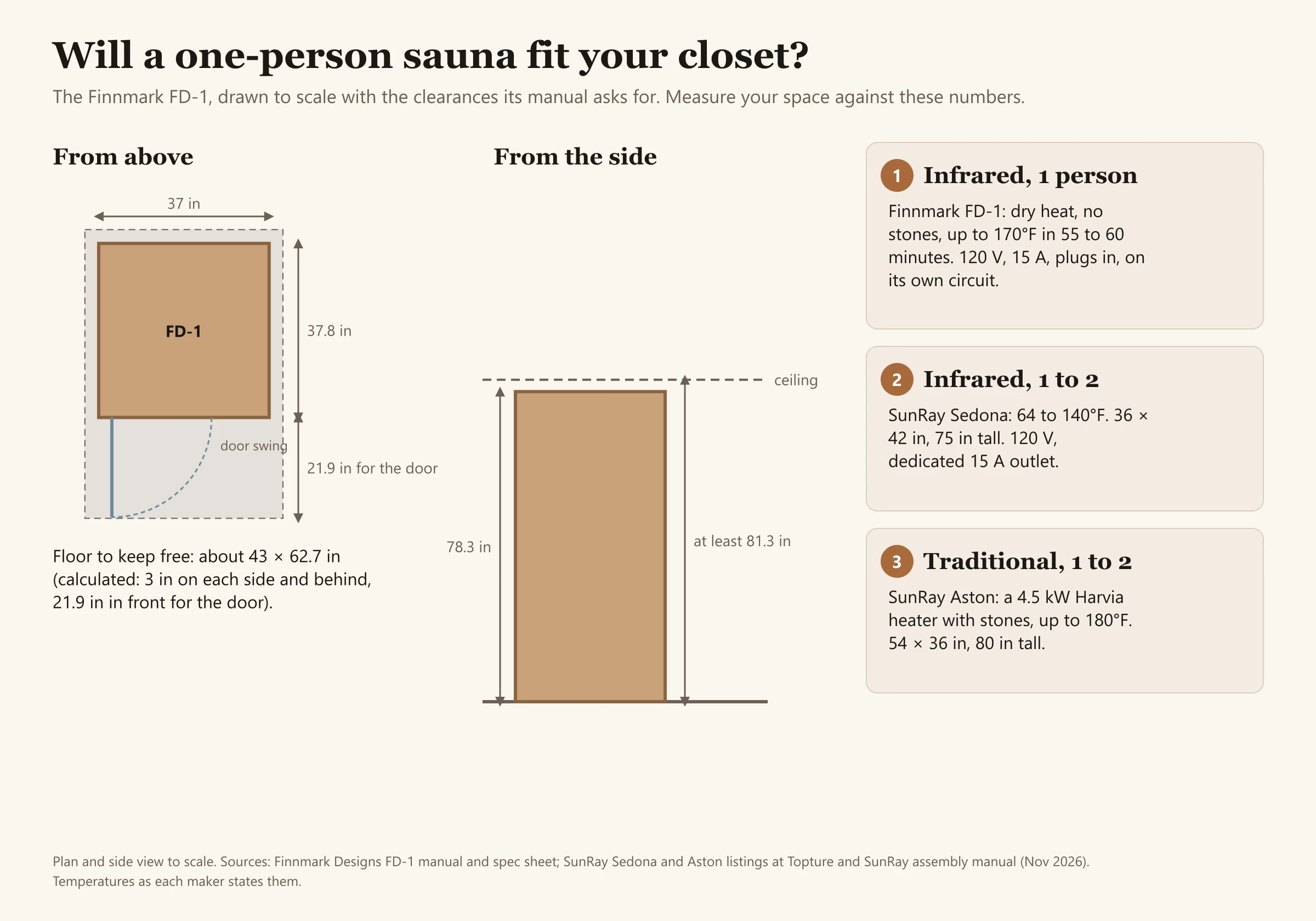
It is smaller than the photos suggest. The Finnmark FD-1 is 37 by 37.8 inches (94 by 96 cm) outside: one bench, one person, knees close.
Inside you get 70.5 inches (179 cm) of headroom and about 46 cubic feet (1.3 m³), worked out from Finnmark’s interior dimensions.
Whether that feels snug depends on you. Mia Maguire, who reviewed a compact one-person cabin for The Daily Beast, is 5 ft 9 in (1.75 m) and “prone to mild claustrophobia in small spaces.” She calls it “cozy” and has felt comfortable in it. Her sister’s boyfriend, at 6 ft 2 in (1.88 m), said he felt “a little cramped.”
The cheapest cabins are smaller still: the Dynamic Sicily is 65 inches (165 cm) tall, so you sit inside and cannot stand. The one traditional cabin in this class is 54 inches (137 cm) wide against the FD-1’s 37 inches (94 cm).
Should you buy one size up?
If anyone else might ever want in, read the seat count one size down. On the TigerDroppings forum, a Mississippi owner of a “2 person (supposedly)” infrared cabin is blunt about it: “Don’t recommend for 2 people, is a tight fit.”
Mikey_Marjabs, posting on the TrainerRoad forum, gives the same advice from the other side: “take one size bigger than how many you plan on being inside.” He and his wife share a three-seater.
If it really is just you, one seat is enough.
Does it get hot enough?
At one person, this is the decision that changes everything. Infrared cabins have no stones and no water. The Finnmark FD-1 tops out at 170°F (77°C); the SunRay Sedona goes to 140°F (60°C). Both plug into a standard outlet. The Mississippi owner says his peaks at 165°F (74°C) “or so,” and that “feels plenty hot to me.”
Only one cabin in this size class gives you real steam. The SunRay Aston carries a 4.5 kW Harvia electric heater with stones, reaches up to 180°F (82°C), and comes with a bucket and ladle. In Finland, a sauna means a stove with stones and water thrown on them, which is what the infrared or traditional choice comes down to. Be realistic about the stone mass at this size: it is enough for a short burst of steam, not a long evening of it.
How long before you can get in?
The Finnmark FD-1 takes 55 to 60 minutes to reach its top heat, so a weeknight session starts with a switch flipped well before you want it. Owners work around the wait in different ways.
Maguire switches hers on 10 to 15 minutes ahead and says five minutes gets it “comfortably toasty.” Kuttermax, on the TrainerRoad forum, turns his on before a training session so it is pre-heated by the time he is done.
DocSavage, on the same thread, gets in early: “Sit for 30 and it hits 130+,” which is 130°F (54°C).
Which one-person saunas are worth a look
| Model | Seats | Outside footprint | Heater | Power | Wood | Price |
|---|---|---|---|---|---|---|
| Finnmark FD-1 (smallest) | 1 | 37″ W x 37.8″ D x 78.3″ H (94 x 96 x 199 cm) | Infrared, 3 Incoloy heaters + 2 carbon panels, 1,450 W | 120V, dedicated 15A (NEMA 5-15) | Thermo-aspen outside, western red cedar inside | $4,695 |
| SunRay Sedona 100K (cheapest infrared) | 1-2 | 36″ W x 42″ D x 75″ H (91 x 107 x 191 cm) | Infrared, 5 carbon nano heaters, 1,290 W | 120V, 15A dedicated outlet | Canadian red cedar | $2,798 |
| SunRay Aston 200TN (only traditional) | 1-2 | 54″ W x 36″ D x 80″ H (137 x 91 x 203 cm) | 4.5 kW Harvia electric with stones | 240V, 30A dedicated circuit | Canadian cedar | $3,796 |
| Dynamic Sicily DYN-1101-01 Elite (seated, cheapest) | 1 | 36″ W x 28″ D x 65″ H (91 x 71 x 165 cm) | Infrared, 4 PureTech carbon panels | 120V; plan for a dedicated 20A circuit | Pacific cedar | $1,399, from $2,999 |
Prices are the retailers’ own, checked November 25, 2026. This is a range, not a ranking: smallest, cheapest, and the only traditional one. If the spot you have in mind is outside rather than in, that is a different shortlist, and two-person outdoor cabins start it.
Where it can go, and who wires it
Finnmark asks for 3 inches (8 cm) of clearance above and around the cabin, so the FD-1 needs a ceiling of 81.3 inches (207 cm). Its cord is about 9 feet (2.7 m) long, so the outlet has to be within reach; if there is no dedicated 15-amp outlet there, an electrician adds one. The seated Sicily, at 65 inches (165 cm), clears most basement ceilings.
Even an infrared cabin can mean a visit. Kuttermax had an electrician put in a new outlet for his basement cabin: “still 110volt but needs a special plug.”
Traditional changes the job. The Aston’s 4,500-watt heater needs a dedicated 240V, 30-amp circuit, the kind an electric dryer uses, put in by a licensed electrician; a full panel may need upgrading before delivery.
On a damp floor the manual wants a moisture barrier underneath, and the door has to be free to open mid-session for fresh air, so not wedged shut in a closet. Renters should read the apartment sauna rules first; below grade, see the basement sauna notes.
Delivery, assembly and the towel on the floor
Cabins come flat-packed, and the last stretch indoors is yours. Kuttermax’s delivery driver left the pallet in his garage; moving the panels to the basement took two people, and he and a neighbor assembled it in one to two hours.
Others were quicker. The Mississippi owner put his together in “less than 15 minutes.” Maguire brought in a helper and was done in about 25 minutes, and warns that the glass door is heavy.
Then there is the sweat, all of it inside a small wooden box. DocSavage keeps “a towel on the seat and floor” to manage it.
Blanket or cabin?
| HigherDOSE blanket | One-person cabin | |
|---|---|---|
| Space | 71″ x 31″ (180 x 79 cm) unfolded, 18 lbs (8 kg), rolls away | Fixed spot, 36 to 38 in. (91 to 97 cm) square, 65 to 80 in. (165 to 203 cm) tall |
| Heat | 350-420 W, nine levels, up to 175°F (79°C), lying down | 140 to 170°F (60 to 77°C) infrared; up to 180°F (82°C) with steam on the traditional model |
| Set-up | About 10 minutes to preheat, no assembly, no new circuit | Flat-packed, two people, about an hour; 240V models need an electrician |
| Price | $699 blanket only, $89 insert, $788 bundled | $1,399-$4,695 |
If you can give up about ten square feet (0.9 m²) of floor permanently, plus the clearance and the door swing around it, take the cabin: you sit upright, you can read, and on the traditional model you can throw water on the stones. If you can’t, the sauna blanket is the honest compromise. The HigherDOSE is $699 for the blanket alone.
Garage Gym Reviews tester Lindsay Scheele liked the experience (“I felt super relaxed and enjoyed using it”) and was cooler on the price. She notes that comparable blankets from Sun Home Saunas, MiHIGH and Reiiv sell for $500 or less, and rates HigherDOSE’s value 3 out of 5.
What it costs to run
At the U.S. residential average of 18.17 cents per kWh (EIA, September 2026), an hour at full draw costs:
| Model | Per hour at full draw |
|---|---|
| Finnmark FD-1 (1,450 W) | About $0.26 |
| SunRay Sedona 100K (1,290 W) | About $0.23 |
| SunRay Aston 200TN (4,500 W) | About $0.82 |
| HigherDOSE blanket (350 to 420 W) | $0.06 to $0.08 |
These are my arithmetic from the makers’ wattages, not published running costs, and your own rate will differ. The Aston’s heater cycles off once it is up to temperature, so a real session draws less.
Common questions
How big is a one-person sauna?
Figure on a square of about 36 to 38 inches (91 to 97 cm) per side. Full-height models stand 75 to 80 inches (191 to 203 cm) tall; the cheapest seated cabins are 65 inches (165 cm), so you sit rather than stand. Inside, the Finnmark FD-1 gives one bench and about 46 cubic feet (1.3 m³).
Should I get a one-person or a two-person sauna?
If you will only ever sauna alone, one seat is enough. If a partner might join you, size up: one owner of a “2 person” infrared cabin calls it a tight fit for two. The SunRay Sedona seats one to two and costs less than the single-seat Finnmark FD-1.
Can a one-person sauna plug into a regular outlet?
An infrared one can: 120V on its own 15-amp circuit, with nothing else drawing from it. The Dynamic Sicily’s paperwork points to a 20-amp circuit, so plan for that. The traditional SunRay Aston cannot: it needs a 240V, 30-amp circuit installed by an electrician.
Is a one-person infrared sauna worth it?
If what you want is a hot, dry, private session at home with no wiring work, yes, allowing for the heat-up: the Finnmark FD-1 takes 55 to 60 minutes to reach 170°F (77°C). If you want steam off hot stones, no infrared cabin will give you that, and at this size you would be choosing the Aston and an electrician instead.
Can you put a sauna in a closet?
Only an infrared cabin, and only if the closet is deep enough to keep 3 inches (8 cm) of air on every side and above, with the door free to swing about 22 inches (56 cm). The outlet must be within the roughly 9-foot (2.7 m) cord reach, and you need to be able to open the door for fresh air.
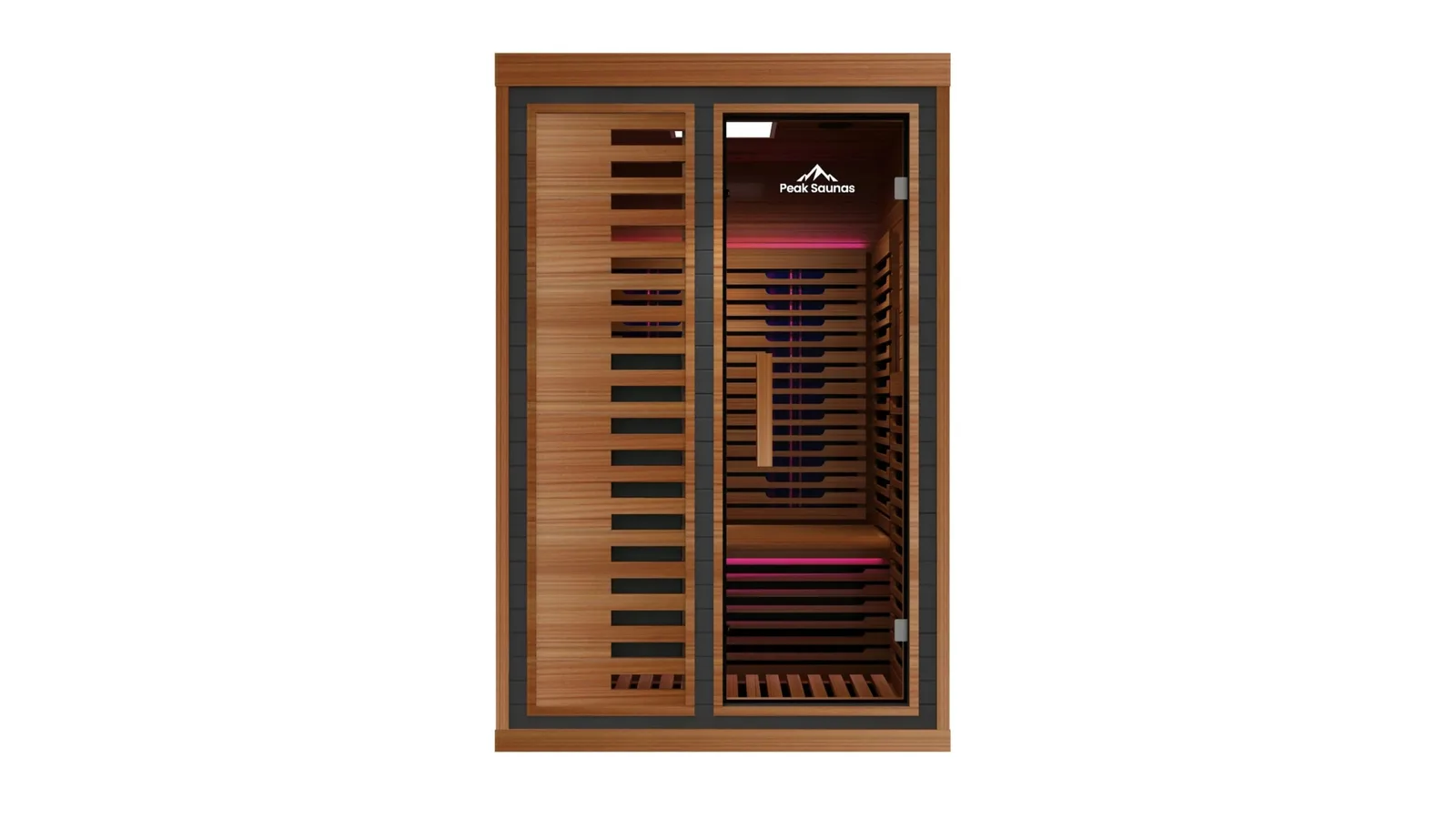
Top photo: Peak Saunas, CC0, via Wikimedia Commons. Diagrams: Heat and Birch, from the makers’ own figures.