Wood-Fired Hot Tubs: How They Work and What to Buy
Some links on this page are affiliate links. If you buy through them, I earn a small commission at no extra cost to you. As an Amazon Associate I earn from qualifying purchases.
You sat in one at a cabin rental: a wooden tub with a stovepipe, a thin line of smoke, no power cord anywhere. Someone else lit the stove, and by the time you climbed in, the water was hot. At home that someone is you, so the question is what an ordinary Tuesday looks like. Figure two hours of heating and $4,000 to $10,000 to buy, for people who would rather tend a fire than a thermostat.
At a glance
- Price: $3,995 for an unbranded cedar tub, up to $10,208 for a Dundalk Starlight with an aluminum interior.
- Heat-up: 90 minutes to about three hours for most tubs, longer in cold weather.
- No thermostat: you steer the temperature with firewood and cold water, and SaunaLife caps its tub at 105°F (41°C).
My picks
- Fastest published heat-up: SaunaLife S4
- Cedar tub with a choice of interior: Dundalk Starlight
Will you still light it on a weeknight?
Stephen O’Grady, whose Maine household already heats with wood in winter, wrote six months after his Goodland arrived that at least one of the family had been in it “nearly every day that it hasn’t rained.” His warning cuts the other way: if you want to get in and out with no work, “this tub isn’t for you.”
Karie Higgins, who rents out her cabin on the Wilson River in Tillamook, Oregon, likes the work itself. Stoking the fire and picking up kindling is, she told Domino, “a lovely ritual.”
The fire can also wear thin. A forum member who posts as fishnaked “used it a ton” for the first two or three winters with his 5 by 3 foot (1.5 by 0.9 m) Snorkel cedar tub. Then use faded: when he wanted a soak most, he least felt like starting and tending a fire for one to two hours.
How a stove heats 300 gallons with no power
Hot water rises. That is the whole engine: water heated at the stove climbs, which pulls cold water in from the bottom of the tub, so the load circulates without a pump. Makers build the stove to exploit it, drawing cooler water through a low channel and pushing heated water back in through an upper one, as SaunaLife describes for the S4.
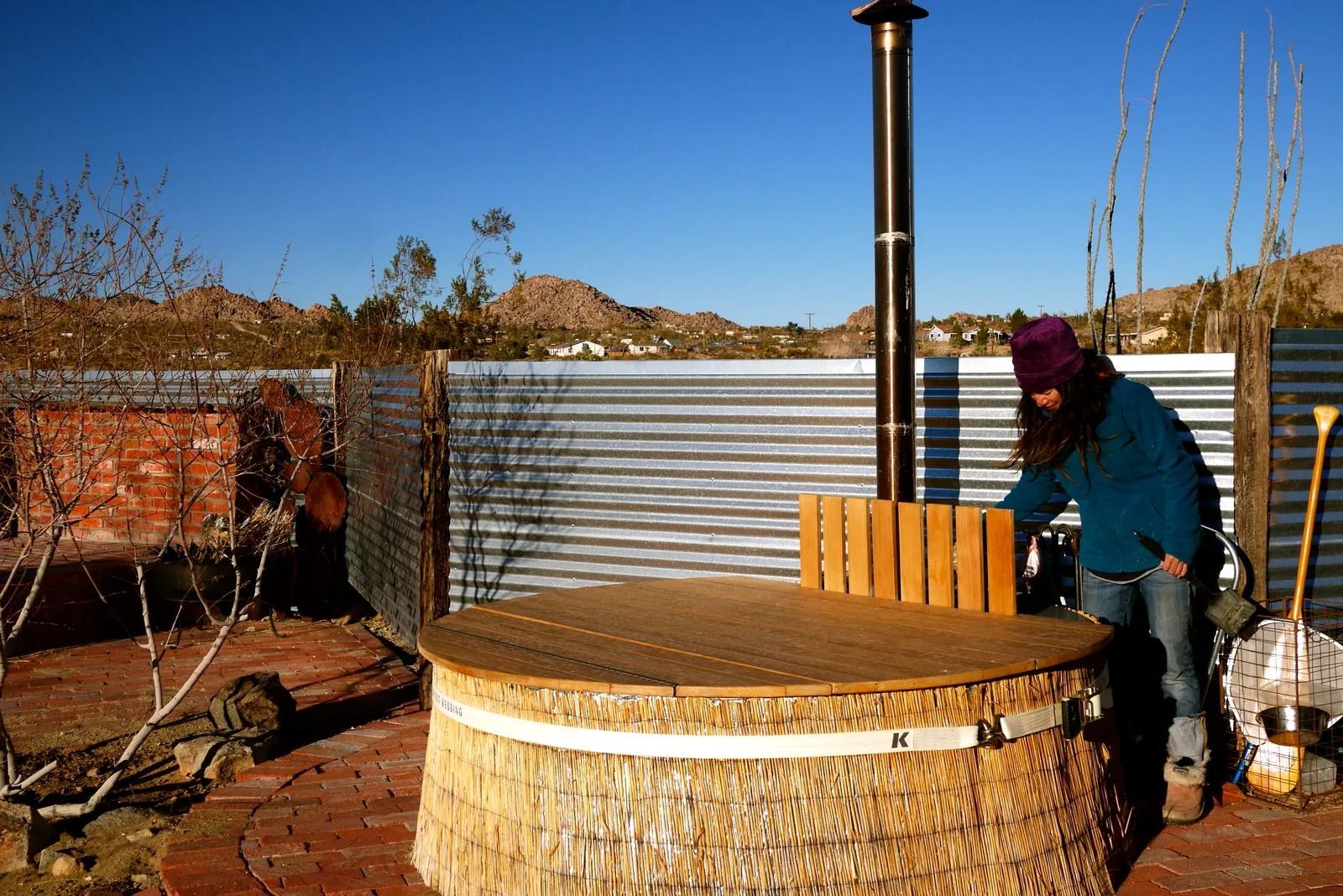
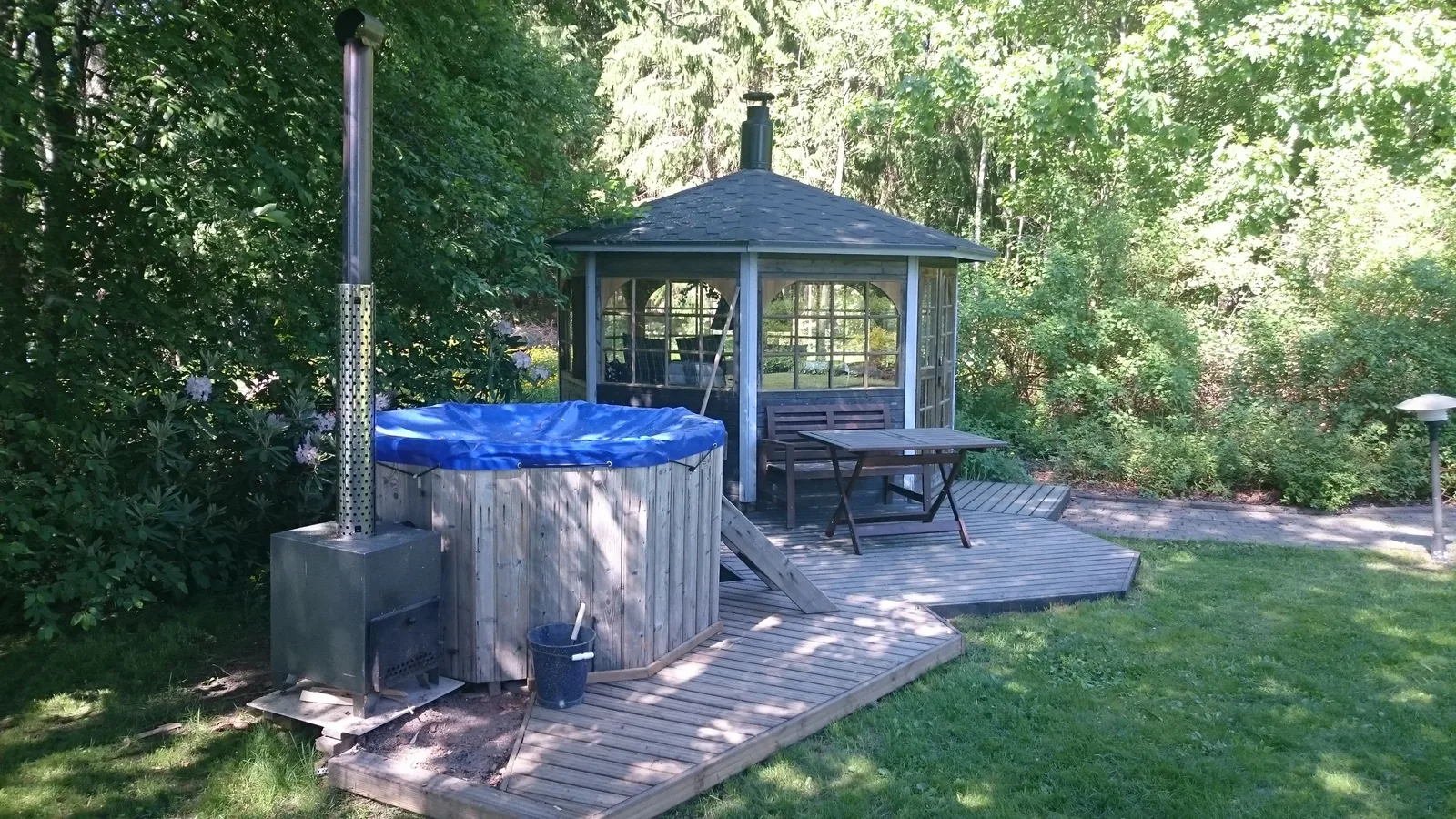
Two layouts. A submerged stove sits inside the shell behind a guard, so it takes its space in the water rather than beside the tub (SaunaLife, AlumiTubs, Goodland). An external stove stands next to the tub and is plumbed in, like the 30 kW marine-grade aluminum heater in Kirami’s Family M package, which keeps the fire and the ash out of the water you sit in.
How long it takes, and what you burn
Volume decides most of it, and the weather decides the rest. The makers’ figures, next to two owners’:
| Tub | Water | Heat-up | Who says |
|---|---|---|---|
| Goodland Original | 190 gal (720 L) | 90 to 120 min | Goodland |
| SaunaLife S4 | 304 gal (1,150 L) | 1.5 to 2 h, 40°F (5°C) to 95°F (35°C) | SaunaLife |
| AlumiTubs small | 315 gal (1,190 L) | About 2 h | AlumiTubs |
| AlumiTubs large | 650 gal (2,460 L) | About 5 h | AlumiTubs |
| Goodland in Maine | About 250 gal (950 L) | About 1.5 h with warmth left from the day before and air at 60°F to 70°F (15 to 21°C); several hours at 30°F to 40°F (around 0 to 5°C) | Owner Stephen O’Grady |
| Snorkel-stove tub at the WildSnow cabin | 400 gal (1,510 L) | Under 3 h, 50°F (10°C) to 100°F (38°C) | Owner Lisa Dawson |
O’Grady’s answer to cold days is timing: he lights the fire in the morning instead of the afternoon, then feeds it until the water nears his target.
None of these owners weighed their wood. O’Grady’s household already handles firewood every day, so for him the tub adds no cost. Cabin Life notes that Wendell and Judy Shiffler’s cedar tub in Fairbanks, Alaska, takes lumber scraps, fallen branches and cut-up pallets. Keep a stack of dry split wood within reach rather than counting on a single load.
What you give up next to an electric spa
There is no thermostat. Temperature control is one more log or a bucket of cold water, and SaunaLife’s own guide says to heat the water to a recommended maximum of 105°F (41°C).
And a stove makes smoke. US wood-burning rules are local, so check your town’s ordinance and your fire department before you buy, since many places require a permit and many prohibit smoke that becomes a nuisance to neighbors, as the EPA notes. If you are choosing between the two rather than pairing them, that is a separate question: see sauna or hot tub.
Keeping the water clean without a filter
Pick a rhythm, and let your water supply set it. With a variety of bathers using hers, Higgins changes the water each visit; refilling, she says, “only takes an hour.” The Shifflers fill theirs with lake water and release it on shore after several days.
O’Grady does not want to overtax his well, so he treats the water and keeps it; his cedar and aluminum tub can run as salt water, which is what he does. Even with the covers on, he writes, it is amazing how much ends up in the tub.
Treating has rules that differ by maker. AlumiTubs reckons treated water in an unfiltered tub holds for around two weeks, with bromine at 2 to 3 ppm and never above 3, no salt chlorine generators and no copper or silver products. SaunaLife prohibits chlorine-containing detergents and rough materials for cleaning its tub, which discolor the surface.
Draining means pulling both plugs, the tub’s and the stove’s, ideally into a hose. At the WildSnow cabin, Lisa Dawson found that dust and rain seeped between the boards of the heavy cedar lid, so they made a reflective bubble-wrap insulation cover that floats right on the water.
Where it can go, and what winter does to it
Full of water, these are heavy. AlumiTubs lists 3,200 lbs (1,450 kg) filled for the small tub, 5,000 lbs (2,270 kg) for the standard and 7,000 lbs (3,180 kg) for the large. That needs a level, load-bearing base, not lawn.
The Starlight crates at 701 lbs (318 kg) empty, so roughly 2,650 lbs (1,200 kg) filled once you add the water (my arithmetic, not Dundalk’s). O’Grady put his loaded Goodland at around 2,450 pounds (1,110 kg), weighed up reinforcing his deck, and set the tub on the ground instead.
AlumiTubs also asks for 10 ft (3 m) of clearance above the chimney, so keep it away from eaves and branches. Higgins kept hers back from the Wilson River, which can flood in winter, and put it beyond the firepit.
Winter is the season for it: hot water, cold air and often a cold plunge between rounds. A tub in regular use holds its heat well: O’Grady’s peaked at 103.6°F (39.8°C) one afternoon, and after a night low of 17°F (-8°C) it was still 65.3°F (18.5°C) the next morning; in very cold weather, he writes, a heated tub “is not going to freeze overnight.”
The Shifflers soak year-round. In the heart of the Fairbanks winter they drill through five feet (1.5 m) of lake ice with a power auger to fill the tub, and Judy admits that afterward “it’s a cold dash back up to the cabin.”
AlumiTubs says it has tested heating at −44°C (−47°F) and tells you to drain the tub when you leave. If you are staying, Finnish rental operators keep a small bed of embers going in frost to hold the heat.
The tubs compared
| Model | Seats | Water | Stove and shell | Heat-up | Price (checked Nov 2026) |
|---|---|---|---|---|---|
| SaunaLife S4 | Not published | 304 gal (1,150 L) | Inside the tub | 1.5 to 2 h, 40°F (5°C) to 95°F (35°C) | $5,690 at the dealer Topture |
| Dundalk Starlight | Not published | 233 gal (880 L) | Cedar shell, white plastic or aluminum interior | Not published | $7,570 to $10,208 |
| AlumiTubs Standard, 6 ft | 4 to 5 | 420 gal (1,590 L) | Inside; all-aluminum tub | ~3 h from a cold fill | CAD 10,095 to 11,995 ($7,150 to 8,500), all sizes |
| Goodland Original | Not published | 190 gal (720 L) | Inside the tub | 90 to 120 min | €7,943.95, tub only, shown in euros on Goodland’s store; confirm the US price |
| Skargards Regal DualBurn 190 | 4 | 900 L recommended | Inside, twin-channel | 1.5 to 2.5 h | From €5,960 ($6,800) |
| Kirami Family M | 2 to 4 | Not published | External 30 kW MACU heater, thermowood shell | Not published | £5,890 ($7,850), package with cover, steps and flue |
| Unbranded Canadian cedar (reseller) | 4 to 5 | Not published | Inside, 304 stainless; 5 ft by 3 ft (1.5 by 0.9 m) tub | 2 to 4 h | $3,995 (regular $5,999) |
USD figures are approximate conversions from the local prices, which were checked in November 2026. Goodland’s own store showed euro pricing on the day I checked.
What one costs
Named makers sit between $5,690 and $10,208; the table above has each one. The cheap end is an unbranded Canadian cedar tub at $3,995 from a wholesale reseller. SaunaLife does not publish a price and routes you to a dealer, so the SaunaLife S4 figure is Topture’s.
Watch what the number includes. Kirami’s price covers the cover, steps, flue set, thermometer, ash shovel and mainland UK delivery. AlumiTubs charges CAD 1,500 ($1,050) more for filtration and steps and takes a CAD 500 deposit. The Dundalk Starlight listing includes shipping.
Kit, import, or build your own
A kit is the normal purchase: tub, stove, flue set, guard and usually a cover, delivered in pieces and assembled on site. Higgins describes hers as screwing the big metal parts, like the chimney, together and putting the cedar planks around the side: “a little bit of a process, but it was relatively easy.” AlumiTubs ships pre-assembled at 200 to 300 lbs (91 to 136 kg).
The cheapest route is a stock tank with a separate coil-heater setup. At the WildSnow cabin, the Dawsons trimmed down a water tank as a liner to keep the tub clean and stop leaks. Whichever way you go, solve the three things kits already solve: a guard so nobody touches hot steel, a drain that sends the water somewhere useful, and a base that carries the filled weight.
Where the wood-fired tub comes from
The Nordic palju (wood-heated outdoor hot tub) is the version that belongs to the Finnish cottage, and the Finnish maker Kirami is a family firm in Sastamala that started out in 2001 reselling Swedish tubs and began building its own in 2003. In Finland the tub sits beside the cottage sauna rather than replacing it, filled for a stay and emptied after, though one cottage owner interviewed by Yle runs his year round, wool hat on.
Common questions
How long does a wood-fired hot tub take to heat?
Between 90 minutes and about five hours, depending on volume and weather. A 190-gallon (720 L) tub is listed at 90 to 120 minutes, 300 to 420 gallons (1,140 to 1,590 L) at two to three hours, and 650 gallons (2,460 L) at roughly five. Cold air and a cold fill push every figure higher.
How much does a wood-fired hot tub cost?
An unbranded cedar tub with an internal stove sells for $3,995. Named makers run from $6,800 to $10,208 for the tub and heater, checked November 2026. Covers, steps, filtration and delivery are sometimes included and sometimes another $1,000 or more.
What are the downsides of a wood-fired hot tub?
No thermostat, so you manage heat with firewood and cold water; a wait of two hours or so before every soak; no filter on most models, meaning you drain and refill or treat the water; smoke, which local burn rules may restrict; and freezing weather, which means draining or tending a fire.
Can you use a wood-fired hot tub in winter?
Yes, and that is the best season for it. AlumiTubs says it has tested heating at −44°C (−47°F). The rule is simple: either keep embers in the stove while you are there, or drain the tub completely when you leave so nothing freezes.
Hero photo: Suomenkotteria, CC BY-SA 4.0, via Wikimedia Commons. Second photo: Joseph from Cabin On The Road, CC BY-SA 2.0, via Wikimedia Commons