120V Sauna Heaters: Can a Sauna Run on a Wall Outlet?
Some links on this page are affiliate links. If you buy through them, I earn a small commission at no extra cost to you. As an Amazon Associate I earn from qualifying purchases.
You rent, or the condo board won’t hear of a new circuit, or the breaker box is already full. Then you find a “110V sauna heater” on Amazon that promises a sauna for four. The short version: a real sauna can run off a wall outlet, but it will be the size of a coat closet and it needs the best part of an hour to get hot. Two legitimate products do it. The rest of those listings are hoping you don’t do the math.
My picks
- Smallest possible room on 120 V: Harvia Vega Compact 1900
- Normal-size sauna, 240 V circuit: Harvia KIP 4.5 kW
Can a sauna really run off a wall outlet?
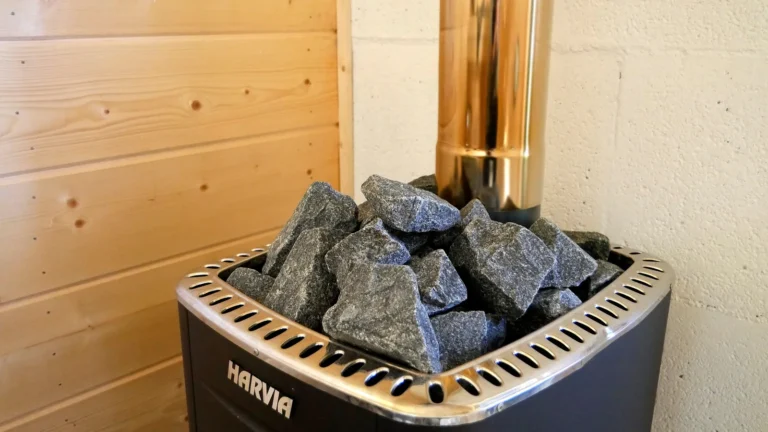
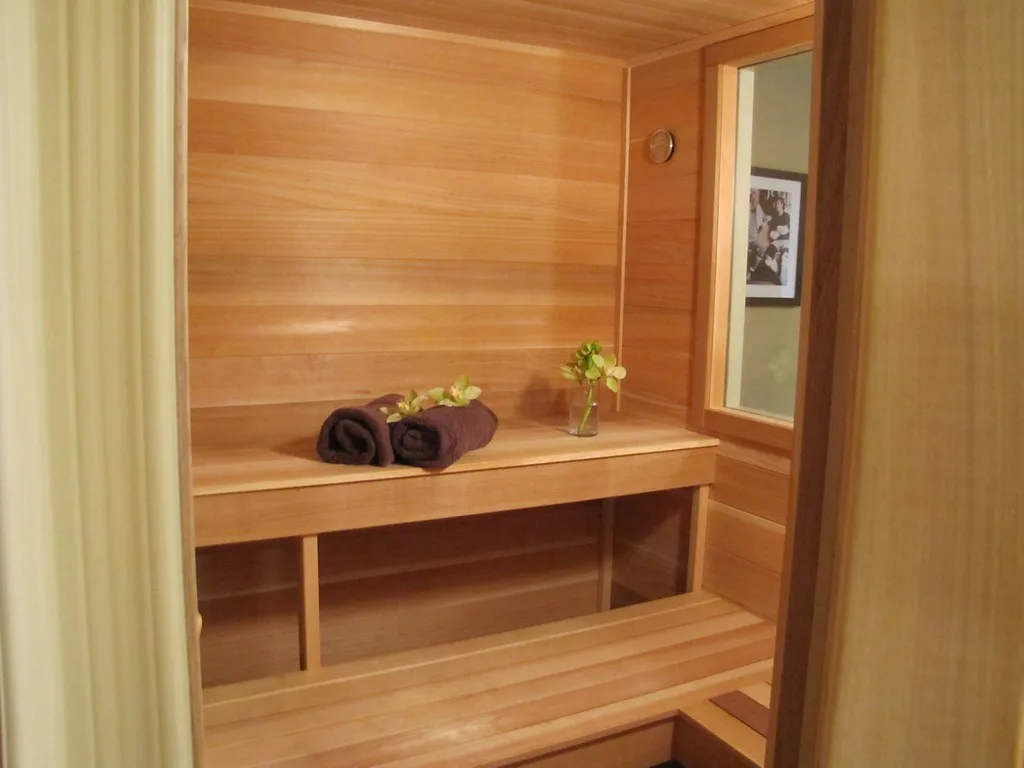
Yes, within limits. The Harvia Vega Compact 1900 is a proper stone heater, UL listed at 1.9 kW, and it runs on 120 V at 15.9 amps (or on 240 V if you have it). Harvia sizes it for rooms of 70 to 106 cubic feet (2 to 3 m³). Finnleo’s Hallmark HM44 goes a step further: a whole 4-by-4-foot (1.2 by 1.2 m) sauna room, heater included, ETL listed as a plug-in unit.
That suits a small indoor room, a renter who can’t touch the panel, or a house with no breaker space left. If you’re picturing a family sauna with room to stretch out, skip ahead to 240 V, which is where the rest of the sauna heater market lives.
Why a wall outlet means a tiny sauna
The outlet sets the limit, not the heater. A 15-amp circuit gives 1,800 watts and a 20-amp one 2,400, but a heater that runs flat out for an hour counts as a continuous load, and code lets a continuous load use only 80 percent of the circuit: 1,440 or 1,920 watts. That is why no 120 V heater goes much past 1.9 kW, and 1.9 kW heats 70 to 106 cubic feet (2 to 3 m³) on Harvia’s chart. Picture a 4-by-4 room with a low ceiling. Anything bigger is a heater sizing conversation, and a 240 V one.
The two that actually exist
| Model | kW | Room / size | Plug or hardwired | Listing | Price (Nov 2026) |
|---|---|---|---|---|---|
| Harvia Vega Compact 1900 | 1.9 | 70 to 106 cu ft (2 to 3 m³) | Hardwired only | UL | $915 (MSRP $1,016.67) |
| Finnleo Hallmark HM44 (complete room) | 1.7 or 2.2 | 48 × 48 × 80 in (122 × 122 × 203 cm), about 438 lb (199 kg) | Cord and plug | ETL, as a complete plug-in room | $8,499 to $8,599 at dealers |
The Vega Compact also needs 28.5 to 29 pounds (12.9 to 13.2 kg) of stones, sold separately. The HM44 is plug and play, once two people have carried in all 438 pounds (199 kg) of it. As for the no-name “110V sauna heaters” on marketplaces: none comes with a maker’s installation manual, a UL or ETL file or a sizing chart, so nobody can tell you what room they heat or whether they are safe in one. That includes the sellers.
What it feels like
Like a sauna, which is the point. It is a stone heater, so water goes on the stones and you get löyly (the burst of steam off hot stones), as long as the stones completely cover the elements, which Harvia insists on: water on bare coils damages the heater. What you trade is time. Harvia’s manual for its small North American wall heaters gives 45 to 60 minutes to reach 175 to 185°F (79 to 85°C), so switch it on before dinner, not after.
What the electrician still has to do
The Vega Compact is hardwired only. It gets its own 20-amp circuit, and Harvia allows no plugs or pigtails inside the sauna, so the 120 V label does not make it a plug-in heater. The HM44 really does plug into a wall outlet: a 15-amp one for the 1.7 kW version, a dedicated 20-amp one for the 2.2 kW.
Either way, have a licensed electrician read the manual against your panel and local code. Mains power in a hot, wet room is not a weekend project, and extension cords are out entirely.
When 240 V is the better call
As soon as the room is bigger than a closet. That means a new circuit from the panel to the sauna, sized to the heater: Harvia’s KIP manual asks for a 30-amp circuit for the 4.5 and 6.0 kW models and 40 amps for the 8.0.
What the electrician charges depends almost entirely on how long that run is and how easy the panel is to reach, so anyone quoting you a national average is guessing. The Harvia range starts at 4.5 kW for a reason, and the smallest KIP is the 4.5 kW.
Other ways around the outlet
| Option | Power | Trade-off |
|---|---|---|
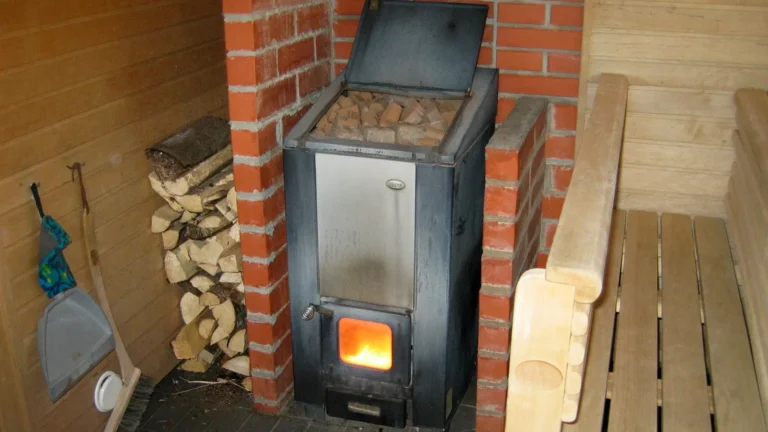
| Wood stove | None | Needs a chimney and clearances; outdoor or off-grid only |
| Sauna tent | Wood stove or propane | No hookup at all, packs down; from $4,088 for the SaunaTrekker package |
| Infrared cabin | 15-amp 120 V plug (Finnleo S-810, S-820) | No stones, so no steam; a warm cabin, not a sauna |
FAQ
Can you plug a sauna heater into a regular outlet?
One traditional sauna does: Finnleo’s Hallmark HM44, a complete ETL-listed 4-by-4 room that plugs into a 15-amp outlet with its 1.7 kW heater. The Harvia Vega Compact 1900 runs on 120 V but has to be hardwired.
Is a 110V sauna heater the same as a 120V one?
Same thing. US household circuits are nominally 120 V, and sellers write 110, 115 or 120 V as they please. What matters is the breaker, 15 or 20 amps, and whether the heater’s draw fits inside the continuous limit.
How big a sauna can a 120V heater heat?
Harvia sizes the 1.9 kW Vega Compact for 70 to 106 cubic feet (2 to 3 m³), roughly a 4-by-4 room with a low ceiling. That is the ceiling for any 120 V heater, because the circuit sets it, not the heater.
Can I run a 120V sauna heater on an extension cord?
No. The Vega Compact’s manual rules out plugs in the sauna room entirely, and Finnleo specifies its plug-in rooms for a wall outlet. Sixteen amps for an hour is exactly the job an extension cord was never built for.
Hero photo: Shixart1985, CC BY 2.0, via Wikimedia Commons. Second photo: Clarkston SCAMP, CC BY 2.0, via Flickr