Sauna Lighting: What Survives the Heat and Where to Put It
Some links on this page are affiliate links. If you buy through them, I earn a small commission at no extra cost to you. As an Amazon Associate I earn from qualifying purchases.
A sauna light fails in one of two ways: you mount it where the heat is, or you mount it where you can see it. The first kills the fixture, the second kills the room. Three kinds survive a hot room: a vapor-proof wall fixture with a wooden shade, a heat-rated LED strip, and fiber optic. All three belong low.
At a glance
- What works: a vapor-proof shaded wall fixture, a sauna-rated LED strip, or a fiber-optic set.
- Where it goes: under the benches and low on the walls, away from the heater. A ceiling light works too, if it is rated for the heat up there.
- What it costs: $117-$194 for a shaded fixture, $298.50-$388 for a strip kit, $740-$1,300 for fiber optic (Nov 2026).
What kind of light can go in a sauna?
Everything in a sauna is rated for the heat and the moisture of the exact spot it is mounted in, and the light is no exception. If the room is still a frame, decide the lighting now, because the cable runs are part of the build rather than a weekend job afterwards.
| Option | Where it can go | Rating to look for | Price |
|---|---|---|---|
| Wall fixture with wooden shade | Low on the wall, away from the heater | Vapor-proof housing, at least 6 in (150 mm) below the ceiling | $117-$194 |
| Heat-rated LED strip | Under benches, behind a backrest; makers advise against the ceiling | Strip rated to at least 140°F (60°C) and IP67, with its driver in a separate rated case | $298.50-$388 |
| Fiber optic | Almost anywhere, ceiling included; the projector stays in a protected box or outside the room | Glass fiber rated to 356°F (180°C); projector box IP55, ambient limit around 131°F (55°C) | $740-$1,300 |
Prices are sellers’ listed prices, checked November 2026.
What “rated for a sauna” means
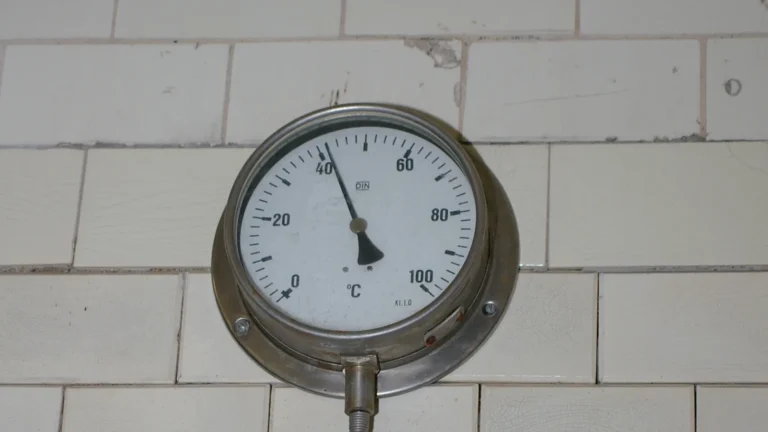
A sauna is not one temperature. Harvia’s own heater manual maps the gradient: about 180°F (82°C) on the wall above the heater, 140°F (60°C) at upper bench level, and 100°F (38°C) at the floor. That is why the same fixture lives for years under a bench and dies in a season over the stones. Harvia tells installers to keep wall lights at least 6 in (150 mm} below the ceiling, lower if possible, and says plainly that it does not recommend a ceiling light at all. That is one maker’s caution, not a ban: Finland’s electrical code for saunas allows fixtures above one metre from the floor if they tolerate 125°C (257°F), and keeps everything else out of a half-metre zone around the heater, all the way up to the ceiling.
Can you use LED strips?
Only strips sold for the job, and only low in the room. Ordinary household strips fail because the heat limits that matter are on the diodes and the electronics, not the silicone. Cariitti’s Antti Bragge, quoted on the Finnish sauna site Saunologia, goes further: LED electronics do not survive high temperatures long term, there is no such thing as a genuinely sauna-proof LED, and the company does not recommend them in the ceiling or at top-bench level.
Read the two ratings separately. Harvia’s strip kit is rated to 140°F (60°C), is not recommended near the ceiling, and needs its transformer in an IP44 case. HUUM’s 16-foot (4.9 m) strip is rated from -13°F to 200°F (-25°C to 93°C) at IP67, but its 90 W power supply tops out at 158°F (70°C) and is only IP20. Tylo’s installation manual puts its waterproof supply in the coolest spot available, under the heater or under the lower bench, and warns that the control cable connection is not waterproof even when the supply is. The strip can be in the room; the brains want to be somewhere cooler, ideally outside it.
On Amazon US, the SuperlightingLED sauna strip runs on 24 V and its seller rates it from -13°F to 212°F (-25°C to 100°C) at IP68. That is the seller’s own figure, not a sauna maker’s datasheet, so mount it low as above. The power supply is sold separately, which suits the rule: it goes in the coolest spot or outside the room.
Where the lights go
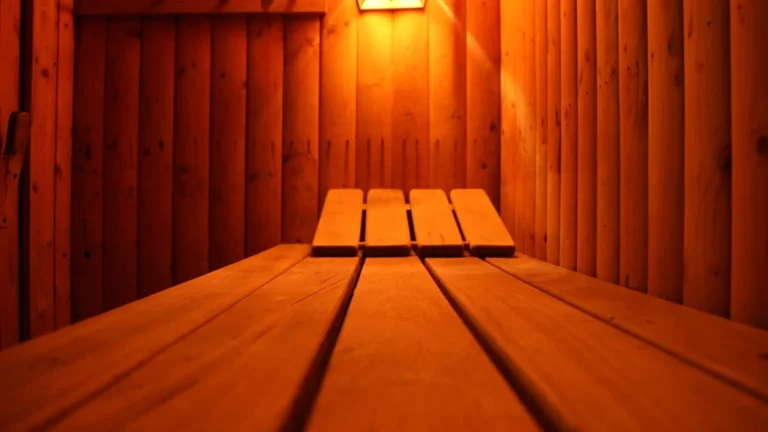
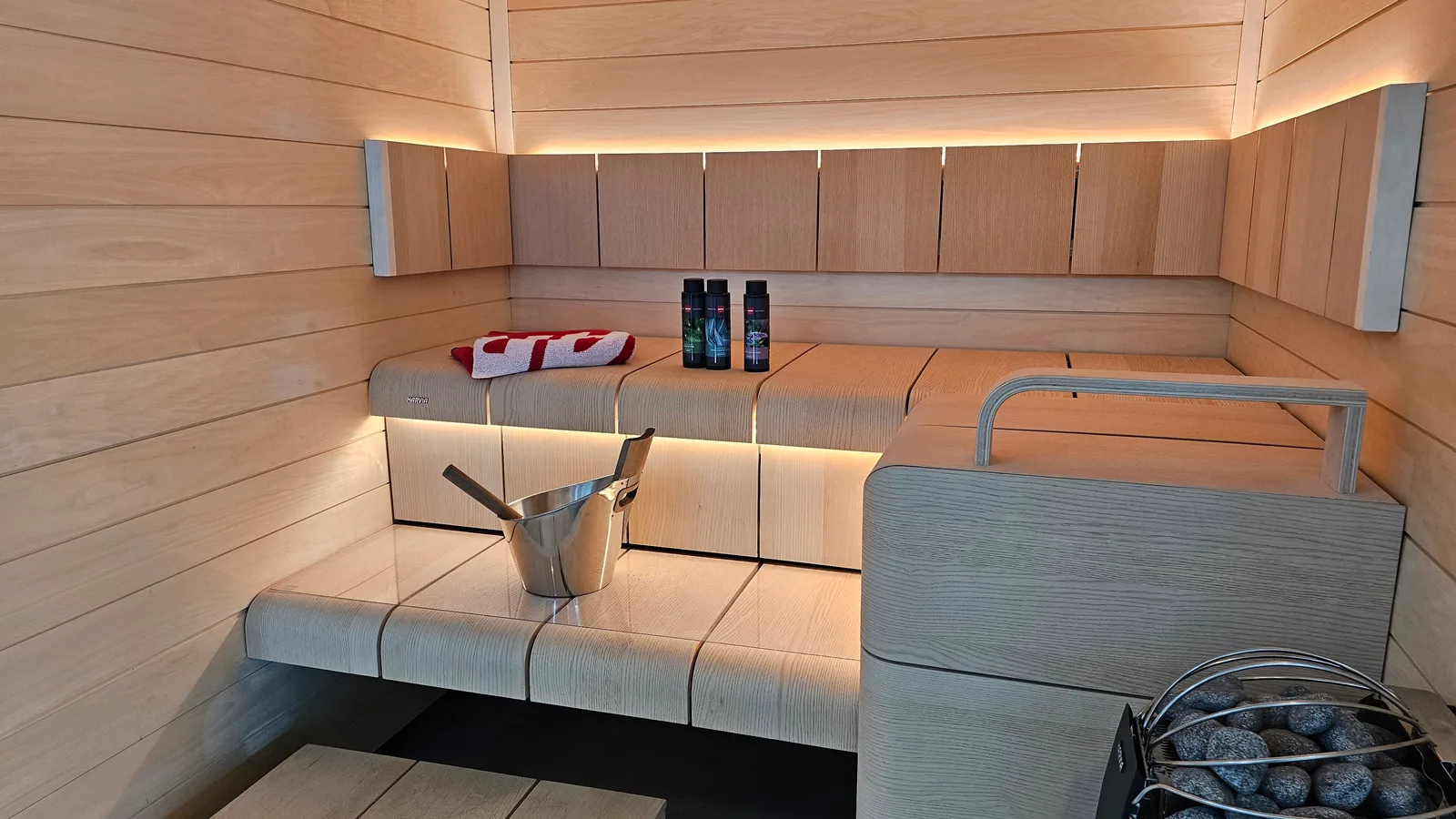
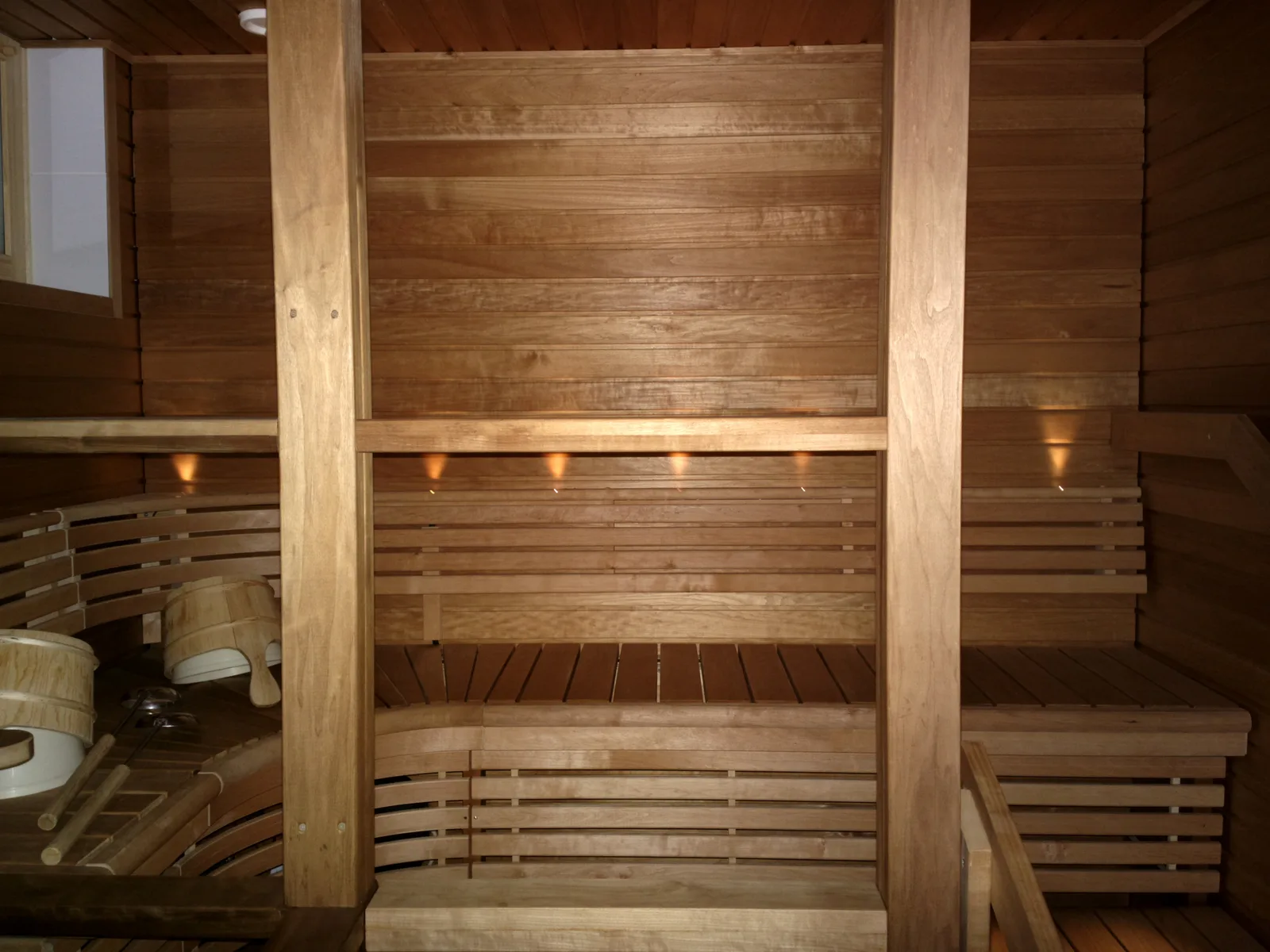
Under the benches is the ideal location, in Harvia’s words, and it is also the best-looking one: the light washes the floor and the bench fronts instead of your face. Behind the backrest works the same way. Low on the wall, away from the heater, suits a shaded fixture; a cedar light shade fits over a standard vapor-proof wall light. The rule Finnish installers work to is that the source itself should not be visible to someone sitting on the top bench: under the benches, behind the backrest or tucked along the ceiling edge all work, a bare bulb at eye level does not.
How bright, and what color?
Warm white. Finnish lighting guidance lands on 2,700-3,000 K, the color of firelight, and the products on the market sit just above it: Cariitti’s projector at 3000 K, Harvia’s strip at 3200 K, HUUM’s at 3500 K. Dimming matters more than wattage, because the brightness you want on the way in is not the brightness you want twenty minutes later. Colored light sold as chromotherapy is not supported by evidence for health or mood effects, so buy it because you like it, not because of what the listing says it does.
Wiring, and what to leave to an electrician
Sauna-rated strip kits run on 12 or 24 volts DC. Only the driver and its feed are line voltage, and that driver needs its own rated enclosure. The heater is a different animal: Harvia’s installation guide specifies hard wiring with 90°C-rated copper insulation, and the maker’s instruction is that a licensed electrician performs all electrical work. Follow the fixture manual, the heater manual and your local code, which in the US means the NEC plus whatever your inspector wants. Plan the light, the heater circuit and ventilation together, before the paneling goes on.
Fiber optic, and why it can go almost anywhere
Fiber optic solves the heat problem by keeping the electronics out of the heat. The glass fibers carry light and no current, are rated to 356°F (180°C), and can run along the ceiling, under benches, or as a glow over the heater with the supplied lens. The projector sits in an IP55 junction box with an ambient limit around 131°F (55°C), which in Finnish practice usually means the dressing-room side of the wall. A Cariitti set runs $740 for the standard kit and $1,300 for the premium one.
How a sauna is lit in the north
Dim, and that is the whole aesthetic. Saunologia’s Lassi A. Liikkanen found that Finns prefer dark saunas, and notes that in the smoke-sauna era the room was pitch black unless a candle or a burning splint lit it. Often the light is one shaded lamp, or just a small window, which he calls the sauna’s spot of light. Light your own room however you like; this is only how it is done up north.
FAQ
Can you use LED lights in a sauna?
Yes, if the strip is sold and rated for sauna heat (at least 140°F / 60°C, IP67) and mounted low, under benches or behind a backrest. Makers advise against LEDs near the ceiling, and the transformer belongs in its own rated case in the coolest spot available.
Where should lights go in a sauna?
Under the benches first, then behind the backrest or low on a wall away from the heater. Harvia calls under-bench the ideal location. A ceiling light is possible if it is rated for the heat up there and stays out of the half-metre zone around the heater. The aim is that someone on the top bench sees the glow, never the bulb.
What color light is best for a sauna?
Warm white at 2,700-3,000 K, with products commonly at 3000-3500 K. It reads as firelight and keeps the room calm. A dimmer is worth more than extra output. Colored light is a preference, not a health feature.
Hero photo: Johnnidian, CC BY-SA 4.0, via Wikimedia Commons. Second photo: Arto J, CC BY-SA 3.0, via Wikimedia Commons