Harvia vs HUUM: Which Sauna Heater Brand?
Some links on this page are affiliate links. If you buy through them, I earn a small commission at no extra cost to you. As an Amazon Associate I earn from qualifying purchases.
Harvia and HUUM are the two names that come up in nearly every electric sauna heater conversation, and they couldn’t be more different. One is a publicly traded Finnish manufacturer whose heaters sell in nearly 100 countries. The other is a smaller Estonian design studio that treats sauna heaters like sculptural furniture. Ready to run, a 6 kW HUUM costs about $1,700 more than a 6 kW Harvia, which raises the obvious question: are you paying for better löyly, or just better looks?
The answer isn’t as simple as “buy the cheaper one.” Here’s where each brand genuinely excels and where each falls short.
Brand Heritage: Finnish Scale vs Estonian Design
Harvia was founded in 1950 by Tapani Harvia in Jyväskylä, Finland, originally as a small workshop making decorative metalwork and hearth doors. Tapani built the first Harvia wood-burning stove for personal use, started selling them commercially by the mid-1950s, and by the end of that decade sauna heaters had become the core business. Electric heater manufacturing started at the end of the 1980s. They’ve been exporting to the US since the 1990s, run a factory in China, and are listed on Nasdaq Helsinki. At the end of 2025 Harvia had 735 employees, and its 2025 revenue was €198.9 million (about $225 million).
HUUM comes from Estonia, where sauna traditions run just as deep as in Finland; the Estonian smoke sauna tradition is UNESCO-listed, after all. HUUM is a smaller, private company that positions itself around award-winning Nordic design and what they call “mild and healthy steam.” Their design philosophy draws from nature and local Estonian sauna traditions, and every heater is developed and produced in Estonia with local metal processors.
The scale difference matters practically: Harvia is a 75-year-old industrial manufacturer with a massive global distribution network. HUUM is a design-forward specialist. Both make excellent heaters, but their supply chains, dealer networks, and parts availability reflect those very different company sizes. The two countries argue about smoke saunas, UNESCO inscriptions, and which of them invented the practice. They are united in agreeing it wasn’t anyone south of the Baltic.
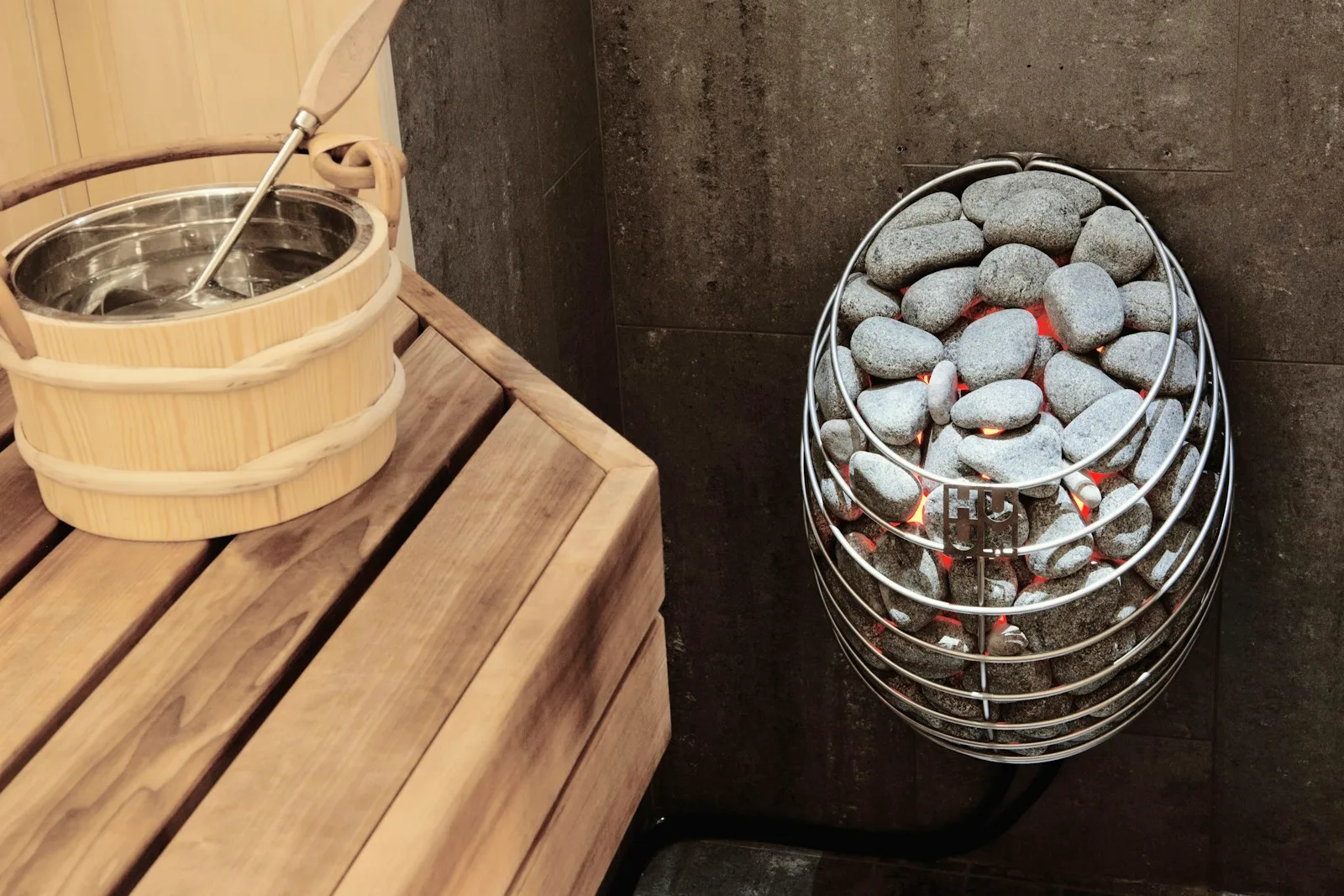
HUUM DROP wall-mounted heater. Photo: HUUM, via Unsplash
Design and Aesthetics
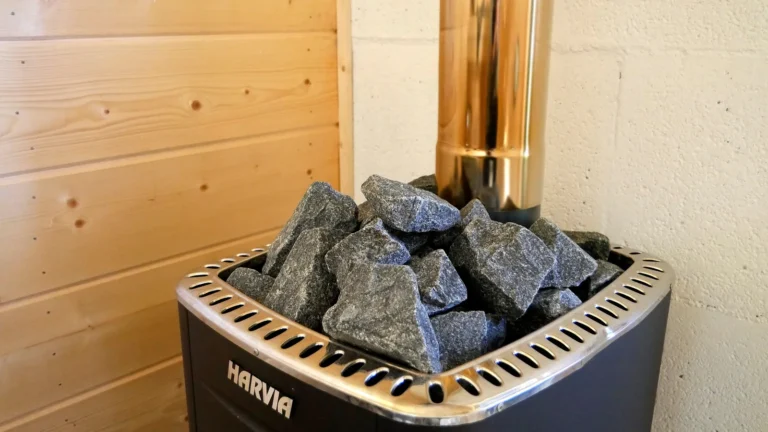
This is where the brands diverge most visibly. Harvia’s lineup spans a wide range, from the basic KIP wall-mount (a no-nonsense box) to the cylindrical Cilindro pillar heater to the more contemporary Spirit model. Even Harvia’s “design” models look like well-made sauna equipment. They’re functional, clean, and clearly engineered by people who prioritize thermal performance. Nobody walks into a sauna and asks “who designed that KIP?” And that’s fine.
HUUM heaters get a different reaction entirely. The DROP looks like a teardrop sculpture suspended from the wall. The HIVE is a freestanding steel cage that showcases a massive mound of sauna stones as the visual centerpiece. People photograph HUUM heaters and post them on Instagram. The brand describes their philosophy as “powerful in minimalism, rustic in charm,” and for once the marketing copy is accurate.
Head-to-Head Comparison
| Category | Harvia | HUUM |
|---|---|---|
| Country of origin | Finland | Estonia |
| Company scale | Listed company, sold in nearly 100 countries | Smaller private company, growing international presence |
| Design philosophy | Functional, industrial, wide product range | Minimalist, nature-inspired, award-winning design |
| Key electric models | KIP, Cilindro, Spirit, Virta | DROP, HIVE, HIVE Mini, CLIFF, STEEL |
| Entry price (6 kW) | $1,195 (KIP, controls built in) | $1,506 (DROP, heater only; $2,888 with HUUM’s UKU control) |
| Price range overall | Budget to mid-range | Mid-range to premium |
| Stone capacity | Varies by model; a 6 kW KIP holds about 44 lb (20 kg) | Higher; a 6 kW DROP holds up to 132 lb (60 kg) |
| Smart controls | Fenix controller (touch screen, Wi-Fi) | Smart controller with mobile app (remote heating) |
| US parts availability | Strong: 30+ years in the US market, large dealer network | Limited: fewer US dealers and service centers |
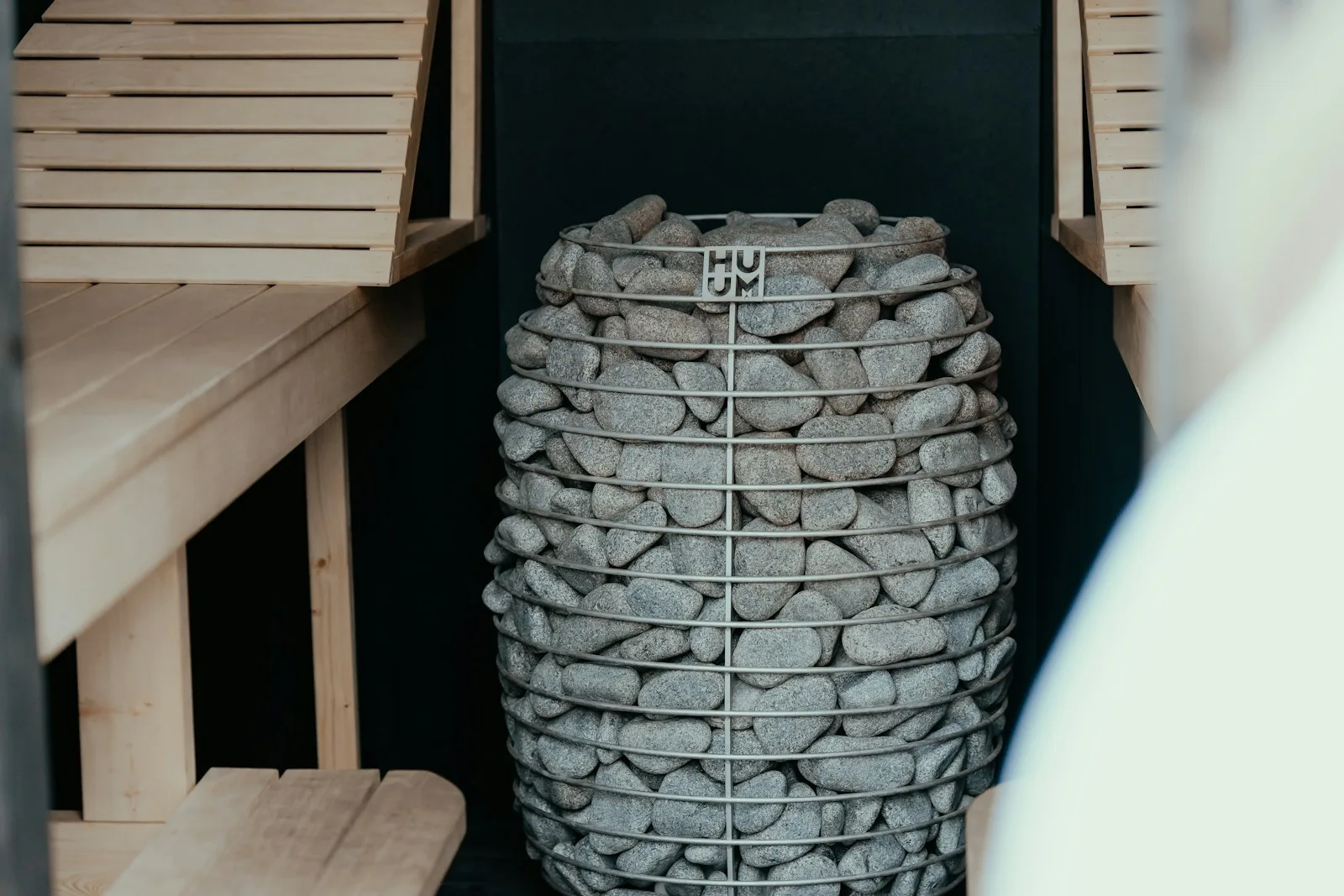
HUUM HIVE floor-standing heater. Photo: HUUM, via Unsplash
Löyly Quality
Löyly (the burst of steam when you throw water on hot stones) is where sauna heaters are ultimately judged. Both brands produce genuine löyly (these are real sauna heaters, not infrared panels), but the experience differs.
HUUM’s design philosophy deliberately maximizes stone mass. The HIVE, for example, is essentially a tall cage packed with stones. More stone mass means more thermal energy stored, which translates to softer, longer-lasting steam when you throw water. The steam doesn’t come in a sharp, aggressive burst; it rolls out gently. HUUM specifically markets “mild and healthy steam” and it’s a fair description of the experience.
Harvia’s löyly quality varies more across their lineup because the lineup is much broader. The basic KIP, with its smaller stone load, produces perfectly decent steam, but it’s a sharper, quicker burst compared to a stone-heavy HUUM. Harvia’s Cilindro model narrows that gap significantly: its cylindrical design holds substantially more stone than the KIP, and the löyly it produces is noticeably softer. If löyly quality is your priority within the Harvia range, the Cilindro is the one to look at.
Build Quality and Reliability
Both brands use quality stainless steel construction and are built to withstand the extreme environment inside a sauna: high heat, high humidity, repeated thermal cycling. Neither brand has a reputation for premature failures when properly installed and used.
Harvia’s advantage here is sheer volume of real-world data. Harvia has been building heaters since 1950, so its designs have been proven in a huge number of real saunas. When something breaks (and all heaters eventually need parts), you benefit from that scale. Replacement heating elements, thermostats, and contactors for Harvia models are widely stocked by US sauna dealers. Most repairs can be handled quickly.
HUUM builds to a high standard, and their metal processing quality from Estonian fabricators is genuinely excellent. But as a smaller company with less time in the US market, the parts supply chain is thinner. If a heating element fails on a HUUM DROP, sourcing a replacement may take longer and cost more than the equivalent Harvia part.
Smart Features and Controls
Both brands have caught up to the smart home era, though their approaches reflect their personalities. Harvia offers the Fenix controller, a touch-screen panel with Wi-Fi connectivity. It’s functional and well-integrated into their heater lineup.
HUUM’s smart controller lets you start heating your sauna remotely via a smartphone app. Drive home from work, tap the app, and your sauna is at temperature when you walk in the door. It’s a simple but genuinely useful feature that fits HUUM’s tech-forward positioning. Both systems work well; neither is a compelling reason to choose one brand over the other.
Best Models by Category
Best Budget Electric Heater
Harvia KIP. The 6 kW model is about $1,195 with time and temperature controls built in, so there is no separate control panel to buy. It mounts on the wall, US dealers have sold it for years, and parts are easy to find. HUUM simply doesn’t compete in this price tier.
Best Design-Forward Heater
HUUM DROP. The teardrop wall-mount design is unlike anything else on the market. At about $1,506 for the 6 kW heater, plus a control HUUM sells separately (about $2,888 as a package), you’re paying a premium, but the DROP transforms the look of a sauna interior. It’s the heater for someone who considers their sauna an extension of their home design.
Best Löyly-Focused Heater
HUUM HIVE for maximum stone capacity and the softest steam, or the HIVE Mini for a home-sized room. If löyly quality is the single most important factor, HUUM’s stone-forward designs have an edge. Within Harvia’s range, the Cilindro is the best löyly performer, at a significantly lower price.
Best All-Rounder
Harvia Cilindro. It bridges the gap between Harvia’s affordability and HUUM’s emphasis on stone mass. Good löyly, reasonable price, excellent parts availability. For most home saunas in the US, it’s the pragmatic choice.
Price Breakdown
The price difference between these brands is significant and consistent across their lineups. Ready to run, a 6 kW HUUM costs about $1,700 more than a 6 kW Harvia, because HUUM sells its controls separately and Harvia builds them into the KIP.
| Comparison | Harvia | HUUM |
|---|---|---|
| 6 kW wall-mount, heater | KIP: $1,195 | DROP: $1,506 |
| Ready to run, with controls | $1,195 (built in) | $2,888 (UKU control package) |
| What the premium buys | Lower price, easier parts | Award-winning design, higher stone capacity, softer löyly |
Is the HUUM premium justified? That depends entirely on what you value. A Harvia is the sauna heater your accountant approves of. A HUUM is the one your guests notice. If you’re building a $15,000 custom sauna as a centerpiece of your home, spending about $1,700 more on a heater that looks like a piece of art is a reasonable decision. If you’re converting a spare closet into a sauna on a tight budget, the Harvia KIP delivers the same fundamental experience, heat and steam, for less than half the cost.
Who Should Buy Which
Choose Harvia if: you want proven reliability with the easiest parts access in the US, you’re working within a budget, you prioritize function over form, or you’re building a commercial sauna where maintenance costs matter. Harvia’s 30+ years in the US market and massive dealer network are genuine practical advantages.
Choose HUUM if: design matters as much as performance, you want maximum stone capacity for the softest possible löyly, you’re building a showcase home sauna, or you appreciate supporting a smaller company with a distinctive design vision. Just go in knowing that parts and service may require more effort.
FAQ
Is HUUM better than Harvia?
Not categorically. HUUM produces softer löyly due to higher stone capacity and offers superior aesthetics; its heaters are genuinely beautiful. But Harvia offers far better value, wider model selection, and significantly easier parts availability in the US. “Better” depends on whether you prioritize design and löyly softness (HUUM) or value, reliability track record, and serviceability (Harvia).
Are HUUM heaters worth the price?
At about $1,700 more for a ready-to-run 6 kW heater, HUUM heaters are worth it for buyers who value design as part of the sauna experience and want maximum stone capacity for soft steam. For a 6 kW wall-mount heater, you’re looking at about $2,888 for a HUUM DROP with its control versus $1,195 for a Harvia KIP with controls built in. The HUUM produces noticeably softer löyly and looks dramatically better, but the core sauna experience (hot room, steam, relaxation) is achievable with either.
Which sauna brand is most reliable?
Both Harvia and HUUM build durable heaters with quality stainless steel construction. Harvia has the edge in proven long-term reliability simply due to scale: after 75 years of building heaters, its designs have far more real-world use behind them. Harvia also has a much larger US dealer and service network, which means faster access to replacement parts when something eventually wears out.
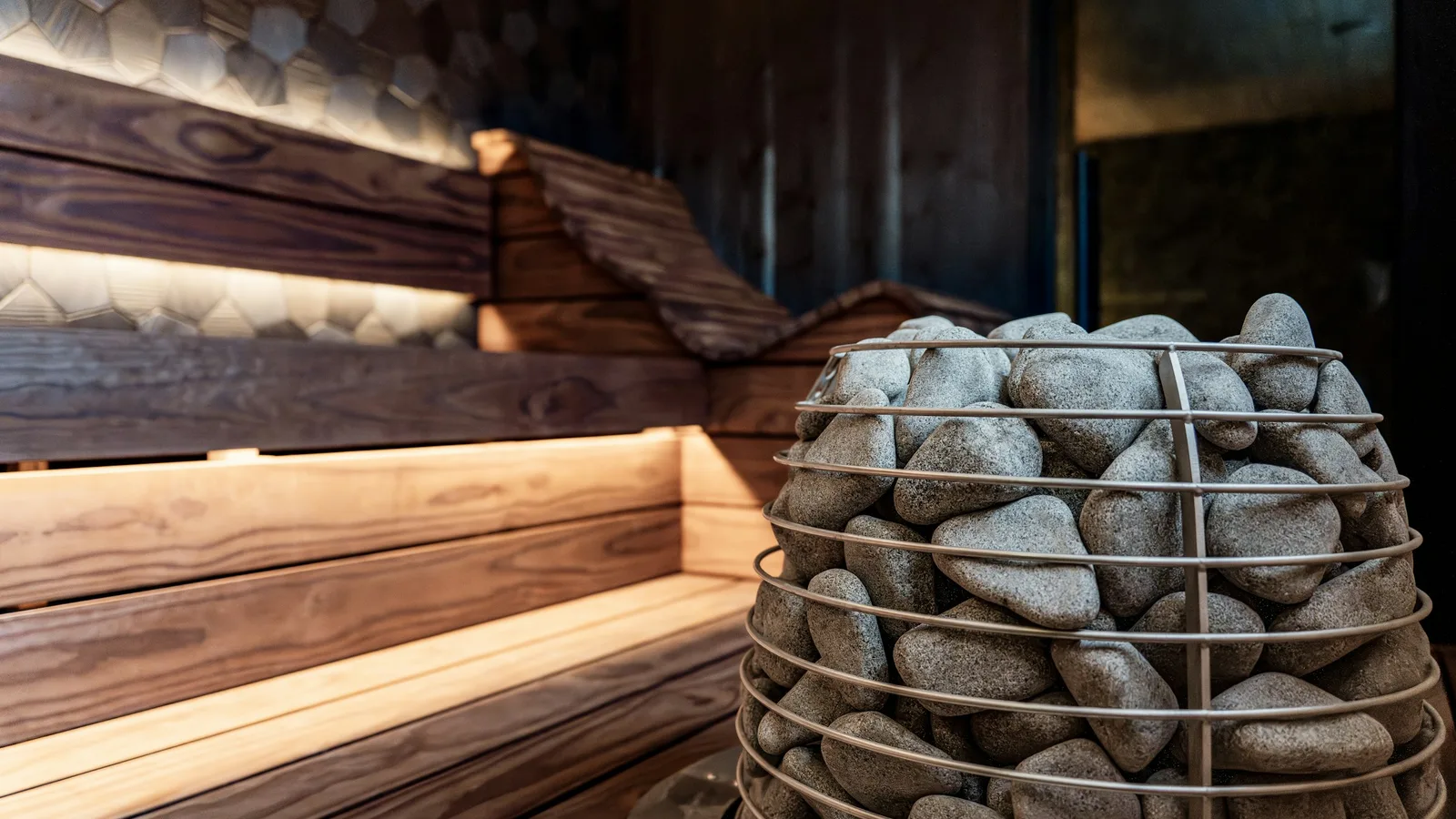
Hero photo: HUUM HIVE Mini heater. Photo: HUUM, via Unsplash