A 2-Person Outdoor Sauna for a Small Backyard
Some links on this page are affiliate links. If you buy through them, I earn a small commission at no extra cost to you. As an Amazon Associate I earn from qualifying purchases.
You have sat in a sauna together at the gym, a spa or on a trip, and one of you keeps saying “we should get one.” The other is asking the sensible questions: where would it even go, what does it really cost, and will we still use it in March? A sauna for two fits most small yards, on about 4.5 to 7 feet (1.4 to 2.1 m) square of ground, and kits run $4,790 to $9,503. The sauna is the easy part. The power, the walk out and delivery day are where the planning goes.
At a glance
- Footprint: roughly 4.5 to 7 feet (1.4 to 2.1 m) square outside, plus space to open the door and step out.
- Kit price: $4,790 to $9,503 for the two-person models below (Topture, checked November 2026).
- Power: a traditional electric heater wants its own 240 V circuit, and running one out to a detached sauna costs $1,500 to $3,800 or more.
My picks
- Smallest footprint: SaunaLife CL3G cube
- Most room inside: Dundalk Luna
- Wood heat: True North 6-foot barrel
- Lowest price with the heater included: SunRay Solace
Will you actually use it?
That is what the skeptic is really asking, and it is a fair question for a project that costs $6,400 or more all in. Owners who have had theirs a while are encouraging. Scott and Amy Dawson, a suburban couple, wrote a couple of weeks after theirs went in that they were using it “almost daily,” in the evening or after a workout.
They are not unusual. In a Sam’s Club review, Randy writes that he and his wife have used their barrel “almost daily since install,” and another owner of the same barrel, eight months in, reports five to six times a week.
Two things make a Tuesday session easy or hard. The first is heat-up: SunRay’s Eagle takes 45 to 60 minutes, so a heater you can start before dinner, by timer or app, matters more than any feature inside. Check that the controls also work without Wi-Fi; one owner could not keep the app connected with the sauna 10 feet (3 m) from the house. The second is the walk out.
Where in the yard should it go?
As close to the back door and the electrical panel as your yard and your town allow. The circuit is priced by distance: $450 to $900 for a new 240 V circuit inside the same building, and $1,500 to $3,800 or more for a detached sauna 25 to 75 feet (8 to 23 m) from the panel.
The Dawsons’ sauna sits about 100 feet (30 m) from their electrical box. A crew spent several weekends running conduit, building a level pad and laying a stepping-stone path from the house. Whatever your distance, you will walk it in a towel, in the dark, in January, so a lit path is worth more than a nicer door handle.
Leave room outside the door, too. Ben, a Minnesota owner who built his own, likes “sitting outside between rounds, even in the Minnesota winter.” Decide early where you undress, where you rinse, and whether a cold plunge goes beside it. And think about the view from the kitchen: Ben’s wife insisted the sauna match the house, and he admits she was right. “It looks like it is supposed to be there.”
Will a sauna for two fit?
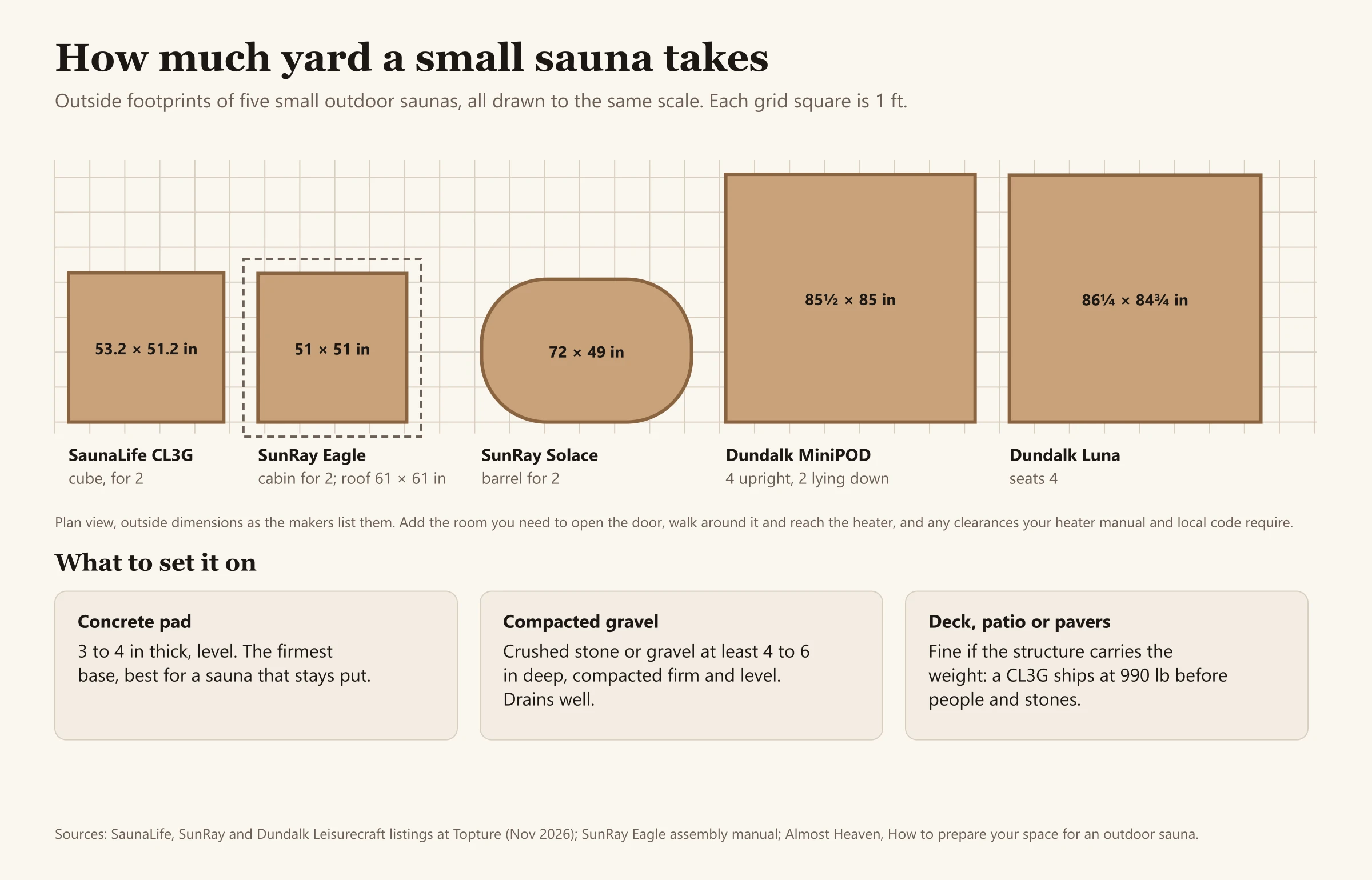
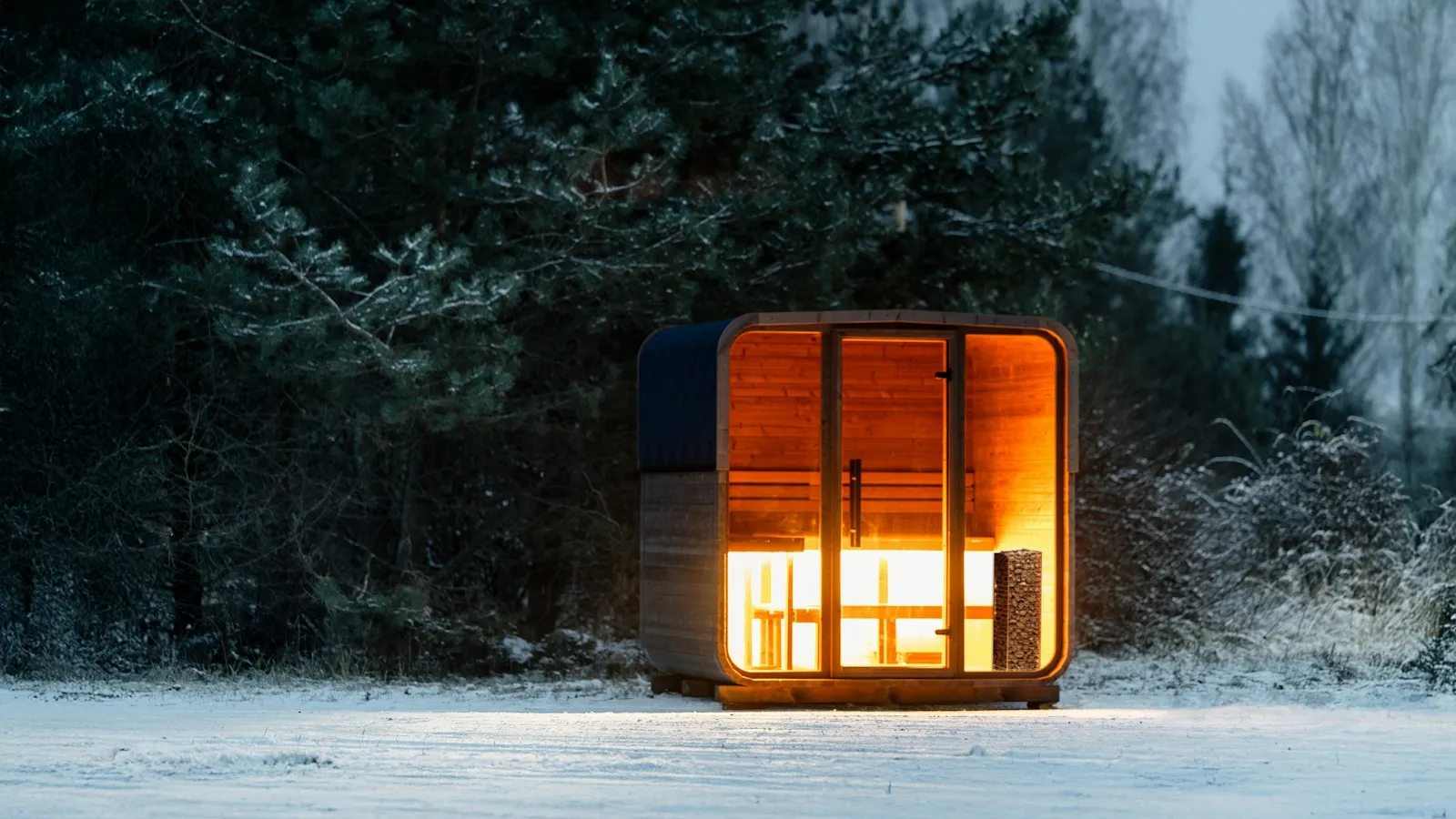
The smallest units in this class are genuinely small. SaunaLife’s CL3G cube is 53 by 51 inches (135 by 130 cm), about the ground a garden shed takes. Dundalk’s Luna is the big one here, just over seven feet (2.1 m) square. The model table below has every size.
| What takes up ground | Figure to plan with |
|---|---|
| Sauna body | SunRay Solace barrel, 72″ x 49″ (183 x 124 cm) |
| Door and the step out | CL3G’s opening is 23.2″ (59 cm) wide, 66.5″ (169 cm) tall; none of these makers publishes a standing-depth figure, so pace out a full step in front and keep it clear |
| Pad under it | 4 to 6 inches (10 to 15 cm) of compacted gravel, or a 3 to 4 inch (8 to 10 cm) concrete slab, level under the body |
| Ground to clear | About 6 by 4 feet (1.8 by 1.2 m) for the body itself (calculated from the Solace’s published dimensions), plus the door side |
Height counts as well: HUUM’s DROP manual asks for a room at least 75 inches (191 cm) tall, with 44 to 51 inches (112 to 130 cm) between the top bench and the ceiling.
Is “two-person” big enough for the two of you?
“Two-person” is a seating chart: two adults upright, shoulder to shoulder. If one of you likes to lie down after a round, read the bench length, not the label. Dundalk’s MiniPOD is the one in this size class rated for two people lying down.
Randy and his wife went the other way and bought a four-person barrel for the two of them. Sauna-design reviewer Trumpkin at LocalMile would approve: he argues that most kits sold in English-speaking markets are “too small, too low of benches.” If two feels tight on paper, it will feel tight in the room, and a four-person room is a smaller jump in footprint than in price.
Barrel, cube or small cabin?
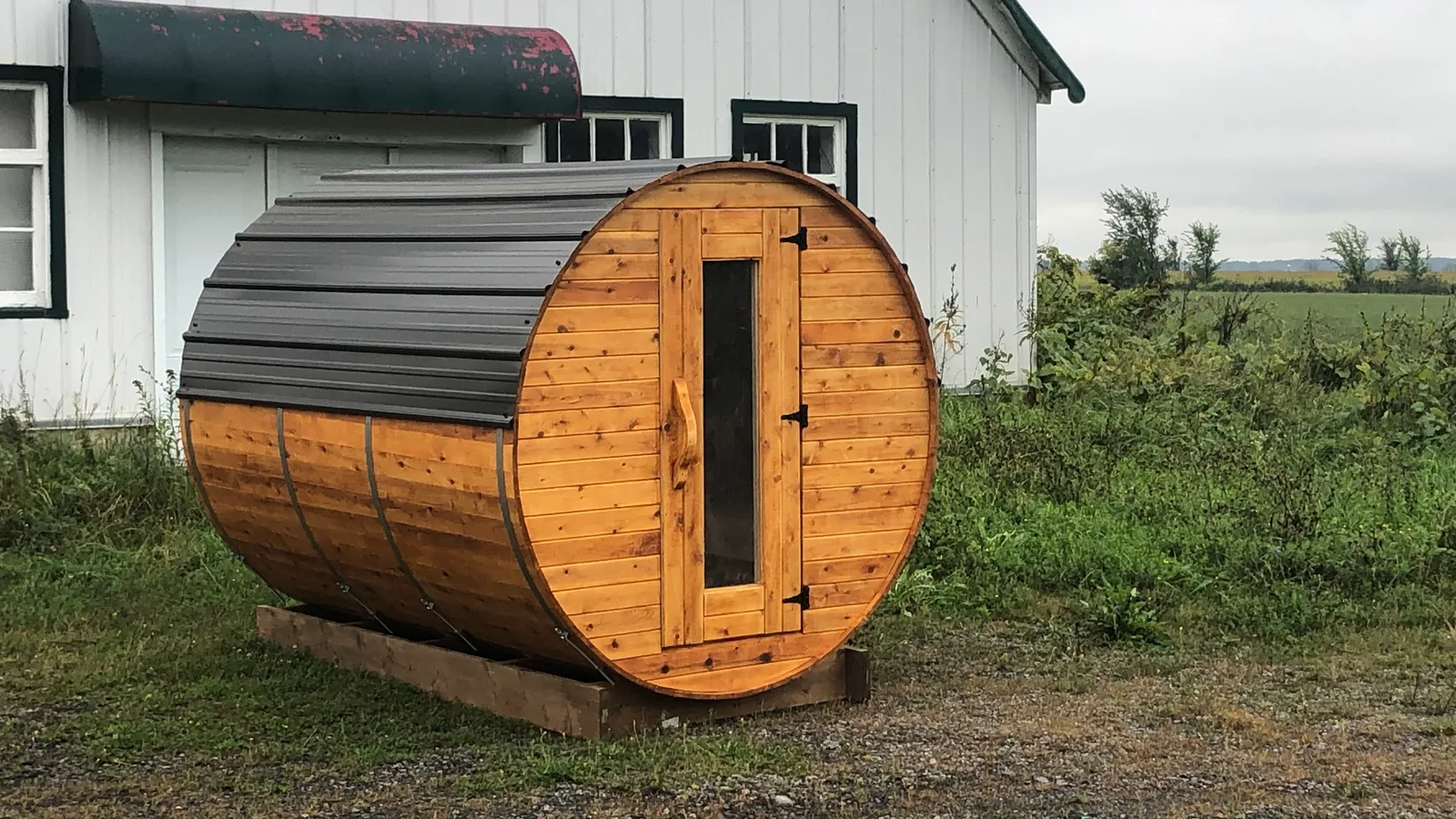
Barrels earn their shape. Topture’s outdoor sauna guide credits the curve with heating the room quickly, and it sheds rain and snow, but you sit in the widest part or you duck.
A cube has straight walls and full height at the bench. The SaunaLife CL3G holds about 93.5 cubic feet (2.6 m³) behind a glass front, which makes a small room feel bigger than it is. A small cabin like the Eagle goes up instead of out: 98 inches (249 cm) tall on a 51-inch (130 cm) square floor.
Electric or wood for two
Electric is the weeknight option: it starts from a switch or a timer. The Eagle’s included 4.5 kW Harvia needs a dedicated 240 V circuit on a 30 A breaker, run by a licensed electrician, so book that visit along with the pad.
Wood is a ritual and a woodpile. Ben’s wood-fired sauna takes his family’s room from 15 below zero to 180°F (-26°C to 82°C) in about 75 minutes, and the summer he built it he cut and split about eight face cords, enough to fill his woodshed. At the rate they sauna, he expects to be “out of wood by May.” Two people burn less than a family of four, but someone still feeds the fire.
A Harvia M3 wood stove kit with chimney and stones runs $2,580 bundled, or $2,660 bought as pieces. Clearances come from that stove’s own manual, not from a rule of thumb.
Five small saunas worth a look
These are the published specs, not a ranking: the smallest, the roomiest, the two cheapest with a heater in the box, and the one that takes a wood stove.
| Model | Seats | Outside footprint | Wood | Heater and power | Price |
|---|---|---|---|---|---|
| SaunaLife CL3G cube | 2 | 53″ x 51″ (135 x 130 cm), 82″ (208 cm) tall (about 93.5 cu ft / 2.6 m³ inside) | Not published | Not included | Not listed |
| Dundalk Luna | 2 to 4 | 86″ x 85″ (218 x 216 cm) (315 cu ft / 8.9 m³ inside) | Not published | 6 kW recommended, bought separately; HUUM DROP 6 kW is 240 V / 25 A | $7,361 |
| True North 6-foot barrel | 2 to 4 | 6-foot (1.8 m) barrel | White or red cedar | Electric or wood, bought separately; HUUM DROP 7.5 kW (240 V / 33 A) or the Harvia M3 wood kit at $2,580 | $8,483 white cedar, $9,503 red cedar |
| SunRay Solace barrel | 2 | 72″ x 49″ x 76″ (183 x 124 x 193 cm) tall | Western red cedar | Harvia electric with stones, included | $4,790 |
| SunRay Eagle cabin | 2 | 51″ x 51″ (130 x 130 cm), 61″ (155 cm) square roof | Aged Canadian hemlock | 4.5 kW Harvia included; 240 V / 30 A | $4,990 |
Prices are Topture’s, checked November 2026; the CL3G’s was not listed there.
What it costs all in
A two-person outdoor sauna costs about $6,400 to $15,800 all in. The sauna itself is about two thirds of that: Topture puts the kit at 60 to 75 percent of a project, and the total is my arithmetic from that share and the kit prices above (November 2026).
| Item | Typical cost |
|---|---|
| Sauna kit | $4,790 to $9,503 for the models above |
| Heater, where not included | $1,317 (Harvia KIP 8 kW with built-in controls) to $3,316 (HUUM DROP 7.5 kW); $2,580 for the wood kit |
| New 240 V circuit | $450 to $900 inside the same building; $1,500 to $3,800 or more 25 to 75 feet (8 to 23 m) from the panel |
| Foundation | $300 to $1,500 |
| Permits | $50 to $300 |
| Freight | Up to $1,990 (SaunaLife) |
The foundation, permit and freight figures are Topture’s for a four-person build, so a two-person pad and a lighter unit sit at the low end.
Delivery day and the assembly weekend
Kits arrive by freight at the curb, and the last stretch to your pad is yours. SaunaLife publishes a 990-pound (449 kg) shipping weight for the CL3G. Scott Dawson called his dad, who brought a hand truck, and they dragged the barrel’s round end pieces across the yard on a winter sled. On SunRay’s product page, Laura B. of Raleigh reports freight taking about two weeks and arriving undamaged.
Plan a full day to put it together: two owners of one barrel model report 8 to 10 hours, and Almost Heaven recommends at least two people. A few weeks in, the Dawsons saw sunlight through a gap at the top of their barrel and added a quarter-inch (6 mm) spacer stave, so look up at the roof after the first month of heat.
What to set it on, and how it handles your weather
Four to six inches (10 to 15 cm) of compacted crushed stone drains on its own; a three to four inch (8 to 10 cm) concrete pad, properly leveled, is the permanent choice; Almost Heaven lists pavers as well. A deck or patio works only if it carries the weight.
In snow country the barrel’s curve sheds snow instead of holding it on a flat roof, and an undersized heater shows up in January, so do the heater sizing math against your room. Tom H. of Minneapolis writes on SunRay’s product page that his has gone “a year through a Minnesota winter outdoors and zero issues.”
In a hot, humid climate the base does the work: gravel or pavers that drain keep the structure off wet ground. Mold is a real risk; one Sam’s Club owner reported it “inside and out” a month in, despite following the after-use instructions. No maker manual I could find publishes a humid-climate venting figure, so set the vents by the manual that ships with your unit.
Do you need a permit?
Permits, setbacks and wood-burning rules are local, set by your city or county, and your HOA writes its own on top. Wood is where they vary most: EPA’s ordinance archive lists burning restrictions across the Denver-Boulder metro and in Chico, California. Some towns exempt small sheds from a permit; check yours before you order. A chimney is where the county starts reading.
Common questions
Will we actually use a backyard sauna?
Owners who have had theirs a while say yes: two couples report using theirs almost daily, and another owner five to six times a week after eight months. Make it easy to start, with a heater you can switch on before dinner and a lit path from the back door.
How much space do you need for a 2-person outdoor sauna?
Figure 4.5 to 7 feet (1.4 to 2.1 m) square of ground. The smallest cube here is 53 by 51 inches (135 by 130 cm), a two-person barrel is about 72 by 49 inches (183 by 124 cm), and Dundalk’s Luna is just over seven feet square. Add room in front to open the door and stand.
How much does a 2-person outdoor sauna cost?
Kits run $4,790 to $9,503 for the models above (November 2026). Since the kit is typically 60 to 75 percent of a project, the all-in figure lands roughly $6,400 to $15,800 once you add the heater, electrical work, a base, permits and freight.
Does a 2-person sauna need 240V?
A traditional electric heater almost always does. SunRay’s Eagle pulls 4,500 W, and SunRay specifies a dedicated 240 V circuit on a 30 A breaker, run by a licensed electrician. Compact plug-in units are a separate category, covered on the 120 V sauna heater page.
Can you lie down in a 2-person sauna?
Rarely, unless the maker says so. Dundalk’s MiniPOD is rated for four upright or two lying down; most two-person barrels and cubes have benches sized for sitting. Check the published bench length before you assume you can stretch out.
Top photo: Jijicok, CC BY-SA 4.0, via Wikimedia Commons. Article photo: Auroom Wellness on Unsplash. Diagrams: Heat and Birch, from the makers’ own figures.